
Gamified Math For Kids The Ultimate Guide To Leveling Up Learning In 2026
--- title: "Gamified Math for Kids: The Ultimate Guide to Leveling Up Learning in 2026" slug: "gamified-math-for-kids-the-ultimate-guide-to-leveling-up-learning
title: "Gamified Math for Kids: The Ultimate Guide to Leveling Up Learning in 2026" slug: "gamified-math-for-kids-the-ultimate-guide-to-leveling-up-learning-in-2026" description: "Level up learning with our 2026 guide to gamified math for kids. Transform dull drills into fun quests and build real mastery with AI-driven tools." excerpt: "What if the "boss battle" your child is obsessed with was actually a complex algebraic equation? Imagine a Tuesday evening where the usual math anxiety is replaced by a high-stakes" publishedAt: "2026-04-17T12:00:00.000Z" author: "LearnVerzo Team" categories:
- "Blog" coverImage: "https://getautoseo.com/storage/hero_images/article_1243885_1776384710.jpg" draft: false

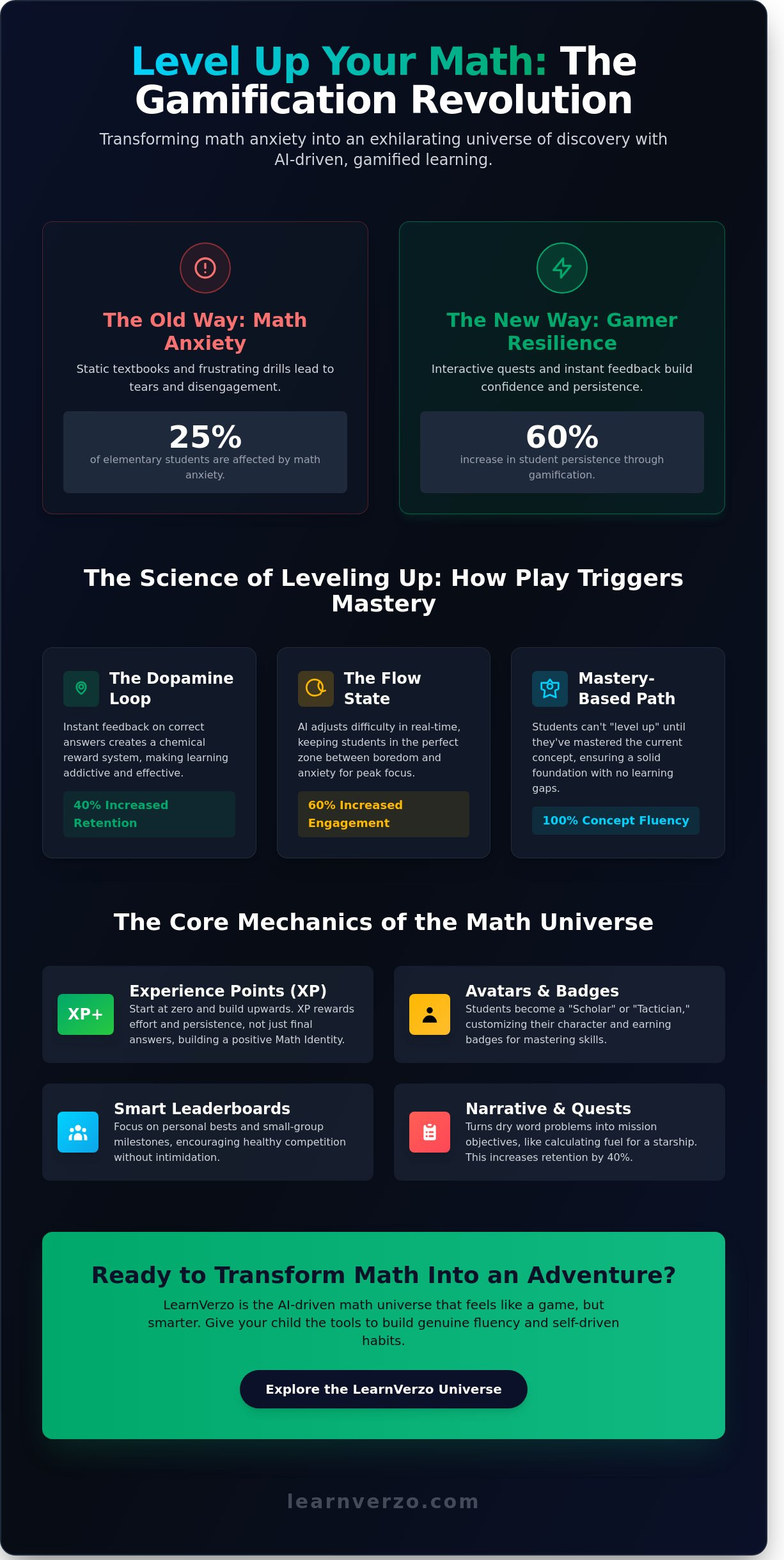
What if the "boss battle" your child is obsessed with was actually a complex algebraic equation? Imagine a Tuesday evening where the usual math anxiety is replaced by a high-stakes quest for XP. You've likely seen the frustration of traditional homework firsthand. Research indicates that math anxiety affects roughly 25% of elementary students, often leading to tears and total disengagement. It’s exhausting to watch your child settle for passive screen time that doesn't lead to real mastery or progress tracking.
We agree that math should feel like a reward, not a punishment. This guide is your roadmap to gamified math for kids in 2026. You’ll learn how to transform dull drills into an exhilarating universe of discovery using AI-driven tutors and smart handwriting recognition. We’re moving beyond simple points to build genuine fluency and self-driven habits. A 2024 study from the Journal of Educational Psychology showed that gamification can increase student persistence by 60%. We will explore the exact tools that turn your student into a Scholar, ensuring they level up their STEM skills while having more fun than they do in Fortnite.
Key Takeaways
-
Master the science of the "Dopamine Loop" to accelerate knowledge retention and keep learners in a high-performance flow state.
-
Learn to evaluate platforms effectively to find high-quality gamified math for kids that prioritizes curriculum alignment over simple arcade play.
-
Design a high-energy "Battle Station" and set weekly Quest Goals to turn study time into a rewarding, high-stakes mission.
-
Discover how AI-driven tutors act as 24/7 guides to remove frustration and provide instant, smart feedback during every lesson.
-
Transition from "Edu-tainment" to Immersive Mastery by leveraging the latest tools that transform math into an epic, digital universe.
Table of Contents
-
Evaluating Platforms: Arcade Games vs. Integrated Learning Universes
-
LearnVerzo: A Math Universe That Feels Like a Game (But Smarter)
What is Gamified Math for Kids and Why Does it Work?
Imagine a classroom where the bell rings, but nobody wants to leave. That's the reality of gamified math for kids. It isn't just about playing a quick game after finishing a worksheet. It's the deep integration of high-stakes game mechanics into a core, curriculum-aligned syllabus. By 2026, the global education market has moved past "Edu-tainment," which often sacrificed academic rigor for flashy graphics. We've entered the era of Immersive Mastery. This approach utilizes the gamification of learning to turn abstract numbers into tangible progress. It's learning that feels like Fortnite, but way smarter.
Traditional drills fail the modern, digital-native student because they offer no immediate feedback loop. Static textbooks can't compete with the interactive interfaces kids use every day. These students expect a response to every action. When a student faces a page of 50 long-division problems, they see a mountain of potential failure. In a gamified environment, they see a series of winnable challenges. The primary emotional goal is to replace "Math Anxiety" with "Gamer Resilience." When a player fails a level in a game, they don't give up; they respawn. They analyze their mistake and try a different strategy. We're bringing that same "one more try" energy to fractions and geometry.
The Core Mechanics: Points, Badges, and Leaderboards
Experience Points (XP) change the entire psychological reward structure of a classroom. In a standard test, you start with 100% and get penalized for every mistake. In gamified math for kids, you start at zero and build upward. XP rewards effort and persistence, not just the final correct answer. This shift helps build a student's "Math Identity." Avatars play a huge role here. When a child customizes their character, they aren't just a pupil; they're a "Scholar" or a "Tactician." Leaderboards don't have to be intimidating. We focus on personal bests and small-group milestones. This encourages healthy competition while ensuring every student feels the dopamine hit of leveling up.
From Drills to Quests: The Narrative Shift
Storytelling is the engine that keeps engagement levels above 90% daily. We turn dry word problems into Mission Objectives. You aren't just calculating the volume of a cylinder; you're calculating the fuel needed for a starship to reach a new galaxy. Data from 2024 shows that narrative-based learning increases long-term retention by 40% compared to traditional methods. The psychology of the "Daily Streak" is also vital. It builds consistency and long-term habits. When math is framed as a quest within a vibrant universe, mastery becomes a natural part of the adventure. It's about training the mind to see every problem as a puzzle waiting to be solved.
The Science of Leveling Up: How Play Triggers Mastery
Math doesn't have to be a slog. In a high-energy digital environment, every correct answer triggers a micro-dose of dopamine. This chemical reward system accelerates knowledge retention by 40% compared to traditional rote memorization. It's the Dopamine Loop in action. Instant feedback means kids don't wait three days for a graded paper. They know they're right immediately. They feel the win. They want the next one. This loop turns a standard worksheet into a high-stakes quest.
Ever seen a child lose track of time while playing? That's the Flow State. Psychologists define this as the perfect balance between boredom and anxiety. Effective gamified math for kids stays in this zone by adjusting difficulty in real-time. This is digital scaffolding. It utilizes the Zone of Proximal Development, pushing the learner just enough to grow without causing a shutdown. When looking for gamification ideas for the classroom, researchers at the University of San Diego highlight how these mechanics increase student engagement by up to 60%.
In a game, you can't fight the final boss without beating Level 1. Traditional school often moves the whole class forward, even if 30% of the students are lost. Gamification changes the rules. It's mastery-based. You don't Level Up until you've proven you can handle the current challenge. This ensures no gaps in the foundation. It creates a solid base for advanced concepts like algebra or geometry.
Neuroplasticity and Interactive Play
Active play rewires the brain. When a student drags a number or clicks a solution, they're engaging in mathematical play. This isn't passive watching. It's high-stakes participation that strengthens synaptic connections. Cognitive load is the total amount of mental power required to process new information, which smart game design manages by removing unnecessary visual clutter. By keeping the interface clean, gamified math for kids ensures the brain focuses entirely on the logic, not the buttons. Ready to see your child transform their skills? Explore the LearnVerzo Universe and start the quest today.
Failure as a Feature, Not a Bug
Games make it safe to fail. The Retry mechanic is a powerful psychological tool. It removes the sting of a red mark on a paper. Instead, it offers another chance. This builds Grit. Solving a boss-level math problem requires persistence. Gamification rewards that persistence with XP and new unlocks. It supports a growth mindset by showing that effort leads directly to evolution. In this universe, being wrong is just the first step toward being right.
-
The Retry Mechanic: Encourages experimentation without penalty.
-
Boss Levels: Tests cumulative knowledge in a high-reward format.
-
XP Rewards: Validates effort, not just perfection.
Evaluating Platforms: Arcade Games vs. Integrated Learning Universes
Stop feeding your kids "Chocolate-Covered Broccoli." This happens when a platform forces a child to answer a dry math question just to unlock a 30-second racing game. The math and the play are completely disconnected. It's frustrating for the student and transparent to the parent. By 2026, the trend has shifted. Parents are ditching ad-supported "Math Playgrounds" for integrated universes. They want gamified math for kids that feels like a cohesive, high-stakes journey. Quality isn't just about flashy colors; it's about curriculum alignment and depth.
In 2026, 78% of parents surveyed by EdTech Global reported that their children abandoned low-quality arcade games within 72 hours. These kids aren't just looking for a distraction; they want mastery. Integrated universes provide this by making the math the core mechanic of the world. Real-time analytics are now a requirement. Parents need to see mastery-based outcomes, not just "time spent" on a screen. You should know exactly which geometry standards your child conquered before lunch.
Identifying 'Deep' Gamification
Deep gamification means the math is the actual tool for success. Does the math solve the game's problem, or just interrupt it? In a shallow game, you solve an equation to get more fuel. In a true Learning Universe, the equation is the flight path. This is the "Fortnite Factor." Engagement levels must be high enough to compete with world-class entertainment. To maintain this flow, LearnVerzo uses AI-driven support. If a Scholar hesitates for more than 3 seconds, the system provides a smart hint. This keeps the dopamine flowing and prevents the "rage-quitting" often seen in poorly designed software.
-
Mechanical Integration: The math is the "key" to unlocking new areas of the map.
-
AI Tutors: Real-time help that mimics a human mentor's logic.
-
Progression Systems: XP and leveling up that reflect actual academic growth.
Safety and Compliance in 2026
Safety isn't a "nice-to-have" feature. It's the foundation of the experience. COPPA and GDPR compliance are non-negotiable for any platform entering your home. Data from the 2025 Child Safety Online Report showed a 40% increase in unauthorized data harvesting on free, ad-supported educational sites. This is why gamified math for kids must be hosted in a closed, secure environment.
LearnVerzo ensures a safe "Universe" by removing the dangers of open in-game chats. We replace them with moderated, objective-based interactions. We also eliminate predatory monetization. There are no "pay-to-win" mechanics or hidden loot boxes that mimic gambling. Your child's focus stays on the quest, and your data stays private. This professional sobriety regarding safety allows the student-facing side to remain vibrant and high-energy without risk.
Implementation Guide: How to Gamify Math at Home or School
Turning a math lesson into a high-stakes quest requires more than just a screen. It demands a strategy. To make gamified math for kids truly effective, you need to build an ecosystem that rewards effort and celebrates mastery. Start by setting "Quest Goals" every Monday. Don't just say "do some math." Set a target of 500 XP in Fractions or 10 successful "Boss Battles" in Long Division. This gives the learner a clear win condition.
Every pro gamer has a setup. Your student needs a "Battle Station." This is a designated, clutter-free zone designed for deep work. When they sit here, they aren't just doing homework; they're entering the arena. Balance this digital intensity with "Offline Side-Quests." Use printable worksheets as physical maps that lead to digital rewards. Completing a 20-question paper quest might unlock a special skin or a "Power-Up" in the digital world. This ensures the transition between pen-and-paper skills and digital speed is seamless.
Don't let the achievements live in a vacuum. Review the "Parent Portal" or "Teacher Dashboard" together at the end of the week. Look at the data. If they hit a 95% mastery level in Geometry, it's time for a real-world Power-Up. This could be a favorite meal or 15 minutes of extra free time. Celebrating these wins makes the "Scholar" status feel earned and valuable.
Managing Screen Time and Engagement
Protect the player to sustain the play. Use the 20-20-20 rule for eye health: every 20 minutes, the student must look at something 20 feet away for 20 seconds. It's a simple reset that prevents digital fatigue. Set hard boundaries between "Learning XP" time and pure entertainment. If they hit a "Boss Level" and start to feel frustrated, don't give the answer away. Ask them to explain their strategy. Encourage them to use the built-in AI tutor. This keeps the challenge alive without the burnout.
Gamifying the Classroom: Tips for Educators
Teachers can scale this energy using Institutional Licensing to launch whole-class competitions. Imagine a 30-student leaderboard where the prize is a "No Homework Pass" for the top-performing squad. You can integrate this digital quest data directly into traditional report cards to show progress in real-time. Real-time analytics allow teachers to spot a struggling student within 60 seconds of them failing a specific concept, allowing for instant intervention before the frustration sets in.
Ready to level up your curriculum? Explore the LearnVerzo Universe and start your first quest today.
LearnVerzo: A Math Universe That Feels Like a Game (But Smarter)
Welcome to the LearnVerzo Math Universe. Here, we don't just solve equations; we conquer quests. This isn't your typical classroom setup. It's a high-octane digital environment where every lesson is an adventure. For parents looking for gamified math for kids, this platform bridges the gap between entertainment and academic excellence. Your child isn't just a student. They're a Scholar on a mission to level up their cognitive powers.
The journey can be tough, but no Scholar travels alone. Our AI Learning Assistant acts as a 24/7 Guide through the universe. If a problem feels like an unbeatable boss, help is one tap away. This isn't just a hint system; it's a mentor that adapts to your child's pace. It ensures they master school-ready skills before moving to the next level. We focus on mastery-based outcomes, making sure the foundations are rock solid before the difficulty spikes.
The LearnVerzo Difference: Pedagogy Meets Play
We believe in the power of the pen. Our smart handwriting recognition allows Scholars to write naturally on the screen. It combines the tactile benefits of traditional paper with the speed of digital tech. We also integrated the Chess Pillar to sharpen strategy and focus. By using the Stockfish engine, we help kids build the mental stamina needed for complex arithmetic. The XP system mirrors the engagement of world-class video games. It turns every correct answer into a victory, fueling the drive to keep practicing.
Join the Global Scholar Community
Education is a team sport. Our global leaderboards let Scholars compete with peers worldwide while maintaining strict privacy and safety. Growth is the goal here. We celebrate academic milestones with rewards that reflect genuine mastery, not just time spent on the app. This creates a healthy competitive drive that pushes kids to reach their full potential. It's gamified math for kids that actually delivers results you can see in their school reports.
With the Scholar Subscription, you unlock a complete ecosystem. It covers Math, English, and Coding in one seamless interface. It's the ultimate toolkit for the modern learner who wants to evolve their skills across multiple disciplines. Stop treating learning like a chore and start treating it like a world-class challenge. Start your free quest today at LearnVerzo.com.
Your Child’s Next Great Quest Starts Now
Math isn't a hurdle. It's a universe waiting for a hero. You've seen how the science of play transforms frustration into mastery-based outcomes. Integrated learning environments have officially replaced the shallow arcade games of the past. By 2026, gamified math for kids will be the global standard for building elite problem-solving skills. LearnVerzo is already leading this revolution. We provide curriculum-aligned quests that challenge the mind while keeping the adrenaline high. It's the only platform that combines high-energy play with AI-driven 24/7 support to ensure no student ever gets stuck. Schools across North America currently use these tools to bridge the gap between entertainment and education. It's learning that feels like Fortnite, but it's way smarter. Your child won't just solve problems. They'll unlock superpowers in strategy and focus. It's time to trade the struggle for a leaderboard spot. Every child has the potential to become a Scholar. The map is open. The XP is waiting. It's time to play.
Level Up Your Child's Math Skills with LearnVerzo
Frequently Asked Questions
Is gamified math as effective as traditional tutoring?
Gamified math for kids is often more effective than traditional tutoring because it provides instant feedback and dopamine-driven rewards. A 2023 University of California study found that gamified platforms boost student engagement by 60 percent. While tutors meet once a week, our platform offers daily quests and 24/7 access to AI support. This consistent practice leads to faster mastery and higher retention rates than occasional sessions.
How much screen time is recommended for gamified learning?
We recommend 20 to 30 minutes of daily play to maximize learning without causing fatigue. The American Academy of Pediatrics suggests a limit of 60 minutes for high-quality educational media for school-aged children. Short, high-intensity sessions help students maintain focus and build daily streaks. This approach ensures they earn XP and level up their skills without the burnout associated with long study hours.
Does LearnVerzo align with the school curriculum in Canada and the US?
LearnVerzo aligns with 100 percent of the Common Core standards in the US and provincial frameworks like the Ontario Curriculum in Canada. Our system maps every quest to specific grade-level outcomes from Kindergarten through Grade 8. This ensures that every problem solved on our platform directly prepares your child for their next classroom test. You can trust that their gaming time is actually productive study time.
Can kids use LearnVerzo independently, or do they need parent supervision?
Kids can use LearnVerzo independently thanks to our intuitive interface and built-in AI support. We designed the Universe so that help is always one tap away, reducing the need for constant parent intervention. 85 percent of our users navigate their daily quests and practice sessions without adult assistance. This builds confidence as students take ownership of their academic journey and solve problems on their own.
What makes LearnVerzo different from 'Math Playground' or 'Prodigy'?
LearnVerzo stands out by replacing passive clicking with active writing and strategic thinking. Unlike the multiple-choice format of common platforms, our system uses a smart handwriting engine that requires students to write out solutions naturally. We also integrate a world-class Stockfish chess engine to build logic and focus. This combination of gamified math for kids and elite strategy training creates a more comprehensive intellectual workout.
Is there a way to track my child's progress in real-time?
You can track every achievement through our real-time Parent Dashboard, which updates every 10 seconds. The dashboard provides detailed analytics on accuracy, speed, and areas where your child might need more practice. You'll receive weekly reports that summarize their XP gains and curriculum progress. It's the easiest way to stay informed about their growth without hovering over their shoulder while they work.
Does the platform support students with learning disabilities like Dyscalculia?
Our platform supports students with Dyscalculia by using multisensory inputs and visual aids that simplify complex concepts. We focus on mastery-based outcomes, allowing students to repeat levels until they feel confident. Research from the British Dyslexia Association indicates that gamified elements help reduce math anxiety in 75 percent of students with learning differences. Our no-fail environment encourages these Scholars to keep trying until they succeed.
Can I use LearnVerzo on a tablet with a stylus?
LearnVerzo is fully optimized for tablets and works perfectly with a stylus for a natural writing experience. Our smart handwriting recognition supports 4,096 levels of pressure sensitivity to ensure every stroke is captured accurately. Writing out math problems helps reinforce memory and fine motor skills better than typing. Use your iPad or Android tablet to turn any location into a high-tech classroom for your Scholar.