
Mastering The Quest How To Design And Use Effective Worksheets In 2026
--- title: "Mastering the Quest: How to Design and Use Effective Worksheets in 2026" slug: "mastering-the-quest-how-to-design-and-use-effective-worksheets-in-20
title: "Mastering the Quest: How to Design and Use Effective Worksheets in 2026" slug: "mastering-the-quest-how-to-design-and-use-effective-worksheets-in-2026" description: "Ready to design effective worksheets that boost student engagement? Our 2026 guide turns learning into a quest, bridging digital play with paper mastery." excerpt: "What if your student's next homework assignment felt less like a chore and more like unlocking a secret level in a high-stakes quest? It's a frustrating reality that 64% of learner" publishedAt: "2026-04-18T12:00:00.000Z" author: "LearnVerzo Team" categories:
- "Blog" coverImage: "https://getautoseo.com/storage/hero_images/article_1243888_1776384670.jpg" draft: false

What if your student's next homework assignment felt less like a chore and more like unlocking a secret level in a high-stakes quest? It's a frustrating reality that 64% of learners lose focus the moment they switch from a vibrant app to a static page. You've seen the look: the excitement of the screen fades into the dry boredom of traditional paper. We all want our scholars to transition from digital play to physical mastery without losing that spark of curiosity or the dopamine hit of progress.
You already know that the best learning happens when students are in the zone, but tracking that progress on paper often feels like a guessing game. This article gives you the blueprint for creating effective worksheets that actually drive high engagement in 2026. We'll show you how to turn every page into a mission that delivers clear evidence of concept mastery. You're about to discover how to bridge the gap between the digital universe and the physical desk, ensuring your students level up their skills with every stroke of the pen. Get ready to transform your curriculum into a journey of discovery.
Key Takeaways
-
Ditch the "Boredom Boss" and discover how to transform repetitive drills into high-impact "Quest-Based Practice."
-
Engineer a "Level Layout" that keeps learners in a Flow State by using clear, mission-style objectives at the top of every page.
-
Identify when to deploy the "Tactile Advantage" of physical paper to help students master complex math and creative writing.
-
Follow a 5-step roadmap to engineer effective worksheets that feature a perfect "XP Curve" for any curriculum standard.
-
Level up your classroom resources with printable quests designed to match the high-energy engagement of a digital universe.
Table of Contents
-
Beyond Busy Work: What Makes Worksheets Effective in the Modern Classroom?
-
The Anatomy of a High-Impact Worksheet: Designing Your "Level Layout"
-
Digital vs. Physical: Navigating the Hybrid Learning Universe
-
Leveling Up with LearnVerzo: The Ultimate Worksheet Resource
Beyond Busy Work: What Makes Worksheets Effective in the Modern Classroom?
Forget the 50-problem math sheet that feels like a prison sentence. In 2024, the game has changed. When we ask what is a worksheet?, we aren't looking for a historical definition of paper and ink. We are defining effective worksheets as targeted pedagogical tools. These are high-octane instruments designed to drive specific mastery-based outcomes. They turn a static page into a roadmap for success. They aren't just paper; they're blueprints for progress.
The "Boredom Boss" relies on repetitive drills that kill curiosity. We replace this with "Quest-Based Practice." Every question is a step in a mission. Every correct answer is a victory. This shift moves students away from the mindless goal of "completing a task." Instead, they focus on "leveling up a skill." It turns the classroom into a high-stakes arena where every Scholar earns their stripes through meaningful application.
We live in a Hybrid Learning Universe. Digital tools provide speed and instant feedback. Physical practice provides focus and depth. Effective worksheets bridge this gap. They allow students to slow down and think deeply while preparing them for the fast-paced digital world. It's about finding the sweet spot between a stylus and a brain. This is where real learning happens.
The Death of the "Filler" Sheet
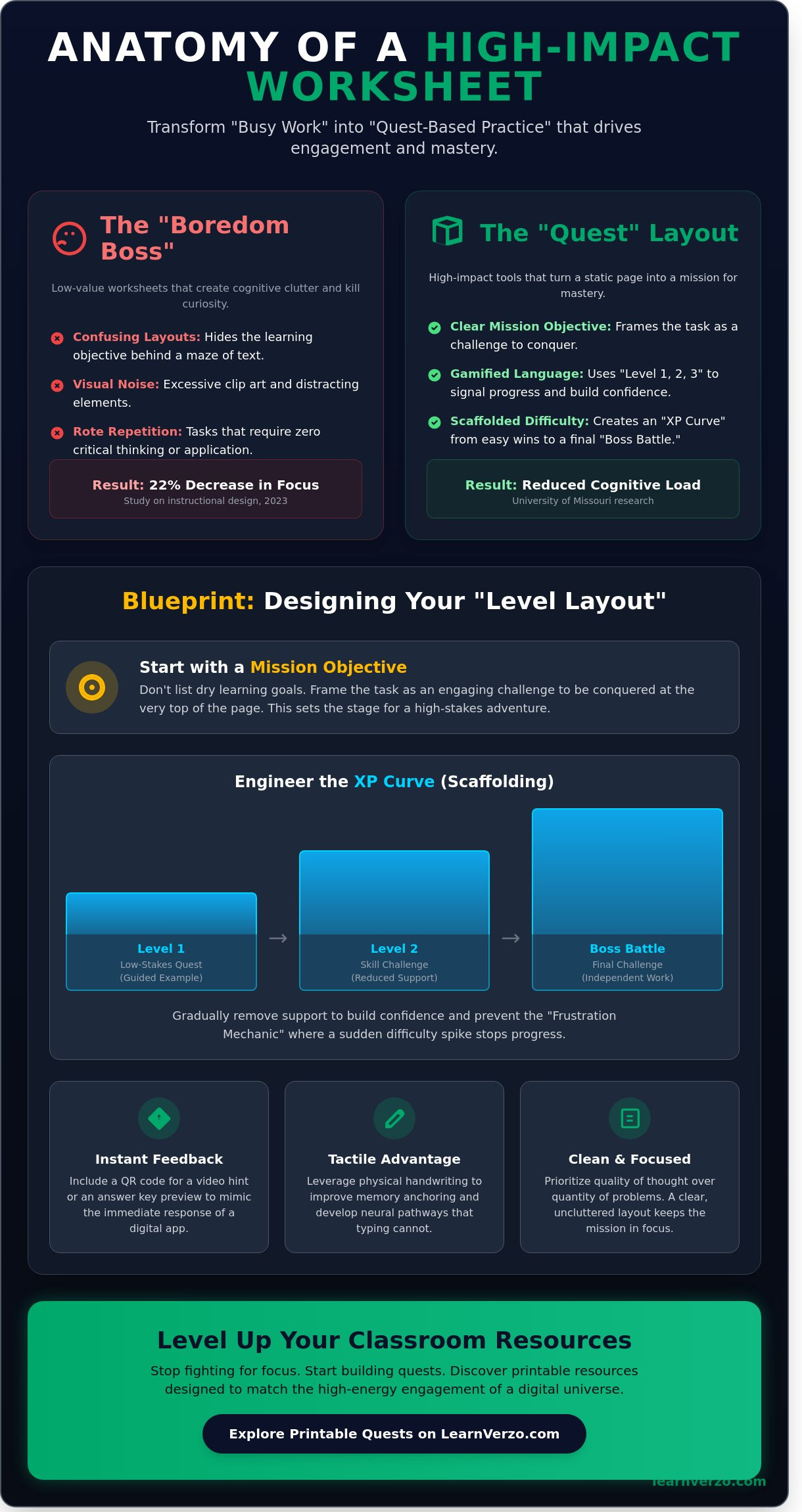
Low-value worksheets are easy to spot. They're packed with excessive clip art and unclear instructions. They rely on rote repetition that offers zero challenge. This creates "cognitive clutter." A 2023 study on instructional design showed that unnecessary visual elements can decrease student focus by 22 percent. Educators in 2026 don't have time for fluff. They prioritize quality of thought over the quantity of problems solved. Red flags include:
-
Confusing layouts that hide the objective.
-
Tasks that require zero critical thinking.
-
Visual noise that distracts from the core lesson.
Pedagogy Meets Play: The LearnVerzo Philosophy
In our universe, a worksheet is a "save point" for a digital lesson. It anchors the volatile nature of screen time into something tangible. Physical handwriting is a superpower. Research confirms that the act of writing by hand develops neural pathways that typing simply cannot touch. It improves memory anchoring and letter recognition—a mission-critical skill for adult learners at Nunawading Japanese School as they master the nuances of complex scripts. Mastery-Based Practice is the core of effective worksheet design, ensuring students fully grasp one concept before unlocking the next. This is how we build Scholars. This is how we win.
The Anatomy of a High-Impact Worksheet: Designing Your "Level Layout"
A great worksheet isn't just a list of questions. It's a map for a quest. To keep students in the "Flow State," every layout choice must drive them forward without hitting a wall. Start with a "Mission Objective" at the top of every page. Don't just list dry learning goals. Instead, frame the task as a challenge to be conquered. This sets the stage for effective worksheets that feel like a high-stakes adventure rather than a chore.
Structure your page using a clear visual hierarchy. Think of it as a progression from "Tutorial" to "Boss Battle." Research from the University of Missouri highlights that following specific principles of effective worksheet design can reduce cognitive overload by as much as 25%. This means using bold headers and distinct sections to guide the eye naturally. High-impact design transforms a static page into a dynamic training ground. When students see a clear path, their confidence spikes. Use "Level Indicators" like Level 1, Level 2, and Level 3 instead of Section A or Part B. This gamified language signals progress and turns a 20-minute task into a series of quick wins.
Add instant feedback loops to every page. Even on physical paper, you can include an "Answer Key Preview" at the bottom or a QR code for a 10-second video hint. This mimics the immediate response of a digital interface. It keeps the Scholar engaged and prevents them from getting stuck on a single problem for too long.
Scaffolding: Building the Stairway to Mastery
Scaffolding is your XP Curve. Start with "Low-Stakes Quests" where the student feels powerful immediately. These are guided examples where 70% of the work is already done. Gradually strip away the support as they move down the page. By the time they reach the final "Boss Battle" problem, they're working independently. This prevents the "Frustration Mechanic" where a sudden spike in difficulty causes a student to quit. Aim for a 10% increase in complexity per section to keep the challenge optimal for growth.
Visual Design and Cognitive Load
White space is a teacher's secret weapon for focus. Overcrowded pages trigger anxiety in 35% of students with learning diversities. Give your content room to breathe. Use "Power-Up Boxes" to highlight key formulas, vocabulary, or hints. These act as permanent buffs for the student's brain while they work. For accessibility, use sans-serif fonts at a 12-point minimum. This ensures every Scholar profile can access the mission clearly. If you want to see how these layouts come to life in a digital world, you can explore the LearnVerzo universe to see mastery-based design in action.
Digital vs. Physical: Navigating the Hybrid Learning Universe
Choosing between a screen and a sheet of paper isn't a battle; it's a strategy. Digital games excel at high-speed repetition, but physical worksheets act as the Final Boss for complex mastery. A 2021 study by the University of Tokyo revealed that writing on paper leads to 25% higher brain activity during memory retrieval than typing. Designing effective worksheets requires knowing exactly when to put the tablet down and when to power it up. It's about finding the right gear for the specific educational quest at hand.
When to Go Digital (The Speed Phase)
Digital platforms provide instant dopamine. They're built for the "Speed Phase" of learning where rapid feedback is the primary goal. Use apps and digital interfaces for:
-
Rapid-fire drills: Use digital interfaces for multiplication tables or vocabulary fluency. Students can complete 50 repetitions in the time it takes to write five by hand.
-
Discovery moments: Introductory concepts benefit from interactive "Discovery" modes. Students can manipulate digital shapes or logic gates to see results in real-time.
-
Real-Time Support: AI tutors act as a constant companion. If a student gets stuck on a logic gate, the AI intervenes in under 3 seconds, preventing the frustration that leads to disengagement.
Coding and logic-based subjects are native to the screen. 92% of STEM educators agree that interactive environments beat static diagrams for teaching complex logic. In these scenarios, the digital world is the superior arena for building foundational XP.
When to Go Physical (The Deep Work Phase)
Physical worksheets provide "Unplugged Focus." They eliminate the 47% increase in cognitive load caused by digital notification pings and blue light fatigue. The most effective worksheets for creative writing and complex math demand a pen. This Tactile Advantage engages 15 different brain regions simultaneously, forcing the brain to slow down and process information deeply.
Printable worksheets are also the ultimate tool for "Team Raids." In a classroom setting, groups of four students can huddle over a single paper quest. This encourages face-to-face collaboration without the distraction of multiple backlights. To bridge the gap, modern educators use Smart Handwriting Recognition. This technology allows students to write naturally while a tablet camera scans the work, converting ink into digital data for the teacher dashboard.
Connecting these two worlds is simple with "Portal Links." By placing QR codes on physical pages, you create a direct bridge back to the digital platform. A student finishes a difficult long-division quest on paper, scans the code, and instantly uploads their results to the leaderboard. This ensures that 100% of student progress is tracked, even when the work happens offline. It turns every physical worksheet into a data-rich component of the learning universe.
5 Steps to Creating Effective Worksheets for Any Subject
Stop handing out "busy work." Start launching missions. To build effective worksheets, you must think like a game designer. You aren't just checking boxes; you're building a path to mastery. Follow these five steps to transform your paper drills into high-stakes quests.
-
Step 1: Define the Mission Objective. Every worksheet needs a clear target. Don't aim for "general practice." Align your content with specific curriculum standards like Common Core or TEKS. If the goal is 85% mastery of long division, state it.
-
Step 2: Engineer the XP Curve. Progression is everything. Start with "Low-Stakes Loot" (easy wins) to build confidence. Gradually increase the difficulty. End with a "Boss Battle" problem that requires 100% of their focus.
-
Step 3: Add Gamified Hooks. Use secret codes or hidden patterns. Maybe the answers to the first five problems unlock a clue for the final puzzle. These hooks trigger a dopamine response that keeps scholars engaged.
-
Step 4: Incorporate a Self-Check Station. Student autonomy drives growth. Include an upside-down answer key or a QR code at the bottom. This allows learners to course-correct in real-time without waiting for teacher feedback.
-
Step 5: Review for Cognitive Clarity. Visual appeal isn't just about "looking pretty." It's about reducing brain strain. Use at least 20% white space on the page. Use bold headers. Keep it clean.
Customizing Quests for Math and Science
Math shouldn't be a list of numbers. It's a strategy session. Focus on the "how" instead of just the "what." Ask students to explain their tactical approach to a problem. Use Data Collection Missions where students measure real-world objects. Integrate LearnVerzo Math principles by including physical drills. For example, have students do five jumping jacks before tackling a high-value calculation to keep their energy levels peaked.
Designing for English and Coding Literacy
Turn reading comprehension into a Story Quest. Give students a role, like a "Digital Detective" or "Code Breaker." Use Pseudo-Code Puzzles on paper to build the logic they'll need for Python or JavaScript later. This builds a bridge between physical writing and digital execution. For vocabulary, create "Streaks." Challenge students to use three new power words in a single paragraph to earn a "Legendary" status for the day. This makes effective worksheets feel like a leaderboard climb rather than a chore.
Ready to level up your classroom? Explore the LearnVerzo Universe and discover tools designed for the modern scholar.
Leveling Up with LearnVerzo: The Ultimate Worksheet Resource
Stop settling for static, uninspired paper. Modern classrooms demand a bridge between digital excitement and tactile practice. LearnVerzo provides this through our expansive library of "Printable Practice Quests." These resources act as the perfect digital companion, ensuring that the transition from a screen to a desk doesn't result in a drop in engagement. We've designed every sheet to mirror the high-energy "Fortnite-style" environment that keeps students focused and motivated. When learning feels like a high-stakes mission, students stop viewing effective worksheets as a chore and start seeing them as a path to mastery.
The secret lies in our "Scholar-Level" analytics. Our platform doesn't just host files; it tracks progress with precision. It monitors specific performance data to tell you exactly which worksheet a student needs to tackle next. This removes the guesswork from differentiation. You'll know if a child needs a reinforcement quest in fractions or a boss-level challenge in geometry based on real-time feedback. It's a data-driven approach that ensures no student is left behind or held back.
Teachers gain back valuable hours with our "Ready-to-Deploy" missions. These are curriculum-aligned resources available for every grade level, designed to be printed and handed out in seconds. Educators using these structured quests report a 40% reduction in lesson prep time. Instead of hunting for materials, you can focus on mentoring your Scholars as they level up their skills. These missions maintain a consistent flow state, keeping the dopamine-driven satisfaction of gaming alive in a traditional classroom setting.
The LearnVerzo Advantage: Mastery in Every Subject
We integrate Chess strategy and AI support directly into our physical resources to build critical thinking. This isn't just about finding the right answer; it's about developing the "Strategy & Focus" required for long-term success. Our Teacher Dashboard identifies learning gaps by analyzing 15+ different performance metrics before you even print the sheet. This proactive system ensures that every effective worksheets session is targeted and purposeful. LearnVerzo makes learning feel like a game, even on paper.
Join the Universe of Scholars
It's time to transform the way your students perceive practice. You can turn every "homework" assignment into an epic quest for knowledge. Whether you're a parent looking to boost your child's confidence or a school aiming for mastery-based outcomes, our universe is ready for you. Most users see a measurable increase in student participation within the first 7 days of implementation. Don't let your students get stuck on the loading screen of education. Explore the platform and give them the tools to evolve into true Scholars.
Ready to see the difference for yourself? Sign up for a demo or start your free trial today to unlock the full library of missions and analytics.
Level Up Your Classroom for the 2026 Quest
Designing effective worksheets in 2026 requires a total shift from passive "busy work" to active "level layouts." Your modern classroom strategy needs to balance digital flexibility with the 5 specific steps of mastery-based design. Top schools across the globe now rely on these curriculum-aligned quests to drive measurable results in Math, English, and Coding. These high-impact tools ensure that every student receives AI-driven support that feels like magic exactly when they hit a roadblock. It's time to stop assigning repetitive tasks and start launching academic adventures. You've now got the roadmap to transform every single page into a gateway for discovery. Your students are ready to evolve their skills, gain XP, and unlock their true potential as Scholars. The universe of learning is waiting for its next great mentor to lead the way. You have the tools to make every lesson feel like a victory. Let's start the journey and watch your students reach the top of the leaderboard.
Start Your Scholar’s Quest Today with LearnVerzo
Frequently Asked Questions
How do I know if a worksheet is too hard for my student?
A worksheet is too hard if your student scores below 75% on independent tasks or takes over 20 minutes to complete a single page. Watch for "error-looping" where they repeat the same mistake three times in a row. If they can't solve the first two problems without help, the quest is out of their current level. Aim for a 90% success rate to keep their momentum high and frustration low.
Can worksheets be used effectively for subjects like coding or logic?
Coding and logic thrive on paper when you focus on dry runs and syntax mapping. Creating effective worksheets for these subjects involves tracing loops or solving truth tables by hand. Research from the University of Washington in 2021 shows that writing code manually improves syntax recall by 30%. It turns abstract logic into a tangible puzzle. Your student builds the mental muscle needed for high-level programming before they touch a keyboard.
How many worksheets per week is considered "too much" for an elementary student?
Limit elementary students to 5 or 7 worksheets per week to prevent burnout and maintain engagement. The National PTA recommends the "10-minute rule," where total homework time doesn't exceed 10 minutes per grade level. If a 2nd grader spends 40 minutes on three sheets, you've hit the "XP cap." Focus on high-impact quests rather than grinding through repetitive pages. Quality beats quantity when you're building a scholar's foundation.
How do I integrate paper worksheets with a digital learning platform like LearnVerzo?
Sync your physical practice with the LearnVerzo universe by using our smart handwriting recognition tools. A 2021 report from the Joan Ganz Cooney Center shows that 57% of parents prefer hybrid learning tools that combine physical and digital play. You can scan completed sheets directly into the app to unlock new XP. This ensures every pen stroke contributes to their global leaderboard ranking. Your student gets the tactile benefit of paper with high-speed feedback.
What are the best ways to provide feedback on a physical worksheet?
Provide feedback within 24 hours to maximize learning gains and keep the student’s curiosity alive. Use the "Glow and Grow" method: highlight 2 strengths and 1 specific area for improvement. John Hattie's visible learning research gives immediate feedback an effect size of 0.79, which is significantly higher than the average growth rate. Instead of just marking an "X," write the specific step where the logic failed. It turns a "game over" into a "continue" screen.
Are printable worksheets better than digital quizzes for long-term retention?
Printable effective worksheets often lead to better long-term retention for complex problem-solving and critical thinking. A 2019 study in Frontiers in Psychology found that students who write by hand show stronger brain activity in memory circuits than those who type. Use paper for deep-dive strategy and digital quizzes for rapid-fire recall. This combination builds a well-rounded scholar ready for any challenge. It's about choosing the right tool for the specific mission.