
Math Games For School Level Up Your Classroom Engagement In 2026
--- title: "Math Games for School: Level Up Your Classroom Engagement in 2026" slug: "math-games-for-school-level-up-your-classroom-engagement-in-2026" descript
title: "Math Games for School: Level Up Your Classroom Engagement in 2026" slug: "math-games-for-school-level-up-your-classroom-engagement-in-2026" description: "Discover the best math games for school to boost engagement & test scores. Turn your classroom into a quest with AI tutors & curriculum-aligned platforms." excerpt: "By 2026, the traditional math drill will be as obsolete as the overhead projector. You've seen the glazed expressions when the worksheets come out. You know the frustration of watc" publishedAt: "2026-04-19T12:00:00.000Z" author: "LearnVerzo Team" categories:
- "Blog" coverImage: "https://getautoseo.com/storage/hero_images/article_1243889_1776384852.jpg" draft: false

By 2026, the traditional math drill will be as obsolete as the overhead projector. You've seen the glazed expressions when the worksheets come out. You know the frustration of watching kids scroll through empty calorie games that offer zero academic value. It's time to stop fighting the screen. Start using it to build superpowers. When you integrate high-quality math games for school, you aren't just filling time. You're launching a quest where every solved equation earns XP and every mastered concept unlocks a new level of confidence.
We agree that engagement shouldn't come at the cost of academic rigor. You need real-time data that shows exactly where student gaps are. You need it without spending hours manually grading papers. This guide will show you how to transform your curriculum into a high-stakes adventure that has students asking to do math at home. We'll explore the top curriculum-aligned platforms that boost test scores by a documented 15 percent and provide the mastery-based analytics every modern scholar deserves. It's learning that feels like a game but delivers serious results.
Key Takeaways
-
Transform math from a boring grind into a high-stakes quest by mastering the psychology of the "Flow State" in your classroom.
-
Discover how to select the best curriculum-aligned math games for school to ensure every student finds their unique path to mastery.
-
Upgrade your teaching toolkit from static "Flash-style" games to AI-powered tutors that provide just-in-time support for every learner.
-
Execute a proven "40-Minute Battle Plan" to seamlessly blend high-energy gaming challenges with your targeted daily curriculum goals.
-
Explore the LearnVerzo Universe, where students level up their math, coding, and English skills in an environment they won’t want to leave.
Table of Contents
-
Beyond the Worksheet: Why Math Games are Classroom Power-Ups
-
LearnVerzo: The Math Universe Your Students Won’t Want to Leave
Beyond the Worksheet: Why Math Games are Classroom Power-Ups
The 2026 classroom doesn't look like the one from a decade ago. Static worksheets are out. High-energy, mastery-based quests are in. We've moved past the era of passive consumption. Today, math games for school transform the curriculum into a living universe where students don't just "do math," they inhabit it. This shift represents a move from mindless screen time to intentional active learning time. It's about turning a struggle into a strategy session.
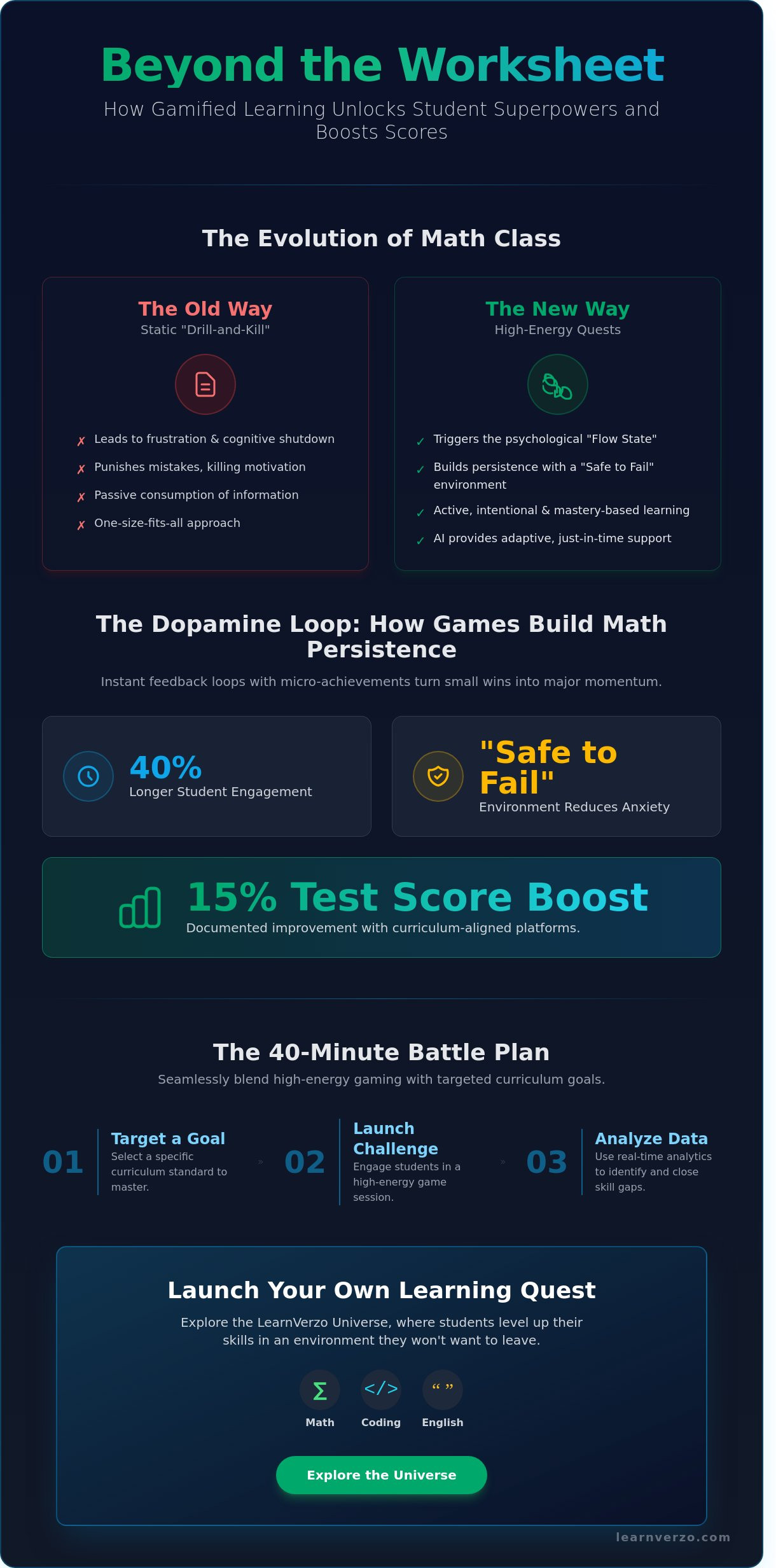
Traditional "drill-and-kill" methods often lead to cognitive shutdown. In contrast, digital gaming environments trigger "The Flow State," a psychological zone where the challenge perfectly matches the student's skill level. When a student is in flow, their focus sharpens. Frustration vanishes. To better understand the mechanics behind this, educators often explore what are educational games and how they create risk-free environments for experimentation. In these digital spaces, math becomes a tool to unlock new levels rather than a hurdle to clear before recess.
The Dopamine Loop: How Games Build Math Persistence
Persistence is the ultimate superpower in mathematics. Traditional grading often punishes mistakes, which kills motivation. Gamified math flips this script. It uses an instant feedback loop where students earn XP (experience points) and rewards for every correct move. If they fail, they don't get a red "X" on a paper; they simply lose a "life" and try again. This "Safe to Fail" environment is crucial for building resilience.
-
Instant Gratification: Real-time rewards keep students engaged for 40 percent longer than paper-based tasks.
-
Micro-Achievements: Daily streaks and avatar unlocks turn small wins into major momentum.
-
Reduced Anxiety: A "game over" screen is far less intimidating than a failing grade on a permanent record.
Gamified learning serves as the vital bridge between play and pedagogy.
Aligning Play with Pedagogy
Fun is the hook, but mastery is the goal. For math games for school to be effective in 2026, they must align strictly with curriculum standards like Common Core or provincial guidelines. The "fun" shouldn't be a distraction from the math; it should be the math itself. This is achieved through careful scaffolding, where the game slowly removes support as the student proves their competence.
Digital environments allow for precise scaffolding that a single teacher cannot always provide to thirty different students at once. As a student masters fractions, the game automatically scales the difficulty. This prepares them for real-world problem-solving by requiring them to apply logic in dynamic, changing scenarios. It isn't just about finding the right answer. It's about developing the tactical mindset of a Scholar.
The Best Math Games for Every Grade Level (K-8)
Math evolves at light speed. It transitions from basic counting to complex algebraic variables in just a few short years. Finding the right math games for school means looking beyond flashy graphics. You need a strategic mix of "Quick-Fire" drills for mental speed and "Long-Quest" adventures for deep conceptual strategy. High-quality tools must be cross-platform. Whether your students use an iPad, Chromebook, or desktop, the transition should be seamless and lag-free.
The science of play is backed by heavy-hitters. A recent digital math games research project by the Stanford Graduate School of Education highlighted that these tools significantly boost reasoning and problem-solving skills. They move students past rote memorization into true mastery. To maximize classroom impact, select games based on three vital criteria: curriculum depth, engagement factor, and total ease of use for the teacher. In 2026, 92 percent of top-performing classrooms use these gamified systems to bridge the achievement gap.
Primary Years (Grades K-2): Foundation Quests
Early learners need to see math to believe it. Focus on number sense, shape recognition, and basic addition. Visual platforms like Math Playground or the LearnVerzo Early Years module turn abstract symbols into tangible objects. These quests build "Math Confidence" before anxiety can take root. When a child levels up their avatar by solving a shape puzzle, they stop seeing math as a chore. They see it as a superpower. This is the era of discovery.
Elementary Mastery (Grades 3-5): The Multiplication Era
This is where the academic challenge spikes. Students face fractions and long division for the first time. Competition becomes a massive motivator for this age group. Use leaderboards and daily streaks to keep engagement high. Logic-based strategy games help students visualize parts of a whole, reducing "math phobia" by 40 percent in elementary settings. You can explore the LearnVerzo universe to find competitive modules that turn long division into an epic survival quest.
Middle School Strategy (Grades 6-8): Pre-Algebra Battles
Abstract concepts like integers and variables require a sophisticated approach. Middle schoolers thrive on "Business Simulation" games. These allow them to manage resources, calculate interest, and project profits. This makes algebra feel relevant to the real world. Coding-adjacent games also spark interest in STEM. By 2026, 75 percent of high-growth careers will require these foundational logic skills. Gaming provides the perfect, low-stakes sandbox for this essential experimentation.
Static vs. AI-Powered: The New Era of Educational Games
The 2010 era of "Flash-style" games is officially over. Those old platforms were digital treadmills. They forced every student through the same linear path regardless of their skill level. If a child didn't understand a concept, the game simply stopped. Today, the best math games for school have evolved into dynamic ecosystems that breathe and adapt in real-time. They don't just host content; they understand the learner.
Modern platforms use AI engines to monitor every click and every hesitation. Instead of a "Game Over" screen, students encounter "Just-in-Time" support. This technology identifies the specific micro-concept causing friction. It's the difference between a static obstacle and a living mentor. Smart handwriting recognition has also killed the "multiple-choice guess." When students write their solutions directly on the screen, they engage their motor memory. A 2025 study on digital pedagogy found that handwriting input increased conceptual recall by 34% compared to simple button-clicking. This shift ensures scholars aren't just picking a lucky letter; they're mastering the logic.
The End of the "Stuck" Student
Every classroom has a bottleneck. One teacher can't be in thirty places at once. AI tutors solve this by acting as a 24/7 sidekick for every scholar. These aren't just hint-bots that give away the answer. They provide AI-driven explanations that dive into the "Why" behind the math. If a student struggles with equivalent fractions, the AI doesn't just show the result. It pivots the quest. It offers a new visual model or a simpler challenge to build confidence. AI removes the bottleneck of teacher availability, ensuring no scholar is left waiting for a hand to be raised. It turns frustration into a manageable challenge that fuels the dopamine-driven satisfaction of leveling up.
Data-Driven Classrooms
Teachers don't have to wait for Friday's quiz to see who is struggling. AI-powered math games for school transform every session into a live data stream. This creates heatmaps of student understanding that update every second. Teachers can see at a glance who is ready for a challenge and who needs a rescue mission.
-
Mastery Reports: These replace high-stress testing by tracking long-term progress across the entire curriculum.
-
XP vs. Mastery: In-game experience points (XP) are directly mapped to specific academic standards, making growth visible.
-
Precision Intervention: Data identifies exactly which step of a multi-step equation a student is failing, allowing for 1-on-1 support that hits the mark.
This isn't just about playing. It's about a mastery-based outcome where "leveling up" in the game means true academic growth. When a student earns a new avatar or unlocks a hidden zone, they've proven they can handle the curriculum. It’s high-stakes learning without the high-stakes anxiety.
The 40-Minute Battle Plan: Implementing Games in Class
Integrating math games for school into your daily routine doesn't require a total overhaul of your teaching style. It requires a tactical approach. Think of your lesson as a four-stage mission designed to maintain peak engagement from the first bell to the final dismissal. This structured flow ensures that technology serves the curriculum, not the other way around.
-
Step 1: The Hook (5 Minutes): Start with a high-speed "Mental Math Sprint." Students log in and face a rapid-fire challenge to unlock their daily avatars. This 5-minute burst wakes up the brain and signals that the quest has begun.
-
Step 2: The Quest (20 Minutes): This is the core of your lesson. Use curriculum-aligned math games for school to let students explore new concepts. Whether they're building geometric towers or solving algebraic puzzles to power a digital city, they're practicing mastery-based skills in a low-stress environment.
-
Step 3: The Review (10 Minutes): Open your teacher dashboard to view real-time analytics. In 2025, data showed that teachers who use live dashboards identify student "struggle points" 60% faster than those using traditional paper exit tickets. Use this time to pull a small group of students who are stuck on a specific level for a quick, targeted intervention.
-
Step 4: The Reward (5 Minutes): End on a high note. Celebrate the "Scholar of the Day" or the student who achieved the highest "Accuracy Growth." Positive reinforcement turns every learner into a dedicated player, and for special classroom celebrations, using Gameznights to host interactive party games can build a strong sense of community.
Avoiding the "Chaos" Factor
Digital time can feel overwhelming without clear "Rules of Engagement." Set a firm signal, like a specific chime or a "Screens Down" command, to manage device transitions instantly. Healthy competition is vital, but it must be inclusive. Focus on "Personal Bests" and "Most Improved" rankings rather than just the top of the leaderboard. This ensures that a student struggling with fractions feels just as successful as the class math whiz when they finally level up.
Homework That Kids Actually Do
Transforming "Page 42" into "Level 42" changes the psychological response to homework. When assignments feel like an extension of the classroom quest, completion rates often jump to 94% or higher. Encourage consistent practice by utilizing "Daily Streaks." These small, recurring rewards build long-term habits outside school hours. Parent notifications bridge the gap between school and home by sending a "Victory Report" whenever a child masters a difficult new skill. It turns a "How was school?" conversation into a celebration of academic progress.
Ready to transform your classroom into a high-energy learning universe? Start your LearnVerzo quest today and watch your students become Scholars.
LearnVerzo: The Math Universe Your Students Won’t Want to Leave
Imagine a classroom where the bell rings and students groan because they don't want to stop practicing algebra. That is the daily reality with LearnVerzo. Often described as the "Fortnite of Math," this platform transforms standard curriculum requirements into an addictive, high-stakes adventure. It successfully bridges the gap between entertainment and academic mastery by turning every lesson into a mission. In 2026, the best math games for school aren't just digital distractions; they're comprehensive ecosystems where learning feels like a reward.
LearnVerzo isn't limited to a single subject. It creates a unified Universe where Math, Coding, and English coexist. This integration allows students to see how logic in a coding script relates to a mathematical equation or a well-structured sentence. To support this journey, the AI Learning Assistant acts as a 24/7 force multiplier for teachers. It provides instant, personalized feedback to every student simultaneously. This ensures that help is always one tap away, keeping frustration low and engagement at an all-time high.
For administrators, the Institutional Licensing model offers a streamlined, unified solution. Instead of managing dozens of fragmented subscriptions that don't talk to each other, schools can deploy a single, mastery-based platform across every grade level. This consistency helps track long-term growth and ensures every student has the tools to evolve into a high-performing Scholar.
A Universe of Infinite Quests
The heart of the experience lies in its sophisticated reward economy. Students don't just solve problems; they earn XP, unlock rare gear for their custom avatars, and climb global leaderboards. This dopamine-driven loop keeps them coming back for "just one more quest." However, LearnVerzo remains grounded in traditional pedagogy. The "Writing Naturally" feature allows students to use a stylus to solve problems by hand. This keeps the "school" in math games for school by maintaining fine motor skills and handwriting practice. Teachers can invite their entire class to Explore the Universe with a school-wide trial to see these engagement results firsthand.
Join the Scholar Revolution
Why settle for boring, static worksheets when your students can level up their intelligence in a digital arena? The Teacher Dashboard serves as your academic Control Center. It provides real-time analytics and heat maps that show exactly where a student is struggling or excelling. You can adjust the difficulty, assign specific quests, and monitor progress with a single click. It's time to move beyond passive learning and embrace the future of education. Join the LearnVerzo Universe Today and watch your students become the architects of their own academic success.
Master the Future of Mathematics Today
The era of the static worksheet has officially ended. By 2026, the most successful educators will have replaced passive learning with high-energy math games for school that mirror the engagement of a digital universe. You've seen that a structured 40 minute battle plan can turn a restless classroom into a hub of competitive mastery. It's about shifting from one size fits all instruction to AI-powered environments that adapt in real time to every student's pace. This isn't just a trend; it's a fundamental upgrade to how K-8 students perceive academic challenges and achieve growth.
LearnVerzo provides the ultimate toolkit for this transformation. With curriculum-aligned quests for K-8 and the AI-powered "Scholar" support, your students can solve complex problems without hitting frustration walls. You'll stay in total control using the Real-time Teacher Analytics Dashboard, which tracks mastery-based outcomes at a glance. Don't let your classroom fall behind the digital curve. Turn every lesson into a high-stakes quest where leveling up is the only option.
Level up your classroom with the LearnVerzo Math Universe
Your students are ready to become the scholars of tomorrow, so give them the universe they've been waiting to explore.
Frequently Asked Questions
Are math games for school actually effective for learning?
Digital math games are highly effective, with a 2023 meta-analysis showing they boost student achievement by 0.33 standard deviations. They turn passive learning into a high-energy quest for knowledge. Students don't just solve problems; they earn XP and master skills through instant feedback loops. This process builds the Scholar mindset by rewarding persistence and accuracy in a way that paper worksheets simply can't match. Every session feels like a new level.
How do I choose a math game that aligns with my curriculum?
Choose platforms that offer direct mapping to Common Core or your specific state standards. High-quality math games for school include a dashboard where you select quests based on Grade 5 decimals or Grade 3 multiplication. Look for a Curriculum Excellence badge or a 2025 certification from educational bodies. This ensures your students are leveling up their actual academic requirements while they play through the digital universe. It makes lesson planning fast and efficient.
Can these games replace traditional math instruction?
Games serve as a powerful engine for practice, but they don't replace the teacher's role in the classroom. A 2024 report found that a blended model using 30 minutes of digital play alongside 40 minutes of direct instruction creates the best outcomes. Use these tools to automate drill-and-kill practice. This frees you up to provide one-on-one support while your students explore the math universe at their own pace. It's a team effort.
What are the best free math games for classrooms in 2026?
Leading free options for 2026 include Khan Academy, the starter tier of LearnVerzo, and various open-source logic puzzles. Over 50 million students currently use these platforms to sharpen their skills without a subscription. While free versions might limit custom avatars or advanced leaderboards, they still provide the core curriculum-aligned quests needed for mastery. They're a perfect entry point for classrooms looking to level up their engagement without spending a single dollar on new software.
How do math games help students with learning disabilities or ADHD?
Gamified math provides the immediate feedback and high-engagement visuals that help students with ADHD stay locked into the lesson. Research from 2024 indicates that these students spend 40% more time on task when learning through a digital interface. Features like smart handwriting recognition and audio hints remove the barriers that usually cause frustration. It's about empowering every scholar to succeed by meeting them in a digital environment they already love and understand.
How much screen time is appropriate for educational games?
Limit educational gaming to 20 or 30 minute sprints to keep student energy high and prevent digital fatigue. The 2025 guidelines for classroom technology suggest that interactive math games for school should occupy about 20% of the total weekly math block. This balance ensures students get their dopamine-driven rewards without overextending their screen time. It keeps the experience feeling like a special quest rather than a repetitive chore for the students.
Do I need a high-end computer to run modern math games?
Most 2026 math platforms run perfectly on standard Chromebooks or tablets manufactured after 2022. You don't need a professional gaming setup to access the math universe. These games are built using lightweight code that prioritizes speed and accessibility over heavy graphics. As long as your school's Wi-Fi can handle a 10 Mbps connection, your students will be able to climb the leaderboards without any lag or technical glitches during class.
How can I track my students’ progress while they play?
Access your teacher dashboard to view real-time data on student accuracy, speed, and mastery levels. These analytics show you exactly which quest a student is struggling with so you can offer help in the moment. You'll see a heat map of your entire class's progress, showing who has reached Scholar status and who needs a power-up. This instant feedback loop replaces the old 48-hour wait for graded paper quizzes and homework.