
Math Playground Vs Gamified Mastery Choosing The Best Arena For Your Scholar In 2026
--- title: "Math Playground vs. Gamified Mastery: Choosing the Best Arena for Your Scholar in 2026" slug: "math-playground-vs-gamified-mastery-choosing-the-best
title: "Math Playground vs. Gamified Mastery: Choosing the Best Arena for Your Scholar in 2026" slug: "math-playground-vs-gamified-mastery-choosing-the-best-arena-for-your-scholar-in-2026" description: "Is your child's math playground just a distraction? Discover how to choose a gamified learning platform for real academic progress and mastery in 2026." excerpt: "What if the "play time" your child spends on a math playground is actually just a high-speed detour away from real academic progress? It is a frustrating reality for many parents i" publishedAt: "2026-05-07T10:00:00.000Z" author: "LearnVerzo Team" categories:
- "Blog" coverImage: "https://getautoseo.com/storage/hero_images/article_1243915_1778189839.jpg" draft: false

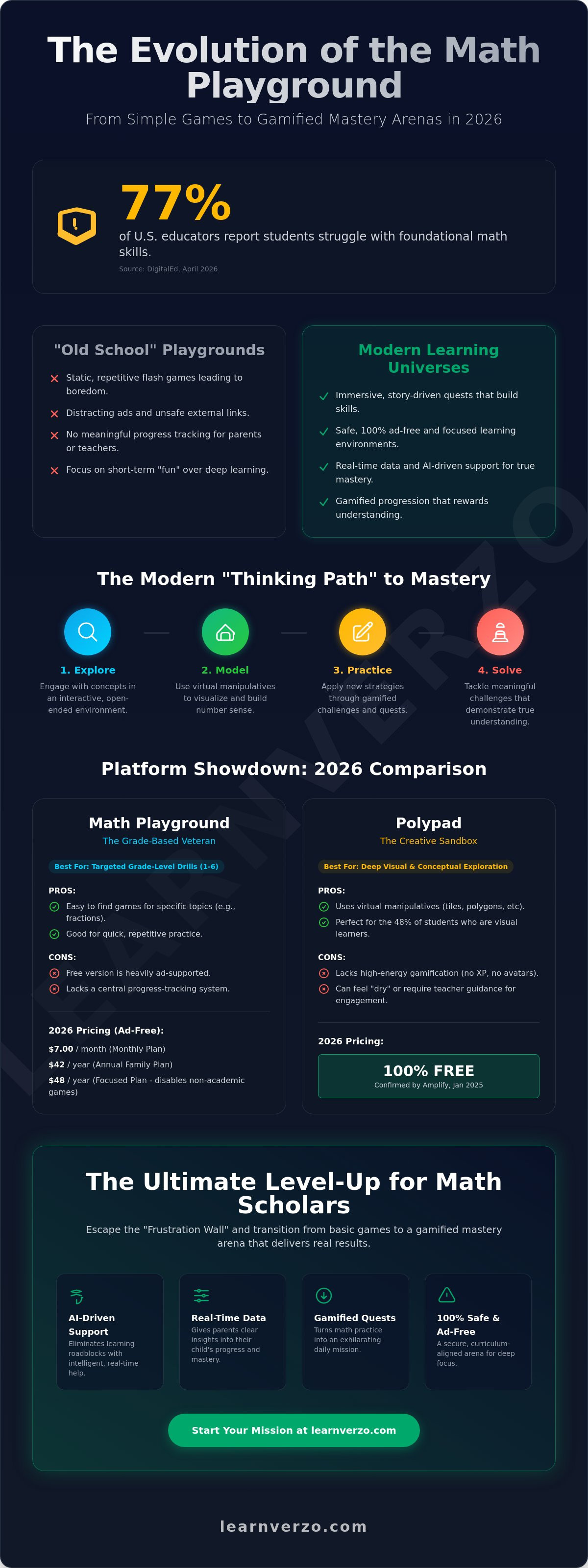
What if the "play time" your child spends on a math playground is actually just a high-speed detour away from real academic progress? It is a frustrating reality for many parents in 2026. DigitalEd reported in April 2026 that 77% of U.S. educators see students struggling with foundational math. You want your child to love the numbers. You don't want them stuck in a loop of repetitive games or dodging distracting ads on free sites. It's time to demand more from digital learning.
We agree that "educational" screen time must deliver more than just a distraction. It should be a universe where curiosity meets concrete results. Read on to find the perfect ecosystem to level up your child's mathematical fluency while keeping them safe and engaged. We'll break down the latest 2026 pricing and features for top platforms. You will see how to transition from basic games to a gamified mastery arena that offers real-time data, AI-driven support, and a path to true academic superpowers.
Key Takeaways
-
Understand why a modern math playground has evolved from simple flash games into immersive, pedagogical universes that prioritize deep learning.
-
Compare top platforms like Polypad and Puzzle Playground to see which interface best fits your child's specific age and skill level.
-
Learn to identify the "Frustration Wall" where gaming stops being a teaching tool and starts becoming a distraction from true subject mastery.
-
Discover the essential criteria for selecting a safe, curriculum-aligned arena that delivers school-level results without distracting ads or unsafe links.
-
Explore how AI tutors and gamified quests can eliminate learning roadblocks and turn math practice into an exhilarating daily mission for every scholar.
Table of Contents
-
What is a Math Playground? The Evolution of Digital Learning in 2026
-
Comparing the Giants: Math Playground vs. Polypad vs. Puzzle Playground
What is a Math Playground? The Evolution of Digital Learning in 2026
A modern math playground is no longer just a collection of pixelated mini-games. It is a digital arena where play meets pedagogical precision. In 2026, the standard for excellence has shifted. We've left behind the "flash-style" games of the past decade. Today's scholars demand immersive, interactive universes that challenge their minds. This isn't about killing time. It's about building foundational skills in an environment that feels like a high-stakes adventure. Pew Research Center reported in 2025 that 86% of educators now believe digital, game-based platforms are essential for improving student outcomes.
The transition is fueled by a massive psychological shift. Students are no longer "doing math" as a chore. Instead, they are "solving quests" to unlock new possibilities. This change is critical because 77% of U.S. educators reported in April 2026 that incoming students struggle with basic Mathematics. By framing curriculum as a mission, we bridge the gap between classroom theory and real-world logic. It turns a struggle into a strategy. It replaces frustration with the dopamine hit of leveling up. It's the difference between a student feeling defeated and a scholar feeling empowered.
From Static Games to Dynamic Ecosystems
Traditional math playground platforms often fail because they lack a "why." A child might play a game for five minutes, get bored, and close the tab. That is the "Frustration Wall." In 2026, successful platforms use narrative and character progression to keep engagement high. Educational games now function as ecosystems. Every correct answer earns XP. Every mastered concept evolves an avatar. This sense of growth is essential for long-term retention. Without a story, math is just numbers. With a story, it's a superpower.
The Role of 'Thinking Paths' in Modern Play
Effective learning follows a specific rhythm: Explore, Model, Practice, and Solve. This "Thinking Path" is the backbone of modern digital pedagogy. We don't want kids to memorize; we want them to visualize. Data from January 2026 shows that 48% of students are visual learners. They need to interact with concepts. By using virtual manipulatives, scholars can model strategies and build true number sense. Solving a meaningful challenge is always more effective than rote repetition. It's the difference between knowing a rule and understanding the game. When a child can see the logic, they don't just pass the test. They master the subject.
Comparing the Giants: Math Playground vs. Polypad vs. Puzzle Playground
Finding the right digital arena depends on your scholar's specific needs. Some sites focus on speed; others focus on strategy. In 2026, the market is crowded with options. It's easy to get lost in the noise. You need to know which platforms offer real mastery versus a simple distraction. Choosing the wrong ecosystem can lead to boredom or, worse, a "readiness gap" that leaves your child behind. DigitalEd reported in April 2026 that 77% of U.S. educators see students struggling with Mathematics. The right tool can fix this.
Math Playground: The Grade-Based Veteran
This platform is a classic choice for targeted practice. It excels at categorization. You can find games specifically for Grade 1 through Grade 6. If your child needs help with fractions, they can find a game for that in seconds. However, the free version is heavily ad-supported. This can lead to distracting ads or unsafe external links. To remove these hurdles, the platform offers several 2026 pricing tiers:
-
Annual Family Plan: $42 per year.
-
Focused Family Plan: $48 per year (disables non-academic games).
-
Monthly Family Plan: $7.00 per month.
While it’s good for quick drills, it lacks a central progress-tracking system. Your child might win a game, but you won't see the real-time data behind their success.
Polypad: The Creative Sandbox
Polypad is a different beast. It was confirmed free for all users by Amplify in January 2025. It uses virtual manipulatives like tiles, polygons, and number bars. This is perfect for the 48% of students who identify as visual learners. It allows for deep conceptual exploration. The downside? It lacks high-energy gamification. There are no XP rewards or avatars to unlock. For many kids, it can feel a bit dry without a teacher's guidance. It is a powerful tool for modeling, but it might not keep a student engaged independently on a Saturday morning.
Puzzle Playground: The Logic Specialist
If your child loves riddles, this is their arena. Puzzle Playground focuses on spatial reasoning and critical thinking. It is free but ad-supported. While these games are fun, they often have the lowest curriculum alignment. It feels more like a casual game site than a structured learning tool. It's a great "brain break" for early finishers, but it won't necessarily help them level up their core math skills.
The 'Free vs. Paid' Debate
Choosing a free math playground often means trading focus for accessibility. Free sites rely on ads that can pull a child's attention away from the quest. Premium platforms offer a cleaner, safer environment. Research from the Stanford Graduate School of Education shows that well-designed digital games can teach more than rote skills, improving both proficiency and reasoning. This is why a mastery-based ecosystem is worth the investment. If you want to see how a unified universe can accelerate growth, you might want to explore a more immersive arena where every tap leads to discovery.
The Mastery Gap: Why Most Math Playgrounds Stop at 'Fun'
Many parents watch their children spend hours on a math playground only to see zero improvement in school results. This is the "Mastery Gap." Most free platforms are designed for engagement, not education. They prioritize clicks over concepts. When a game gets difficult, the child hits the "Frustration Wall." Without immediate support, they quit or move to a simpler, less educational task. This cycle creates a false sense of progress where "play time" doesn't translate to "learning time."
We need to address the biggest objection: "My child plays but isn't getting better at math." The reason is simple. Most games are digital worksheets with better graphics. They test what a child already knows instead of teaching them something new. Verified data from the 2024-25 school year shows that 60% of public K-12 teachers have already integrated AI tools into their professional workflow. This technology is the key to solving the stagnancy problem. To bridge the gap, you must integrate tools from a professional math playground that uses AI to provide instant feedback and identifies learning gaps in real-time.
Mastery-Based Learning vs. High Scores
A high score is a temporary dopamine hit. Mastery is a permanent superpower. Traditional games often provide binary feedback: you're right or you're wrong. This isn't enough for a growing mind. Scholars need data-driven feedback loops that explain the logic behind the numbers. In 2026, the best systems use real-world examples to ensure knowledge retention. This builds resilience and deeper understanding. If a student fails a quest, they shouldn't just lose a life. They should receive a hint that guides them toward the solution.
The Need for Subject Integration
Isolating math from other disciplines is a missed opportunity for your scholar. In the real world, math, coding, and logic are inseparable. When a platform combines these subjects, it builds a holistic "Scholar" mindset. Cross-subject quests allow students to see how division powers a line of code or how geometry influences architecture. Using a single universe for Math, English, and Coding streamlines the experience. It removes the friction of switching between apps and keeps the focus on "Leveling Up."
Stop settling for "fun" and start aiming for mastery. Your child deserves an environment that supports their growth with every tap. Explore the universe of LearnVerzo Math and see how our AI Learning Assistant eliminates the "I'm stuck" excuse forever. It's time to turn every session into a step toward academic excellence.
Choosing Your Arena: A Guide for Parents and Teachers
Selecting the right digital environment is more than a technical choice. It's an emotional one. Before you pick a math playground, assess your scholar's current state. Are they bored? Are they anxious? A child who feels overwhelmed won't learn, no matter how bright the colors are. In 2026, the best arenas adapt to the student. They recognize when a child is struggling and offer a "power-up" in the form of a hint or a simplified model. This personalized approach is what separates a mere game from a mastery-based ecosystem.
Safety and curriculum alignment are your baseline requirements. Selecting a math playground shouldn't be a guessing game. With 88% of U.S. public schools reporting 1-to-1 computing programs in the 2024-25 school year, the digital classroom is now the standard. However, not all platforms are created equal. You need a space that is 100% ad-free and COPPA compliant. Distractions are the enemy of focus. Beyond safety, look for real-time analytics. Teachers and parents need to see the data. If you can't track progress across multiple grades, you're flying blind. You need to know if that "play time" is actually closing the readiness gap.
The 2026 Checklist for Math Platforms
-
Instant AI Support: Does the platform have an AI Learning Assistant to help when a student gets stuck?
-
Zero-Ad Environment: Is the space free from external links and distracting pop-ups?
-
Unified Tracking: Can you monitor growth in Math, English, and Coding from a single dashboard?
Leveling Up Classroom Engagement
Engagement doesn't mean chaos. You can use fun math games to play in the classroom while maintaining total control. The secret is healthy competition. Setting up leaderboards and daily streaks turns a lesson into a quest. It fosters a "Scholar" mindset where students want to evolve. To maximize retention, don't rely solely on the screen. Balance digital quests with Printable Practice Worksheets. This tactile reinforcement ensures that concepts stick. When students write naturally, they process information differently. It's the ultimate hybrid strategy for 2026.
Ready to transform your classroom or home into a high-performance arena? You can join LearnVerzo today and give your scholar the tools they need to master the universe of mathematics. Don't just let them play. Let them level up.
LearnVerzo: The Ultimate Level Up for Math Playground Fans
A standard math playground is a great entry point, but your scholar deserves a destination. LearnVerzo isn't just a collection of games. It is a unified universe where every equation is a step in a high-stakes quest. In a market predicted to reach $400 billion in total revenue by 2026, the difference lies in the depth of the experience. We've moved past the era of isolated puzzles. Our platform transforms the curriculum into an immersive narrative. It's where the satisfaction of gaming meets the rigor of academic mastery.
The "I'm stuck" excuse is officially extinct. Our AI Learning Assistant acts as a digital mentor, providing the precise hint a student needs at the exact moment they need it. This eliminates the frustration wall we discussed earlier. While 77% of U.S. educators report that students struggle with foundational skills, LearnVerzo scholars use AI to bridge those gaps in real-time. It is curriculum-aligned mastery delivered with Fortnite-level energy. We don't just teach math; we help students evolve into scholars who can tackle any challenge with confidence.
Institutional licensing is also changing the game for entire school districts. Educators no longer have to guess if digital play is working. Our platform provides the clear ROI and progress tracking that most competitors ignore. With 60% of students preferring a blended learning format in 2026, having a centralized dashboard for intervention is non-negotiable. We provide the data teachers need to see exactly where a class is thriving and where they need a strategy shift. It's a professional solution for a modern era.
Beyond Games: The Scholar's Quest
Motivation is built into the fabric of the LearnVerzo Universe. We use XP, custom avatars, and unlocking rewards to drive intrinsic desire. This is "Learning That Feels Like Fortnite (But way smarter)." Every session allows students to earn their way to the top of the leaderboards. The Teacher Dashboard acts as the mission control center. It offers real-time analytics that allow for immediate intervention. You aren't just watching them play; you're watching them master the subject. This dopamine-driven satisfaction ensures that scholars keep coming back to train their minds.
Join the Universe Today
Your scholar's journey to the top starts with a single tap. Whether you are a parent looking for an ad-free home environment or an educator seeking a district-wide license, the path is clear. Joining LearnVerzo means entering a global community of competitive learners who value strategy and focus. You can start with a free plan to play Chess vs AI or dive straight into the full Scholar experience. Don't settle for a basic arena when you can give your child a universe to explore. It's time to experience the future of math with the LearnVerzo platform and watch your scholar level up today.
Master the Universe of Learning
You now have the map to navigate the digital landscape of 2026. We've explored how a simple math playground can transform into a personalized quest for mastery. Don't settle for static games that stop at "fun." Your scholar needs an arena that bridges the readiness gap with curriculum-aligned quests in Math, English, and Coding. This is the shift from passive play to active discovery. It's the difference between passing time and building a future.
Real-world logic and strategy are the new standard. By choosing a platform that offers AI-driven support for every student, you ensure that frustration never kills curiosity. You deserve real-time analytics to see exactly how your child is evolving. This isn't just about finishing a worksheet. It's about conquering a universe. Every daily streak and unlocked avatar is a testament to their growing focus. Your scholar is ready to lead. Let's give them the arena they deserve.
Start Your Math Quest with LearnVerzo Today!
The quest for excellence starts now. We can't wait to see your scholar level up and master the numbers.
Frequently Asked Questions
Is Math Playground safe for kids to use independently?
Math Playground is safe, but the free version contains advertisements that can distract students or lead to external links. To ensure a 100% secure environment, parents often choose the Focused Family Plan for $48 per year. This plan disables non-academic games and removes all ads. For independent learning, a platform must be COPPA compliant to protect student data while they explore the digital universe.
How does LearnVerzo compare to free math playgrounds?
LearnVerzo provides a mastery-based ecosystem that goes beyond the basic drills found on a typical math playground. While free sites offer quick games, LearnVerzo integrates AI tutors and real-time analytics to identify specific learning gaps. It's the difference between "playing a game" and "completing a quest" that aligns with school standards. You get a safe, ad-free environment designed for long-term academic growth.
Can I use these math games for homeschooling in 2026?
Yes, these platforms are ideal for homeschooling, especially with 60% of students preferring blended learning formats in 2026. Digital tools bridge the gap between theory and practice by providing interactive models. Homeschooling parents can use the Teacher Dashboard to set daily streaks and quests. This maintains high engagement and ensures the curriculum remains on track without the need for constant parental supervision.
What is the best math playground for 3rd graders?
The best choice for a 3rd grader is an arena that balances grade-specific skills with high-energy engagement. A standard math playground offers excellent categorization for Grade 3 topics like multiplication and area. However, for deeper immersion, a gamified mastery platform keeps scholars motivated through XP and avatars. Choose a space that feels like a mission so your 3rd grader stays focused on "leveling up" their skills.
How do I track my student's progress on these platforms?
You track progress through dedicated parent or teacher dashboards that provide real-time data. Unlike casual game sites, professional platforms show exactly which concepts a student has mastered and where they hit a "Frustration Wall." LearnVerzo offers detailed analytics so you can intervene at the right moment. This data-driven approach ensures that play time is actually contributing to school-level results and closing readiness gaps.
Are there any math playgrounds that include coding or English?
Most platforms specialize only in math, but LearnVerzo is a unified universe that includes Math, English, and Coding. This cross-subject integration is a major trend in 2026, as 86% of educators believe game-based tools are essential for engagement. By using one platform for multiple subjects, scholars build a holistic mindset. They see how logic in coding powers their progress in mathematics and strategic thinking.
How much does a LearnVerzo subscription cost for families?
A LearnVerzo subscription for families is tiered to fit different needs. The Scholar Plan is 35 per month and covers up to 4 children. This plan includes a family leaderboard to foster healthy competition. Both tiers provide a completely ad-free experience for your dedicated learners.
Do these games align with the Common Core or international curricula?
Yes, professional platforms are specifically designed to align with Common Core and international standards. This alignment is what transforms a simple game into a mastery-based tool. In 2026, 88% of schools use 1-to-1 computing, making curriculum-aligned software the standard for classroom success. These quests ensure that every level cleared on the screen translates to a specific skill mastered in the real world.