The Ultimate Guide To Choosing An Adaptive Learning Platform For Students In 2026
--- title: "The Ultimate Guide to Choosing an Adaptive Learning Platform for Students in 2026" slug: "the-ultimate-guide-to-choosing-an-adaptive-learning-platfo
title: "The Ultimate Guide to Choosing an Adaptive Learning Platform for Students in 2026" slug: "the-ultimate-guide-to-choosing-an-adaptive-learning-platform-for-students-in-2026" description: "Find the best adaptive learning platform for students in 2026. Our guide covers AI, gamification, pricing, and new ADA rules to ensure personalized mastery." excerpt: "The global adaptive learning market hit $5.26 billion in 2026 for a simple reason: traditional classrooms can't keep up with the speed of a digital native's mind. You've seen it ha" publishedAt: "2026-05-02T10:00:00.000Z" author: "LearnVerzo Team" categories:
- "Blog" coverImage: "https://getautoseo.com/storage/hero_images/article_1362312_1777603260.jpg" draft: false

The global adaptive learning market hit $5.26 billion in 2026 for a simple reason: traditional classrooms can't keep up with the speed of a digital native's mind. You've seen it happen. A student gets bored with content that's too simple or hits a wall when a lesson feels impossible. Finding the perfect adaptive learning platform for students is about more than just software. It's about creating a personalized universe where every lesson feels like a quest and every win earns XP toward real-world mastery.
We agree that education should be as engaging as a high-stakes video game but as structured as a world-class academy. This guide promises to show you how to choose a platform that replaces frustration with curiosity. You'll learn how to leverage data-driven insights to guide your student toward total mastery of core subjects like Math and English. We'll preview the best tools on the market, explain the impact of the April 2026 ADA Title II accessibility rules, and compare options like Pifini.ai’s $50 per user annual plan to help you find the perfect fit.
Key Takeaways
-
Discover how AI-driven ecosystems eliminate "learning walls" by tailoring every lesson to a student's unique pace in real-time.
-
Learn why the right adaptive learning platform for students uses scaffolding to build support around hard concepts, ensuring frustration never stops progress.
-
Explore the psychology of the "Dopamine Loop" and how XP, badges, and streaks transform subjects like Math and English into an exhilarating quest.
-
Understand the 2026 safety standards for data privacy and curriculum alignment to ensure your child’s digital universe is both secure and academically rigorous.
-
Transition from passive learning to active mastery by leveraging real-time analytics that turn invisible progress into actionable data for parents and mentors.
Table of Contents
-
The Mechanics of Mastery: How Adaptive Algorithms Personalize the Journey
-
Gamification Meets Adaptation: Why Your Child’s Learning Needs a Quest
-
Choosing the Right Platform: A Guide for Parents and Educators in 2026
-
Leveling Up with LearnVerzo: The Future of Mastery-Based Education
What is an Adaptive Learning Platform for Students?
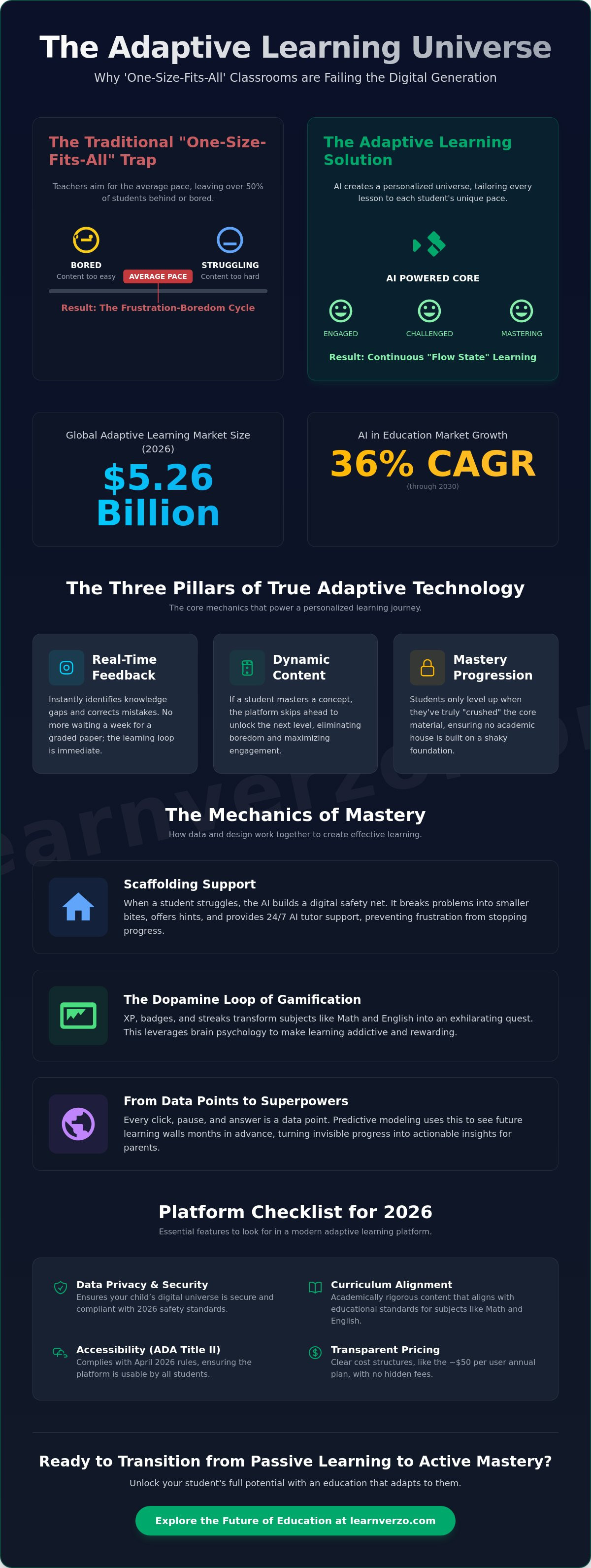
Imagine a classroom where the textbook actually talks back. It doesn't just read aloud; it watches how you think. An adaptive learning platform for students is a digital ecosystem powered by AI that tailors every lesson to a learner's unique pace. While traditional software might just show a video, these platforms analyze every click, pause, and answer. They identify knowledge gaps before they turn into "learning walls." In 2026, we've moved past static screens. This is the year of the "Scholar," where education evolves from a chore into a series of interactive quests.
Many people confuse "personalized" with "adaptive." Personalized learning often requires a teacher or parent to manually adjust the path. Adaptive learning is automatic. It’s a self-correcting system. To understand the history and technical roots of this technology, you can explore What is adaptive learning to see how far the field has come. Essentially, an adaptive learning platform for students acts as a GPS for the student’s mind that recalculates the route every time they answer a question.
The Three Pillars of True Adaptive Tech
True adaptive tech stands on three core pillars. First, real-time feedback loops. Waiting a week for a graded paper is a relic of the past. If a student misses a step in a long division problem, the system catches it instantly. Second, dynamic content branching. If a student masters a concept early, the platform skips the fluff and unlocks the next level. Finally, mastery-based progression. A student only levels up when they’ve truly crushed the core material. This ensures no one builds their academic house on a shaky foundation.
Why Traditional "One-Size-Fits-All" is Failing
The "one-size-fits-all" model is broken. It falls into the "Middle-of-the-Road" trap. Teachers often aim for the average pace of the class, which means 50% of the students are either bored or drowning. Elementary students get stuck in a vicious frustration-boredom cycle. If the content is too easy, they check out. If it's too hard, they quit. With the global adaptive learning market projected to reach $5.26 billion in 2026, the world is finally realizing that every brain needs its own custom-built universe. These platforms solve the engagement crisis by keeping students in the "Flow State," where the challenge always matches their current skill level. It removes the friction of traditional schooling and replaces it with the dopamine-driven satisfaction of leveling up.
The Mechanics of Mastery: How Adaptive Algorithms Personalize the Journey
Mastery isn't just about finishing a chapter. It’s about owning the knowledge. A modern adaptive learning platform for students uses a technique called scaffolding to ensure this happens. Think of it as a digital safety net. When a student struggles with a concept like fractions, the system doesn't just mark it wrong. It builds a support structure. It might break the problem into smaller bites or offer a hint. If you want to dive deeper into the technical side, EDUCAUSE provides a great breakdown of how adaptive learning systems work to personalize these paths in real-time.
Late-night study sessions don't have to be lonely. AI tutors provide just-in-time support, acting as a 24/7 mentor when parents are busy. However, digital isn't the only way to level up. To truly lock in mastery, we recommend balancing screen time with printable practice worksheets. Writing naturally helps the brain process information differently than clicking a mouse. This hybrid approach ensures that digital XP translates into real-world skills.
From Data Points to Superpowers
Every click is a data point. If a student hesitates for 10 seconds before answering, the system knows their confidence is low. Predictive modeling takes this further. With the AI in education market growing at a 36% compound annual rate through 2030, these systems are becoming incredibly sharp. By analyzing arithmetic speed, the platform can predict if a student will hit a wall in Algebra months before it happens. Smart handwriting recognition adds another layer. It allows students to solve problems on a tablet as if they were using paper, keeping the focus on the "how" rather than just the "what."
The Teacher’s New Best Friend
For schools, the institutional licensing model is a game-changer. Teachers don't have to wait for Friday's quiz to see who is struggling. They get a real-time dashboard showing class-wide trends. If 40% of the class is failing a specific quest, the teacher can pivot to a small-group intervention immediately. This data-driven approach turns educators into master strategists. It removes the guesswork and allows for 1-on-1 interventions that actually move the needle. Ready to see these mechanics in action? Explore the LearnVerzo universe to see how we turn data into discovery.
Gamification Meets Adaptation: Why Your Child’s Learning Needs a Quest
Most educational tools focus on corporate training or college students. They forget the K-8 engagement gap. For a child, an adaptive learning platform for students shouldn't feel like a digital textbook. It should feel like a universe waiting to be explored. While competitors treat gamification as a surface-level "skin," true mastery happens when the game mechanics are hardwired into the learning engine. This is where the Dopamine Loop comes in. By using XP, badges, and daily streaks, the platform rewards effort as much as accuracy. This is the "Fortnite Effect" in action. It creates an environment where students actually want to "play" their homework because the rewards feel earned and the progress is visible.
Math is often the biggest source of stress for young learners. That's why gamified math for kids has become the ultimate antidote to math anxiety. Instead of a scary test, it’s a high-speed quest for mastery. When students aren't afraid to get an answer wrong, they take more risks. They explore. They evolve. Leaderboards and social learning features foster a sense of healthy competition. Students join a global community of Scholars, turning a solitary task into a shared adventure. Gamification is the engine of engagement, while adaptation is the steering wheel of education.
Beyond Points: The Narrative of Growth
Points are just the beginning. Real engagement comes from world-building. Avatars and immersive narratives turn a standard curriculum into a map of a new world. Every lesson is a new territory to conquer. Unlocking rewards mirrors the satisfaction of mastering a new skill, creating a sense of momentum that keeps a student moving forward. At LearnVerzo, we even integrate the "Chess Connection." Strategy games like chess build the deep focus and tactical thinking needed to thrive on an adaptive learning platform for students. It turns a simple math problem into a strategic move on a larger board.
The Psychology of Play in Education
The psychology of play is about reducing the fear of failure. In a digital world, a wrong answer isn't a red mark on a paper; it's a "try again" prompt that keeps the game going. This low-stakes environment is essential for building confidence. Adaptive difficulty ensures students stay in the "Flow State." If the quest is too easy, they get bored. If it's too hard, they quit. The algorithm constantly adjusts the challenge level to keep it "just right." This balance is why the global personalized and adaptive learning market is projected to hit $61.7 billion in 2026. Parents and educators are realizing that when learning feels like play, mastery becomes inevitable.
Choosing the Right Platform: A Guide for Parents and Educators in 2026
Selecting an adaptive learning platform for students is like choosing the right gear for a high-stakes quest. You need a tool that balances academic rigor with the thrill of discovery. In 2026, the market is flooded with options, but not all of them turn a user into a true Scholar. Your first priority is curriculum alignment. The "fun" elements must directly support what is being taught in the classroom. Don't settle for a platform that just keeps them busy. Choose one that builds a universe where learning feels like a game across Math, English, and even Coding.
Safety is the next critical level. The Federal Trade Commission’s updated COPPA rules, which took effect in late 2025, require stricter transparency and data minimization for minors. Ensure your chosen platform is compliant. Additionally, as of April 2026, updated ADA Title II regulations require digital content in public schools to meet WCAG 2.1 Level AA standards. This means the platform must be accessible to everyone, regardless of how they interact with the screen. Check for device compatibility too. A great platform should support tablets with stylus input, allowing students to practice handwriting while they earn XP.
The Evaluation Checklist for 2026
-
24/7 Support: Does it offer an AI tutor for primary school students to help with those tricky late-night questions?
-
Visibility: Is there a clear dashboard for parents and teachers to monitor XP, daily streaks, and specific knowledge gaps?
-
Eye Health: Does the platform provide offline resources, such as printable worksheets, to balance digital quests with tactile learning?
Red Flags to Avoid
Avoid "passive" platforms. If a student spends 80% of their time watching unskippable videos, they aren't learning; they're just spectating. Real mastery requires active input. Watch out for hidden costs or "pay-to-win" mechanics. Educational tools should reward effort and strategy, not the size of a parent's wallet. Finally, stay away from platforms that lack a clear mastery-based outcome. Every lesson should have a "level up" moment where the student proves they've crushed the concept before moving on. Ready to equip your student with the ultimate learning tools? Join the LearnVerzo universe today and start the journey to mastery.
Leveling Up with LearnVerzo: The Future of Mastery-Based Education
The search for the perfect adaptive learning platform for students ends where the universe begins. LearnVerzo isn't just a collection of lessons. It’s a high-octane ecosystem where academic objectives meet the psychology of play. We believe that when a student feels like a hero on a quest, the "learning walls" that once caused frustration simply vanish. By 2026, the global personalized learning market has grown to $61.7 billion because the world has realized that engagement is the key to retention. LearnVerzo leads this charge by offering a unified experience across Math, English, and Coding.
LearnVerzo Math transforms what used to be a "boring" subject into a high-speed quest for mastery. Students don't just solve equations; they unlock new territories. For those focusing on literacy, Engaging English learning happens through immersive storytelling where every grammar rule and vocabulary word helps build their personal avatar's story. Coding follows the same logic, using interactive games to teach the foundations of AI and software development. If a student ever gets stuck, the AI Learning Assistant is one tap away. This mentor provides just-in-time support, ensuring that help is always available during late-night study sessions.
Why Scholars Choose LearnVerzo
We don't just have users; we have Scholars. This status elevation changes how a child views their time on the platform. It’s not "homework time" anymore. It’s "insight time." For parents and educators, our real-time analytics turn invisible progress into a clear map of superpowers and growth areas. We also integrate Chess as a core pillar of our identity. By using the Stockfish engine and tactical puzzles, we help students build the deep strategy and focus needed for academic success. It’s about training the mind to think three moves ahead, whether on a chessboard or in a complex science problem.
Get Started on Your Quest Today
Joining the LearnVerzo universe is a simple three-step process designed for speed. First, create your Scholar profile and choose your avatar. Second, take the initial diagnostic quest so the AI can map your current skill level. Third, start leveling up. We offer flexible subscription models for families and bulk institutional licensing for schools looking to scale student success. Every feature we build is designed to remove friction and replace it with the dopamine-driven satisfaction of true mastery. Don't let your student get left behind in a "one-size-fits-all" world. Join the LearnVerzo Universe and Level Up Your Learning Today!
Master the Future of Education
The shift toward personalized paths isn't just a trend; it's a necessity. By 2026, the global market for personalized learning has reached $61.7 billion because it actually works. Choosing the right adaptive learning platform for students means moving beyond static videos and embracing a system that evolves with every learner. You've seen how real-time analytics and scaffolding remove the frustration of traditional lessons. Now, it's time to give your student the tools to become a true Scholar.
LearnVerzo bridges the gap between high-stakes play and academic precision. With curriculum-aligned quests in Math, English, and Coding, we ensure the "fun" always leads to total mastery. Our AI-driven support is one tap away for instant help. Meanwhile, top schools across the globe use our real-time analytics to guide every student toward their full potential. Stop settling for "middle-of-the-road" instruction. Explore the LearnVerzo Universe and start your mastery quest today! Your student has the potential to level up. We provide the universe where they can finally do it.
Frequently Asked Questions
What is the difference between adaptive learning and traditional online courses?
Traditional online courses usually offer a one-size-fits-all video stream or static quiz. An adaptive learning platform for students is dynamic. It uses AI to analyze every answer and instantly recalculates the student's path. This ensures they don't waste time on mastered content or hit a "learning wall" with concepts that are too advanced. It is the difference between a static map and a live GPS.
How does an adaptive learning platform help students who are struggling with math?
Math anxiety often stems from missing foundational steps. Adaptive algorithms identify these hidden gaps immediately. If a student struggles with Algebra, the system might trace the issue back to a specific weakness in fractions from two years ago. It builds a digital scaffold around that concept. This allows the student to earn XP and regain confidence before moving to higher levels in the quest.
Is adaptive learning technology safe for primary school children?
Yes, it is safe when the platform complies with 2026 regulations. As of April 2026, updated ADA Title II and stricter COPPA rules ensure high standards for data privacy and digital accessibility. Look for platforms that prioritize data minimization and provide transparent parental controls. Safe platforms create a "walled garden" where children can explore the universe without exposure to external risks or unvetted content.
Can adaptive learning platforms be used in a traditional classroom setting?
Absolutely. Teachers use these platforms to drive small-group instruction. Instead of teaching to the "middle" of the class, the educator uses real-time analytics to see exactly who needs a 1-on-1 intervention. As of April 2026, 134 bills regarding AI in education have been introduced across 31 states to help schools integrate these tools safely into their daily curriculum and digital infrastructure.
How much does an adaptive learning platform for students typically cost in 2026?
Pricing varies based on the scale of the quest. As of April 2026, Pifini.ai offers its adaptive learning platform for students at 8 per month for up to 100 users. These options make it possible for both families and large institutions to find a budget-friendly path to mastery.
What subjects are best suited for adaptive learning technology?
Subjects with clear logic and mastery-based progression work best. Math, English, and Coding are the primary pillars. The AI excels at tracking progress in these areas because they rely on building-block concepts. The market is expanding rapidly. The AI in education sector reached $4 billion in 2024 and is projected to grow at a 36% compound annual rate through 2030, bringing adaptive technology to science and social studies.
How does the AI tutor in LearnVerzo provide support to students?
The LearnVerzo AI tutor acts as an innovative mentor that is always one tap away. It doesn't just give the answer. It provides "just-in-time" support by asking leading questions that help the student solve the problem themselves. This mirrors the strategic focus found in chess. It teaches the student to analyze their next move before they commit, turning a potential frustration into a moment of discovery.
Do adaptive learning platforms replace the need for teachers or tutors?
No, it acts as a superpower for the humans involved. The platform handles repetitive tasks like grading and data tracking. This frees up teachers and parents to focus on emotional support and complex problem-solving. It turns the educator into a master strategist who uses data-driven insights to guide the student's unique journey. Mastery is a team effort between the student, the mentor, and the technology.