Ai In Education 2026 Leveling Up Learning Through Personalized Quests
--- title: "AI in Education 2026: Leveling Up Learning Through Personalized Quests" slug: "ai-in-education-2026-leveling-up-learning-through-personalized-quests
title: "AI in Education 2026: Leveling Up Learning Through Personalized Quests" slug: "ai-in-education-2026-leveling-up-learning-through-personalized-quests" description: "Discover how AI in education is leveling up learning with personalized quests. See how adaptive tech helps students master skills and reduces teacher burnout." excerpt: "Did you know that as of May 2026, 30% of K-12 students are now using AI tools at least once every single day? The era of the "one-size-fits-all" classroom is over because AI in edu" publishedAt: "2026-05-09T10:00:00.000Z" author: "LearnVerzo Team" categories:
- "Blog" coverImage: "https://getautoseo.com/storage/hero_images/article_1243918_1778303544.jpg" draft: false
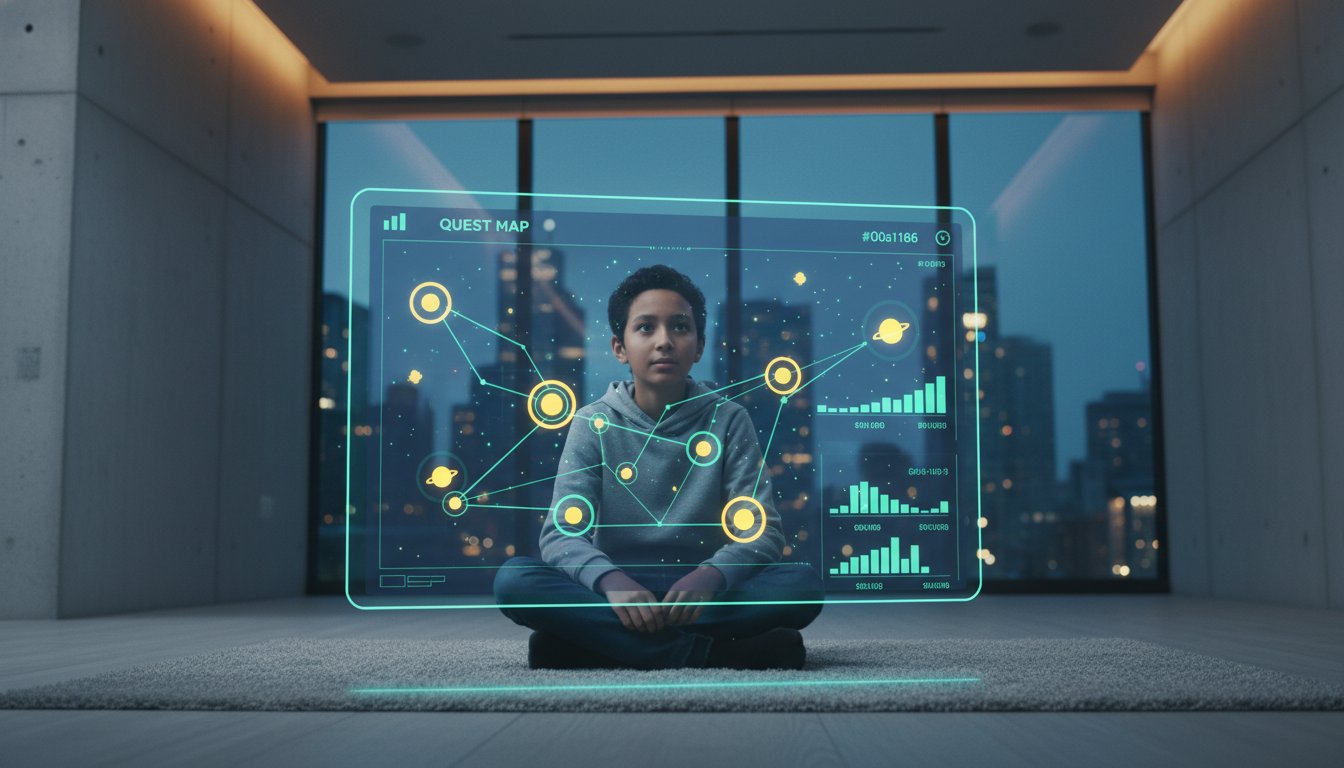
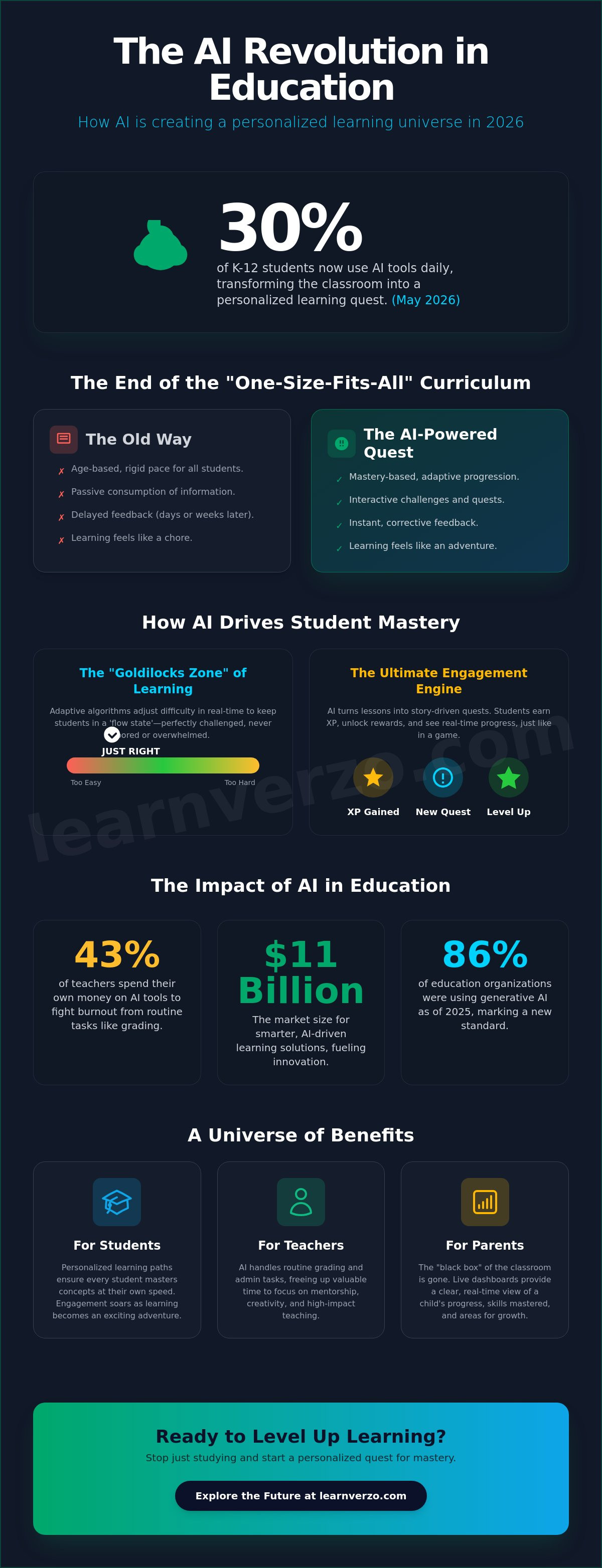
Did you know that as of May 2026, 30% of K-12 students are now using AI tools at least once every single day? The era of the "one-size-fits-all" classroom is over because AI in education has turned the world into a personalized learning universe. You've probably felt the frustration of watching a child disengage when a curriculum doesn't move at their speed. Teachers feel it too, with 43% of educators now spending their own money on AI tools to fight the burnout of routine grading. We agree that learning shouldn't be a chore; it should be a quest.
You'll discover how AI is transforming the classroom from a static environment into a personalized universe of mastery and play. We'll explore how XP-based rewards and real-time progress tracking are fueling the $11 billion market for smarter learning. From the latest U.S. Department of Education priorities effective May 13, 2026, to the rise of AI literacy in Utah, this is your map to the future of education. It's time to stop just studying and start leveling up.
Key Takeaways
-
Understand how AI in education has evolved from basic chatbots into a system of adaptive algorithms that turn every lesson into a personalized quest for mastery.
-
Explore the "Goldilocks Zone" of learning where instant feedback loops and adaptive difficulty keep students challenged without feeling overwhelmed.
-
Discover how radical personalization supports neurodiverse learners while freeing teachers from hours of routine grading and administrative tasks.
-
Learn to identify "screen time that counts" by choosing platforms that focus on mastery-based outcomes rather than passive consumption.
-
See how a unified universe of Math, English, and Coding can transform your curriculum into a high-stakes adventure where every student can level up.
Table of Contents
-
The Evolution of AI in Education: From Chatbots to Personalised Learning Quests
-
Balancing the Screen: Navigating the Pros and Cons of AI in Schools
-
Leveling Up with LearnVerzo: Where AI Meets the Psychology of Play
The Evolution of AI in Education: From Chatbots to Personalised Learning Quests
The classroom has officially evolved. In 2026, AI in education isn't just a fancy search bar or a chatbot that answers basic questions. It's a sophisticated system of adaptive algorithms designed to personalize content in real-time. We've moved past the era of digital textbooks that act like heavy, glowing bricks. Instead, we've entered the age of the Innovative Mentor. This AI understands a student’s strengths, weaknesses, and even their mood. Looking back at the history of AI in education, the progress is staggering. We've shifted from simple automated grading to a world where individualized learning is the global standard. AI in education is a dynamic co-pilot for student discovery that navigates the vast universe of knowledge alongside every learner.
The End of the One-Size-Fits-All Curriculum
Traditional classrooms often force 30 different kids to learn at the exact same pace. It doesn't work. One child is bored while another is lost. AI fixes this by identifying knowledge gaps the second they appear. If a student struggles with fractions, the system doesn't just lower the grade. It pivots. It offers a new quest to reinforce that specific skill. This is the shift from age-based cohorts to mastery-based progression. The goal is to keep every student in the "flow state." This is the psychological sweet spot where the challenge is high enough to be exciting but low enough to be achievable. It's about constant momentum. You don't move on because the calendar says so; you move on because you've mastered the level.
AI as the Ultimate Engagement Engine
Why does a child spend six hours on a video game but struggle with twenty minutes of homework? The answer is the psychology of play. Modern platforms use AI to bridge this gap. By 2026, AI generates dynamic, story-driven quests that turn math problems into epic missions. You aren't just solving for X; you're unlocking a secret vault or saving a digital civilization. We've replaced passive video watching with interactive AI-driven challenges. The AI acts as a quest-giver, reacting to every choice the student makes. This transforms learning from a chore into a high-stakes adventure. Students earn XP, unlock rewards, and see their progress in real-time. It's learning that feels like a game because it uses the same dopamine-driven mechanics to ensure every Scholar stays engaged and hungry for the next discovery.
How AI Mechanics Drive Student Mastery in 2026
Forget the frustration of waiting two weeks for a graded paper. In 2026, the feedback loop is instantaneous. AI in education has replaced the red pen with real-time guidance that mirrors the speed of a high-stakes game. When a student solves a complex problem, the system validates the logic immediately. This is critical for mastery. It stops errors from becoming ingrained habits. If a mistake happens, the AI doesn't just mark it wrong. It provides a hint that nudges the learner back on track. With 86% of education organizations now using generative AI as of 2025, this level of responsiveness is no longer a luxury. It's the new baseline for effective learning.
This leads us to the "Goldilocks Zone." This is the psychological sweet spot where the challenge is perfectly matched to the student's current skill level. Too easy, and they disengage. Too hard, and they give up. Adaptive algorithms monitor every click and keystroke to adjust the difficulty on the fly. It's like a game that gets harder as you get better, ensuring the dopamine hit of a "level up" is always within reach. For parents, the "black box" of the classroom is gone. Instead of a vague report card every three months, you get a live feed of progress. You can track every XP point earned and every skill mastered through data-driven dashboards. Smart handwriting recognition adds another layer of depth. Students write naturally with a stylus, and the AI analyzes the stroke order and logic. This ensures that while the tech is cutting-edge, the fundamental skill of writing remains central.
The AI Tutor: Help is Always One Tap Away
Help is one tap away. AI tutors for primary school students provide 24/7 support that feels like a conversation with a mentor. These tutors don't just hand out answers. They use scaffolding to prompt deeper thinking. They might ask, "What would happen if we changed this number?" or "Where did you see this pattern before?" This dialogue fosters a growth mindset, teaching Scholars that every challenge is just a puzzle waiting to be solved.
Gamification Meets Pedagogy
We've turned the curriculum into a high-stakes adventure. Math problems are now boss battles. Coding is the key to building entire digital worlds. Leaderboards and daily streaks turn the chore of studying into a competitive quest. Gamified math for kids ensures that every mission is curriculum-aligned. Your child isn't just playing; they're mastering the skills they need for a digital-first future. Ready to see your child evolve into a Scholar? You can join the LearnVerzo universe and start the quest today.
Balancing the Screen: Navigating the Pros and Cons of AI in Schools
AI in education is the ultimate power-up, but every pro player knows you need a balanced build. The biggest win is radical personalization. Neurodiverse and gifted students finally get a curriculum that evolves with them in real-time. No more waiting for the rest of the class to catch up. No more feeling left behind. For educators, the gain is equally massive. Routine tasks are vanishing. As of 2025, 86% of education organizations adopted generative AI to handle the heavy lifting of grading and admin work. This isn't about replacing teachers. It's about giving them their time back.
There are real challenges to master. Data privacy is the final boss of the digital classroom. Parents and regulators worry about the "black box" of AI decision-making. How does the algorithm decide what a child learns next? There is also the risk of digital burnout. Too much screen time can lead to a lack of physical reinforcement. We believe in a hybrid approach. Use the AI to master the logic, but use printable practice worksheets to lock in that knowledge through handwriting. Balance is the only way to reach the next level.
Teacher Dashboards: The Human-AI Partnership
Teachers are the ultimate quest-givers. A teacher dashboard AI acts as a high-tech scouting report. It flags struggling students before they even realize they're stuck. This allows for "triage" in the classroom. Instead of lecturing to a silent room, teachers use real-time analytics to focus on one-on-one mentorship. They intervene exactly where they're needed most. It turns a chaotic classroom into a focused arena of discovery.
Data Privacy and Ethical AI in 2026
Safety isn't a feature; it's a requirement. Maryland's latest legislation, set to take effect on June 1, 2026, highlights the urgent need for a state plan regarding AI's effects on students. We treat student data with the highest professional sobriety. This means using platforms that are strictly COPPA and GDPR compliant. Every "Scholar" deserves a safe universe to explore. We ensure AI outputs are free from bias and perfectly aligned with core educational values. Protecting a child’s digital footprint is just as important as protecting their academic future.
Implementing AI Literacy: A Guide for Parents and Educators
AI literacy is the new literacy. By May 2026, states like Utah have already made this official. HB 218 now requires digital skills courses, including AI literacy, for 7th and 8th graders as of May 6, 2026. You don't have to wait for a school mandate to start. Implementing AI in education at home is about strategy. It's about moving from passive scrolling to active discovery. Follow these four steps to turn your home into a mastery-based universe.
-
Step 1: Focus on Screen Time That Counts. With 30% of K-12 students using AI daily, the goal isn't less time; it's better time. Choose tools that require active input. Avoid mindless clicking.
-
Step 2: Demand Mastery-Based Outcomes. Don't settle for "completed" badges. Look for platforms that prove a child can actually solve the problem before they level up.
-
Step 3: Integrate Digital and Physical. Use the AI to find the gaps. Use paper to bridge them. This locks in the knowledge.
-
Step 4: Start Family Quests. Turn learning into a shared mission. Use AI to generate coding challenges or math puzzles that the whole family can tackle together.
The Digital-Physical Balance
The screen is just the starting line. We believe printable practice worksheets are still essential in 2026. Handwriting creates a different neural connection than typing. AI in education makes this process smarter. Instead of generic packets, the AI generates custom worksheets based on a student’s real-time performance. If they missed three geometry questions on the tablet, the printer produces three targeted practice problems. This creates a learning universe that exists both on and off the screen. It keeps the mind sharp and the hand steady.
Teaching Kids to Use AI Responsibly
Is AI for cheating or for discovery? The difference lies in prompt engineering. We teach Scholars how to ask the right questions. Instead of asking for an answer, they learn to ask for a hint or a method. This is how we build a generation of Scholars who are fluent in the language of the future. We want kids who see AI as a tool, not a crutch. They should use it to evolve their thinking and unlock new superpowers. It's about curiosity. It's about mastery. Ready to equip your child with the skills they need to lead? Join LearnVerzo today and start your first quest.
Leveling Up with LearnVerzo: Where AI Meets the Psychology of Play
The future isn't coming; it's already here. While others talk about the potential of AI in education, we've built the universe where it lives. The LearnVerzo platform is the ultimate embodiment of the 2026 learning revolution. It’s a place where Math, English, and Coding aren't just subjects on a screen. They are epic quests waiting to be mastered. We've bridged the gap between the high stakes of a video game and the academic rigor of a world-class curriculum. It's learning that feels like Fortnite, but way smarter. Every lesson is a mission. Every correct answer earns XP. This is where dopamine meets discovery.
Our unified universe ensures that every student evolves at their own pace. We don't believe in "good enough." We believe in mastery. By using sophisticated algorithms, the platform identifies exactly when a student is ready to level up. There’s no more "one-size-fits-all" frustration. Instead, Scholars feel the exhilarating rush of unlocking new rewards through hard work and focus. It turns the chore of studying into a competitive, high-energy adventure. Your child isn't just a user; they are a hero in their own educational story.
Real-Time Analytics for Schools and Families
Visibility is the ultimate superpower for parents and educators. Our platform provides a single, vibrant interface to track progress across every subject. Parents get personal dashboards to monitor daily streaks and skill level-ups in real-time. For principals, we offer aggregated data that shows exactly how an entire student body is performing. The power of institutional licensing allows schools to scale this success across every grade level. It transforms classroom management from a guessing game into a data-driven strategy session. Everyone stays informed. No student gets left behind.
The Future of the LearnVerzo Universe
The quest is only getting bigger. We are constantly expanding our universe with features that challenge the mind. Soon, advanced Chess strategy engines will join our pillar of focus and logic. We’re also evolving our English mastery quests with deeper AI-driven storytelling. Every update is designed to move the student avatar closer to becoming a world-class Scholar. This is the new standard for AI in education. We aren't just teaching kids how to pass a test; we’re teaching them how to master the world. Stop watching the revolution from the sidelines. Level up your child’s learning journey today. Join the LearnVerzo universe and start the quest.
Master the Future of Learning Today
The evolution of AI in education has officially turned the classroom into a personalized universe of discovery. We've seen how 86% of education organizations adopted these tools by 2025 to create mastery-based paths that adapt in real-time. It's no longer about sitting through a lecture. It's about conquering quests and earning XP. Whether it's curriculum-aligned Math or world-building through Coding; the goal is clear: total mastery.
You now have the map to balance high-tech feedback with physical reinforcement. Parents and teachers can use real-time analytics to track every skill level-up with professional sobriety. It's learning that feels like Fortnite, but way smarter. Don't let your child stay stuck on a level that doesn't challenge them. It's time to evolve from a student into a true Scholar. Explore the LearnVerzo Universe and Level Up Today! The universe is waiting. Your first quest starts now.
Frequently Asked Questions
How does AI in education improve student engagement?
AI in education boosts engagement by turning passive study into high-stakes quests using gaming mechanics like XP and leaderboards. This approach taps into the dopamine-driven satisfaction of leveling up. Instead of just reading, students complete missions that mirror the engagement seen in popular platforms. It keeps Scholars focused on their academic objectives through a vibrant universe of discovery and play.
Is AI going to replace teachers in the classroom?
AI will not replace teachers; instead, it acts as an Innovative Mentor that handles routine work. By May 2026, AI tools are helping teachers manage grading and lesson planning more efficiently. This allows educators to focus on one-on-one mentorship and complex student needs. It removes the burnout from administrative tasks, turning the teacher into a high-level strategist rather than a paper-pusher.
What are the risks of using AI in primary schools?
The primary risks involve data privacy concerns and the potential for digital burnout without physical reinforcement. Legislation like Maryland's task force, effective June 1, 2026, aims to study these effects on the learning process. To stay safe, schools must use COPPA-compliant platforms. Balancing AI in education with printable worksheets ensures that kids don't lose the essential skill of writing naturally.
How can parents ensure AI screen time is productive?
Parents can ensure productivity by choosing platforms that focus on active discovery rather than passive video consumption. Look for mastery-based outcomes where a child must prove their knowledge to progress. With 30% of K-12 students using AI daily as of 2026, the quality of the interaction matters more than the minutes spent on the device. Focus on screen time that counts.
What does "mastery-based learning" mean in an AI context?
Mastery-based learning means a student only moves to the next level once they have fully understood the current topic. AI facilitates this through instant feedback loops that identify knowledge gaps the second they appear. If a student misses a logic step, the AI provides a targeted quest to fix it. There are no partial credits; only the satisfaction of true mastery.
Can AI help students with learning disabilities?
Yes, AI provides radical personalization that caters specifically to neurodiverse and gifted students. The system adjusts difficulty in real-time to keep learners in the flow state. For a student with dyslexia or ADHD, the AI acts as a patient tutor that never gets frustrated. It provides the specific scaffolding needed to unlock their unique academic superpowers.
What is the best way to introduce AI literacy to children?
The best way to introduce AI literacy is through hands-on prompt engineering and shared family quests. As seen in Utah's HB 218 mandate starting May 6, 2026, teaching kids to ask the right questions is vital. Start by using AI in education to solve puzzles or plan creative projects. This builds a generation of Scholars who view technology as a powerful co-pilot.
How does LearnVerzo use AI to teach Math and Coding?
LearnVerzo uses AI to turn Math and Coding into curriculum-aligned boss battles and world-building missions. Our platform analyzes every keystroke to provide instant feedback and support. Students earn XP for solving equations or writing functional lines of code. It’s a unified universe where every mission is designed to evolve a child’s skills and help them level up their future.