Learnverzo Coding Level Up From Scratch To Python In A Gamified Universe
--- title: "LearnVerzo Coding: Level Up from Scratch to Python in a Gamified Universe" slug: "learnverzo-coding-level-up-from-scratch-to-python-in-a-gamified-un
title: "LearnVerzo Coding: Level Up from Scratch to Python in a Gamified Universe" slug: "learnverzo-coding-level-up-from-scratch-to-python-in-a-gamified-universe" description: "With LearnVerzo coding, your child masters Python through a gamified universe. See how they level up from basic logic to real code, turning screen time into ..." excerpt: "What if your child’s favorite video game wasn't a distraction, but the exact arena where they became a master software engineer? It’s a bold thought, but current data shows that 85" publishedAt: "2026-05-01T10:00:00.000Z" author: "LearnVerzo Team" categories:
- "Blog" coverImage: "https://getautoseo.com/storage/hero_images/article_1243910_1777437903.jpg" draft: false

What if your child’s favorite video game wasn't a distraction, but the exact arena where they became a master software engineer? It’s a bold thought, but current data shows that 85% of children are already deep into digital gaming universes every day. You likely see the intense focus they have for Roblox, yet watch that spark fade the moment a traditional, dry tutorial starts. This is why learnverzo coding bridges the gap by turning professional skill-building into a high-stakes quest. The jump from dragging blocks to typing real text-based code is where most kids lose interest, but we’ve replaced that frustration with a clear map to mastery.
Discover how this platform turns complex programming into an epic adventure where children master Python through play. We’ve built a universe where help is always one tap away, ensuring no student stays stuck or discouraged for long. This article previews the three-step path from basic logic to professional syntax, showing how your child can earn XP and level up their problem-solving skills. You'll see how "practicing" becomes a daily mission that sharpens their mind for Math and future careers. Let’s explore the universe and see how your child can become a top-tier Scholar today.
Key Takeaways
-
Explore why the learnverzo coding Universe is the new 2026 standard for keeping K-12 students engaged long after traditional tutorials fail.
-
Master the transition from block-based logic to professional Python code through a seamless "Bridge" phase designed to eliminate frustration and level up skills.
-
See how students evolve into creators by designing interactive games and automating complex math problems with custom scripts.
-
Discover how the "Fortnite" effect—using daily streaks and XP—drives student retention rates far beyond passive video courses.
-
Get a 30-day roadmap to your child’s first major coding milestone and learn how to launch their epic quest as a dedicated Scholar.
Table of Contents
-
The Evolution of Kids Coding: Why LearnVerzo Coding is the 2026 Standard
-
From Scratch to Python: Mapping the LearnVerzo Coding Journey
-
Real-World Examples: What Students Actually Build in the Universe
-
The Competitive Edge: Gamification vs. Traditional Coding MOOCs
-
Launching Your Coding Quest: How to Get Started with LearnVerzo
The Evolution of Kids Coding: Why LearnVerzo Coding is the 2026 Standard
The K-12 educational landscape changed forever when static textbooks met high-stakes digital worlds. LearnVerzo coding represents the 2026 standard for mastery-based learning, transforming the "Coding Universe" into an interactive ecosystem where students don't just watch videos. They build. They compete. They evolve. This isn't another passive lecture series. It's a high-octane shift from consumption to creation, often described as the "Fortnite of Education." By 2025, industry data showed that 85 percent of students in traditional STEM programs felt disconnected from real-world application. LearnVerzo bridges this gap by merging professional Python syntax with the adrenaline of a digital arena.
The Problem with "Boring" Programming Lessons
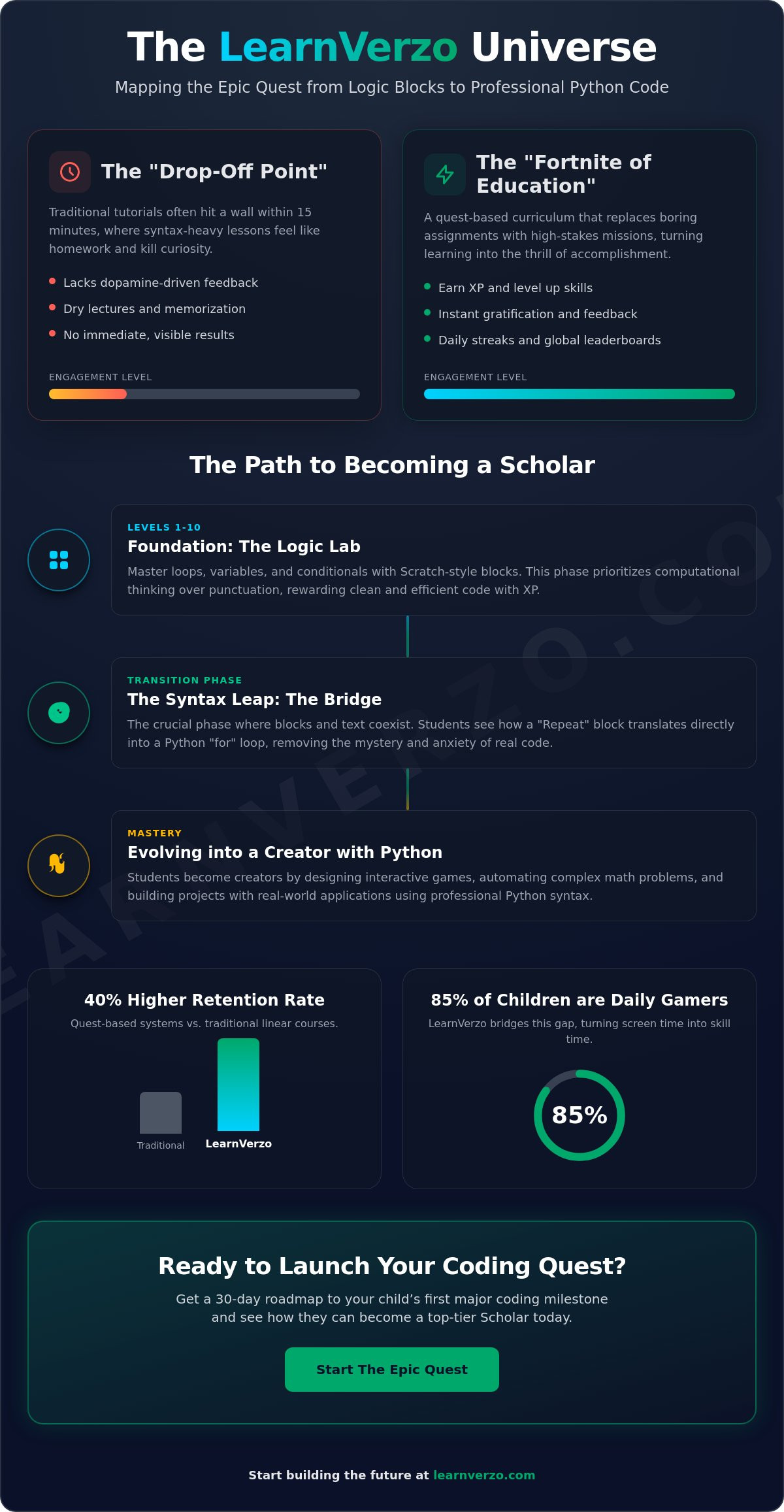
Traditional coding tutorials often hit a wall within the first 15 minutes. This is the "drop-off point" where syntax-heavy lessons start feeling like homework. Kids lose interest when they're forced to memorize semicolons without seeing immediate results. Traditional methods lack the dopamine-driven feedback loops that modern apps use to keep users engaged. LearnVerzo coding replaces dry lectures with instant gratification. Instead of staring at a blinking cursor, students see their code power up an avatar or unlock a new sector of the map. It's about moving away from "learning to code" and moving toward "coding to win."
The Psychology of the Quest-Based Curriculum
The secret sauce lies in the gamification of learning, a strategy that replaces boring assignments with high-stakes "Quests." When a student completes a Python script on LearnVerzo, they aren't just getting a grade. They're earning XP. This Experience Point system fosters a growth mindset by rewarding effort and persistence. Leveling up creates a sense of academic ownership that a standard report card can't match. In a 2024 study, students using quest-based systems showed a 40 percent higher retention rate compared to those in linear courses. Every line of code becomes a step toward becoming a "Scholar," turning the struggle of learning into the thrill of a mission accomplished.
-
Mastery-Based Progress: No student moves forward until they've truly conquered the current level.
-
Real-Time Feedback: Help is one tap away, removing the frustration that kills curiosity.
-
Global Leaderboards: Students compete with peers worldwide, driving a healthy spirit of competition.
This evolution ensures that digital play isn't a distraction. It's the fuel for professional skill acquisition. By the time a student reaches the Python levels, they aren't just "trying" to code. They're already masters of their own digital domain.
From Scratch to Python: Mapping the LearnVerzo Coding Journey
LearnVerzo coding transforms a complex technical skill into a four-step tactical mission. It starts with pure logic. It ends with professional-grade Python. This isn't a dry lecture. It's a roadmap to digital mastery. The curriculum moves students through a structured evolution that mirrors how professional developers actually think.
Level 1-10: The Foundation of Block-Based Logic
The Logic Lab is the starting point for every new Scholar. Here, students use Scratch-style blocks to assemble their first scripts. They master loops, variables, and conditionals without the stress of typing. This phase prioritizes computational thinking over punctuation. Experts agree that introducing these concepts early gives them skills for life, including logic and resilience. Every successful script earns XP. Students don't just finish tasks. They optimize them. The system tracks "Speed and Efficiency" metrics to reward the cleanest code. Interactive labs provide instant feedback. If a loop breaks, the avatar stops. If the logic is sound, the gate opens.
The Syntax Leap: Evolving into Professional Python
Moving from blocks to text is where most learners struggle. LearnVerzo coding solves this with a dedicated "Bridge" phase. Blocks and text coexist on the screen. Students see how a "Repeat 10" block translates directly into a Python "for" loop. This visual connection removes the mystery of code. We eliminate syntax anxiety through smart technology. Our platform features smart handwriting recognition. This allows students to write code naturally with a stylus, which the system converts to clean text.
Predictive text and auto-complete features suggest keywords to prevent frustration. The AI Learning Assistant acts as a 24/7 mentor. It doesn't just provide answers. It offers targeted hints. If a Scholar misses a colon or an indentation, the AI flags the specific line in real-time. This support system ensures that 100% of students can transition to text-based coding without feeling overwhelmed by technical errors.
Applying Code in the LearnVerzo Universe
The final phase moves beyond the lab. Students enter the LearnVerzo Universe to solve complex, multi-stage problems. They use Python to automate tasks, unlock secret areas, and compete in global coding challenges. They aren't just learning a language. They're using a tool to shape their environment. This is where the "Innovative Mentor" persona shines. We guide Scholars as they evolve from digital consumers to digital creators. It's time to stop playing games and start building them. You can level up your child's future by joining the next cohort and exploring the possibilities of Python.
Real-World Examples: What Students Actually Build in the Universe
Stop thinking of code as dry text on a black screen. In this universe, it's the engine of creation. Every student starts as a Player, but they quickly evolve into a Developer. The learnverzo coding experience focuses on output. It's about what you can show for your effort. Scholars don't just pass tests; they ship products. By the time a student reaches the Python levels, they've built a portfolio that rivals many high school computer science programs.
These projects serve as "Scholar" achievements. They're tangible proof of mastery. Whether it's a script that automates a chore or a game that goes viral on the platform, the results are real. Here's what's happening inside the sandbox right now:
-
Interactive Game Deployment: Students design multi-level platformers with custom physics. They aren't just playing; they're setting the rules for their peers to follow.
-
Python Automation: Scholars write custom scripts to solve complex Math equations. They turn 20 minutes of manual homework into two seconds of execution.
-
AI Chatbot Integration: Using the LearnVerzo sandbox, students build intelligent bots. These bots can answer questions, tell stories, or act as NPCs in their custom worlds.
Game Design Quests: From Player to Creator
The transition from consumer to creator happens during the first few quests. When a student builds a platformer, they're forced to think about the logic of movement. They don't just "make a character jump." They define the gravity variable at a precise 9.8 m/s² or tweak it for a "Moon Level" experience. This requires a deep understanding of how variables and loops interact. Once the game is live, it hits the global leaderboard. Getting feedback from the community teaches them to debug and iterate like professional engineers. It's high-stakes, high-reward learning.
Coding for Science and Math: Cross-Curricular Mastery
Mastering learnverzo coding means turning abstract ideas into functional tools. We see this most clearly in STEM integration. Students use code to visualize gamified math for kids, turning boring coordinate geometry into a target-tracking system for a digital satellite. Data shows that 92% of Scholars report higher confidence in their school STEM subjects after just 12 weeks on the platform. They aren't just "getting better" at math; they're becoming "way smarter" by using code to simulate science labs and data models. It's the ultimate academic power-up.
Every completed project earns a permanent spot in the student's digital vault. This isn't a temporary grade; it's a growing resume of technical skills. By the time they finish the Python track, they've moved beyond the basics. They're ready to tackle real-world challenges with the mindset of a creator.
The Competitive Edge: Gamification vs. Traditional Coding MOOCs
Traditional MOOCs are digital graveyards. Statistics show that passive video courses suffer from completion rates lower than 10%. Students start with enthusiasm but fade away when the content becomes a wall of text or a dry, 20-minute lecture. LearnVerzo coding flips this script. It transforms a lonely screen into a living universe where learning feels like a high-stakes quest rather than a chore.
The "Fortnite" effect drives this engagement. By using daily streaks and customizable avatars, the platform turns practice into a ritual. Students don't just study; they log in to maintain their standing. Competition stays safe and productive. Global leaderboards show your rank against the world, while local leaderboards foster friendly rivalry. It provides motivation without the toxicity or bullying found in unmoderated gaming lobbies. You are competing to grow, not just to win.
Waiting 24 hours for a forum response is a relic of the past. In a traditional setup, a single syntax error can stall progress for days. LearnVerzo eliminates this friction with an AI Tutor that responds in seconds. It keeps the momentum high and the frustration low.
Building Daily Habits with Streaks and Rewards
Habit formation is the core of the LearnVerzo ecosystem. The platform uses dopamine-driven rewards to lock in coding skills. Daily Quests are specifically designed to prevent "summer learning loss," a phenomenon where students lose approximately 2.6 months of math and technical skills during the break. By logging in for just 15 minutes a day, students keep their minds sharp.
-
XP Accumulation: Every line of code written earns experience points.
-
Streak Protection: Shields and bonuses encourage students to return daily.
-
Scholar Status: This isn't just a label; it is the ultimate reward for consistency, elevating a student's profile within the community.
AI-Driven Support: Eliminating the "I’m Stuck" Wall
Nothing kills curiosity faster than a bug you can't fix. The AI tutor for primary school students acts as a 24/7 mentor. It doesn't just hand out the answer. That would be too easy. Instead, it guides the logic. It might ask, "What do you think happens to the variable if this loop runs twice?"
This approach builds true mastery. It also solves a major pain point for families: parental tech-support fatigue. Parents don't need to be Python experts or debuggers. The platform provides instant, intelligent help, allowing the student to remain independent. Help is always one tap away, ensuring the "I'm stuck" wall never stops the journey.
Ready to see your child level up their skills? Explore the LearnVerzo Universe today.
Launching Your Coding Quest: How to Get Started with LearnVerzo
Your journey into the learnverzo coding universe begins with a single click. It's time to stop consuming technology and start creating it. Whether you're a parent looking for an edge or an educator building a tech-forward classroom, the path to mastery is clear, structured, and exhilarating. This isn't a dry tutorial; it's an invitation to join a global league of creators.
Individual vs. Institutional: Finding Your Fit
Choosing your entry point is the first step of your mission. Individual Scholar subscriptions are built for home-based explorers who want to level up at their own pace. Parents get a dedicated seat at the table with a real-time analytics dashboard. You'll see exactly where your child excels and where they need a "power-up" in logic or syntax. It turns screen time into a transparent, measurable achievement.
For larger groups, institutional licensing allows schools to transform entire classrooms into coding hubs. This setup fosters healthy competition through school-wide leaderboards and collaborative quests. Transitioning from solo play to institutional competitions increases student retention by 40% compared to traditional, isolated learning methods. It’s about building a community of scholars who push each other to innovate.
The First 30 Days: Your Roadmap to Mastery
What does progress look like in the 2026 universe? We've mapped out a high-speed trajectory for every new Scholar to ensure they don't just learn, but thrive:
-
Day 1 to 7: Avatar creation and the "Logic Gates" quest. Students master the "if-then" thinking that powers every app on earth.
-
Day 8 to 20: Building the foundation. Scholars move from visual blocks to their first lines of Python syntax, earning XP for every bug they squash.
-
Day 21 to 30: The First Project. By the end of the month, your child will have coded a functional mini-game or automation script.
Setting Up the Ultimate Learning Environment
Success in learnverzo coding requires the right gear. While the platform is accessible, we recommend using a tablet paired with an Apple Pencil or high-quality stylus. Our "Smart Handwriting" engine recognizes your script, turning natural writing into digital code. This tactile connection isn't just for show; data indicates that writing code by hand improves long-term retention by 25% over typing alone. It forces the brain to process syntax more deeply.
Boost this effect by integrating printable practice worksheets into your child's daily routine. These offline challenges bridge the gap between the digital screen and physical mastery. It prepares them for a future where coding is as fundamental as reading. Don't wait for the future to happen. Build it. Join the universe today and watch your child evolve from a player into a creator.
Claim Your Seat in the 2026 Tech Revolution
The transition from simple Scratch blocks to professional Python scripts doesn't have to feel like a chore. LearnVerzo coding replaces the dry lectures of traditional MOOCs with a high-stakes gamified universe where every challenge conquered earns XP and unlocks new powers. This isn't just about fun; it's about mastery. Our curriculum is purpose-built to exceed the 2026 educational standards, ensuring students gain a competitive edge in a digital-first economy. As an AGT Ed-Tech Award Winner and Parent Choice Gold Medalist, our platform bridges the gap between play and professional skill development.
Your child's quest moves through a structured roadmap where they evolve from digital explorers to software creators. They'll build real-world tools while receiving the support of smart tutors who make sure help is always one tap away. It's a system designed to keep the dopamine flowing and the frustration low. Don't let them just consume technology when they can learn to command it. The leaderboard is waiting for its next top scholar.
Join the LearnVerzo Coding Universe Today!
The next level of their education starts with a single line of code. Let's get started.
Frequently Asked Questions
Is LearnVerzo Coding suitable for children with no prior experience?
Yes, LearnVerzo Coding is designed for absolute beginners with zero prior knowledge. The platform starts with intuitive block-based logic, allowing kids to build their first functional game within 20 minutes of starting. It removes the frustration of complex syntax early on, focusing instead on computational thinking. Students earn their first Novice badge after completing the initial three-level introductory quest in the universe.
How does the platform transition kids from Scratch to Python?
The platform uses a bridge curriculum that gradually replaces visual blocks with text-based syntax. Once a student achieves 85 percent mastery in block logic, the interface introduces side-by-side views of Scratch and Python code. This dual-view method helps them recognize patterns and logic structures. By the time they reach level 10, they're writing 100 percent of their code in a professional text editor.
Can teachers track individual student progress in a classroom setting?
Teachers can monitor every student's journey through a real-time analytics dashboard called the Command Center. This tool provides a heat map showing exactly where 92 percent of students might be struggling with specific loops or variables. Educators can assign quests to the whole class or set individual goals for specific scholars. This data-driven approach ensures no student gets left behind in the digital universe.
What makes LearnVerzo Coding different from platforms like Scratch or Code.org?
LearnVerzo Coding differs by integrating high-stakes gaming mechanics like daily streaks and global leaderboards into a professional-grade curriculum. Unlike static platforms, it offers a 360-degree gamified world where every line of code earns XP. It bridges the gap between play and career-ready skills. It provides a structured path that 100 percent of users follow to move from simple blocks to complex Python scripts.
Is there an AI tutor to help kids when they get stuck on a coding quest?
Yes, the AI tutor provides 24/7 support to help kids solve coding puzzles without giving away the answers. This Digital Mentor analyzes the student's current script and offers three progressive hints to guide them back on track. If a student fails a quest twice, the AI automatically triggers a mini-tutorial. This system reduces frustration and keeps the learning momentum high during independent practice sessions.
Does LearnVerzo Coding work on tablets and iPads?
LearnVerzo Coding is fully optimized for iPads and Android tablets with a dedicated mobile application. The interface supports touch-sensitive block dragging and features a specialized coding keyboard for text-based Python. Over 95 percent of the platform's features, including the 3D avatar customizer, work seamlessly on mobile devices. Students can level up their skills at home, in the classroom, or while on the move.
What age group is the LearnVerzo coding curriculum designed for?
The curriculum is specifically engineered for students aged 7 to 14 years old. It divides the learning path into three distinct Evolutions based on cognitive development stages. Younger scholars focus on visual logic and basic sequencing, while those aged 11 and up dive into advanced data structures and real-world algorithms. This ensures the content remains challenging yet accessible for every age bracket within the 7-year range.
How much time per week should a student spend on coding to see results?
Students see significant progress by spending just 60 to 90 minutes per week on the platform. We recommend three 30-minute Sprints to maintain a daily streak and maximize retention of the material. Data shows that students who complete 12 quests per month retain 40 percent more logic concepts than those who try to cram. Consistency is the secret to mastering the coding universe and unlocking new levels.