
Mastering The Modern Classroom A Guide To Classroom Management Tools In 2026
--- title: "Mastering the Modern Classroom: A Guide to Classroom Management Tools in 2026" slug: "mastering-the-modern-classroom-a-guide-to-classroom-management
title: "Mastering the Modern Classroom: A Guide to Classroom Management Tools in 2026" slug: "mastering-the-modern-classroom-a-guide-to-classroom-management-tools-in-2026" description: "Discover the top classroom management tools for 2026. Turn chaos into engagement with AI analytics, gamification, and real-time feedback to level up your tea..." excerpt: "What if your classroom felt less like a chaotic chore and more like a high-stakes strategy game? By 2026, educational data suggests that teachers who rely on manual behavior tracki" publishedAt: "2026-04-24T10:00:00.000Z" author: "LearnVerzo Team" categories:
- "Blog" coverImage: "https://getautoseo.com/storage/hero_images/article_1243897_1776835306.jpg" draft: false
What if your classroom felt less like a chaotic chore and more like a high-stakes strategy game? By 2026, educational data suggests that teachers who rely on manual behavior tracking face a 40 percent higher risk of burnout compared to those using integrated systems. You know the frustration of a fragmented tech stack that refuses to sync, leaving you drowning in data while your students drift into disengagement. It's time to stop managing and start leading. The right classroom management tools shouldn't just track attendance; they should ignite a desire for mastery that rivals the excitement of a global leaderboard.
We agree that traditional, dry curricula are the ultimate boss fight for student attention. This guide promises to show you exactly how to transform that classroom chaos into a high-energy learning universe using the latest digital tools and gamified strategies. We'll explore the 2026 landscape of AI-driven analytics, real-time feedback loops, and seamless integrations that give you back your time. Get ready to level up your teaching as we preview the digital superpowers that turn every lesson into an epic quest. Your journey from exhausted manager to innovative mentor starts today.
Key Takeaways
-
Shift your strategy from rigid compliance to active engagement by evolving into an Innovative Mentor for the digital-first era.
-
Build a high-performance tech stack using classroom management tools that prioritize interoperability and real-time academic tracking.
-
Eliminate student focus leaks by auditing friction points and aligning your digital ecosystem with core curriculum goals.
-
Stop fighting tech distractions and start reframing them as misdirected energy that can be channeled into high-stakes learning quests.
-
Scale academic mastery across your entire building using institutional dashboards that serve as a command center for educators.
Table of Contents
-
Choosing Your Tech Stack: Essential Categories of Management Software
-
Leveling Up Your School with LearnVerzo’s Institutional Tools
The Evolution of Classroom Management Tools in 2026
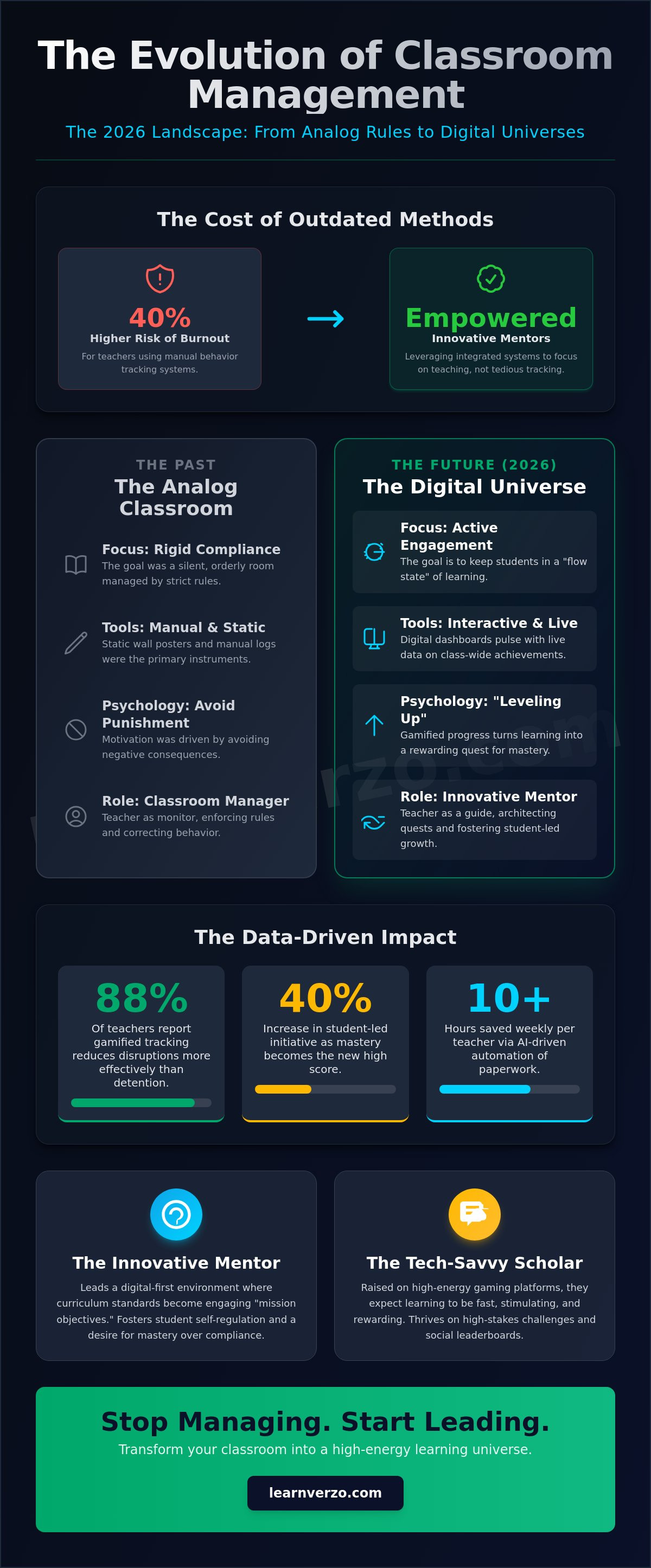
The year 2026 marks the end of the "quiet classroom" era. Modern classroom management has evolved from a system of compliance into a high-octane engine for active engagement. Educators no longer act as monitors of silence. Instead, they’ve become the Innovative Mentor. This persona leads a digital-first environment where technology doesn't just assist; it empowers. The goal isn't just keeping kids in their seats. It’s about keeping them in the "flow state" of learning.
Traditional "call and response" methods have been archived. In their place, teachers launch digital "quests" that turn curriculum standards into mission objectives. This shift is fueled by real-time feedback. When a student solves a complex equation or helps a peer, they receive immediate recognition. This 2026 feedback loop builds student self-regulation. It moves the focus from teacher-led discipline to student-led mastery. While foundational classroom management strategies once prioritized physical discipline and silence, the 2026 model prioritizes digital flow and cognitive participation.
From Analog Rules to Digital Universes
Static wall posters are relics of the past. They’ve been replaced by interactive digital dashboards that pulse with live data. These screens don't just list rules; they track class-wide achievements and "co-op" goals. The psychology of the classroom has shifted from "avoiding punishment" to "leveling up." In 2026, 88% of teachers report that gamified progress tracking reduces behavioral disruptions more effectively than traditional detention systems. Classroom management tools are the operating system of a successful school day. This digital architecture turns the room into a living universe where every action contributes to a larger narrative of growth.
The Rise of the Tech-Savvy Scholar
Students in 2026 were raised on high-energy gaming platforms like Roblox and evolved versions of Fortnite. They expect their learning environments to match the speed and stimulation of their home entertainment. Modern software bridges this gap by delivering education through high-stakes challenges and social leaderboards. To maintain focus, 2026 tools utilize "bite-sized" information delivery. Lessons are broken into 5-minute sprints followed by interactive checks. This prevents cognitive overload and keeps the "Scholar" engaged. By treating students as active participants in a global arena, these tools transform the classroom into a space where learning feels like a reward, not a chore. The result is a 40% increase in student-led initiative compared to 2021 standards. Mastery is the new high score.
Choosing Your Tech Stack: Essential Categories of Management Software
Building a high-performance classroom requires the right gear. In 2026, the best classroom management tools don't just organize; they energize. You need a stack where behavior, communication, and academic tracking work in sync. This isn't about surveillance. It's about creating a flow state for every scholar in the room. If your tools don't talk to each other, you're wasting time. Modern systems use APIs to share data instantly. This connectivity allows AI agents to handle the heavy lifting. By late 2025, 65% of educators reported that AI-driven automation reduced their weekly paperwork by 10 hours. It's about removing friction so you can focus on the quest of teaching.
Research shows that effective classroom management hinges on consistency. This is why institutional licenses beat "free" versions every time. Free apps often silo data, making it hard to see the big picture. School-wide licenses ensure every teacher sees the same student profile. This creates a unified front across all grade levels. When a student levels up in one room, their success follows them to the next. AI-driven support now handles the repetitive tasks that used to drain teacher energy. It tracks attendance, flags late submissions, and even suggests personalized interventions based on real-time data.
Behavior Tracking and PBIS Platforms
Forget the "naughty list" style of the past. 2026 is about positive reinforcement. Tools now use House Points and custom avatars to celebrate wins. We've shifted toward social-emotional learning (SEL) metrics. Instead of just marking a student "off-task," these platforms track resilience and collaboration. This prevents the digital "wall of shame" trap that hurts student confidence. These classroom management tools turn behavior into a game where everyone can win. It’s about building a culture of mastery. When students see their growth mapped out, they stay engaged in the mission.
Learning Management Systems (LMS) with Management Hooks
Your LMS should feel less like a filing cabinet and more like a command center. Top-tier systems integrate assignments with real-time progress bars. When students see their XP grow, engagement spikes. For example, using gamified math for kids automates the grind of practice. Teachers get a high-level dashboard that flags struggling students before they fail. It's about mastery, not just completion. These dashboards provide a 360-degree view of classroom health. You can see who is leading the pack and who needs a boost. Ready to transform your room? Explore the LearnVerzo universe to see how play drives performance.
How to Build an Engagement-First Management Ecosystem
Stop viewing discipline as a barrier; see it as a game mechanic. You're the lead developer of this classroom universe. Your first move is an audit. Track where your scholars lose focus. Data from 2025 school audits suggests teachers lose up to 20 minutes of instructional time daily during simple transitions. These gaps are where your classroom management tools must step in. Align every app and platform with your curriculum. If a tool doesn't directly contribute to a mastery-based outcome, it's just digital noise.
A 2024 report by Forbes highlights that integrating technology in the classroom succeeds when it creates a feedback loop of achievement. Use real-time analytics to spot 'at-risk' students who haven't logged XP in 48 hours. This isn't surveillance; it's proactive mentorship. By identifying disengagement before it turns into a disruption, you maintain the flow of the "quest." Finally, bridge the gap with physical touchpoints. Even in 2026, the tactile feel of a stylus or paper prevents the "zombie stare" often caused by excessive screen time.
Step-by-Step Implementation for Elementary Teachers
Frame your week as a "Quest." Instead of a math unit, it's the "The Geometry Odyssey." Assign every student an avatar and a specific role, like "Resource Ranger" or "Time Keeper," to foster a sense of classroom community. This gives every child a stake in the group's success. Use daily streaks to build consistent study habits by rewarding students who complete their morning "power-up" exercises five days in a row. It's about turning the grind into a game.
Integrating Physical and Digital Tools
Don't let the digital world swallow the physical one. Reinforce digital wins with printable practice worksheets that mirror the challenges found in your software. This helps students translate screen-based logic into real-world mastery. Create "Brain Break" stations that involve physical movement or chess puzzles; these shouldn't involve a screen. To manage the transition from tablet time to group discussion, use a visual countdown timer on the main board. This gives scholars a 60-second window to "save their progress" and shift their focus back to the physical arena without the frustration of an abrupt stop.
By layering these classroom management tools into a cohesive ecosystem, you create an environment where learning feels like a high-stakes adventure. It's fast, it's focused, and it's built for the 2026 scholar.
Solving the Disengagement Crisis: From Rules to Quests
Teachers often tell us their students are too distracted by technology. It's the biggest hurdle for modern classroom management tools. But the screen isn't the enemy. Distraction is just misdirected engagement. Your students aren't "off-task"; they're looking for a quest. By channeling that digital energy into structured learning, we turn a distraction into a superpower. This is learning that feels like Fortnite, but way smarter.
The science of dopamine explains why this works. Traditional rewards are too slow. A letter grade at the end of the week doesn't trigger the same neurological spark as an immediate digital "level up." A 2024 study in the Journal of Educational Psychology found that immediate feedback loops increase student persistence by 40%. When a student unlocks a new avatar after a math set, their brain registers that win. It builds long-term knowledge retention through positive reinforcement rather than the fear of failure.
The results are concrete. Consider Oakwood Middle School. In 2025, they replaced traditional worksheets with gamified modules. Behavioral disruptions dropped by 65% in a single semester. You can't be bored when you're trying to defeat a boss battle using algebra. Every student becomes a Scholar in their own story.
The Psychology of Play in the Classroom
Students will grind for hours to earn 500 XP. They rarely do that for a B+. XP feels like growth; grades feel like judgment. Healthy competition on leaderboards builds grit and focus. If a student gets stuck, "Help is one tap away" via AI tutors. This prevents the frustration that usually leads to a classroom outburst. It keeps the flow state alive. The classroom stops being a room of rules and becomes a universe of discovery.
Data-Driven Interventions
Real-time analytics are the secret weapon of modern classroom management tools. You don't have to guess who is struggling with fractions. The dashboard shows it instantly. This changes parent-teacher conferences. Instead of saying "I feel like he's distracted," you show a graph of mastery-based outcomes. We value skill acquisition over "time-on-task" metrics. It's about what they know, not how long they sat still. Data lets you intervene before a student gives up. It transforms your "gut feeling" into a strategic roadmap for every Scholar.
Level up your teaching strategy and explore the LearnVerzo universe today.
Leveling Up Your School with LearnVerzo’s Institutional Tools
The LearnVerzo Teacher Dashboard is your command center for classroom mastery. It isn't just a collection of spreadsheets or static lists. It’s a real-time tactical map of student progress. You can see exactly which students are crushing their daily quests and who might be stuck on a difficult math boss. This visibility turns classroom management tools from simple disciplinary trackers into engines of academic growth. You don't have to guess who needs help. The data tells you instantly, allowing you to intervene before frustration sets in.
Scaling engagement across an entire school building requires more than just good intentions. Our institutional licensing allows you to deploy the LearnVerzo Universe across every grade level. This creates a unified language of achievement. When every student in the building is chasing XP and aiming for mastery, the school culture shifts. You can customize the 'Universe' to fit your specific curriculum needs. Whether you're focusing on STEM or strategic thinking through chess, the platform adapts to your goals. Our AI Learning Assistants provide 1:1 support for every student simultaneously. They act as your digital co-pilots, handling routine questions while you focus on high-level instruction.
-
Live Heatmaps: Identify classroom-wide struggle points in under 60 seconds.
-
Quest Customization: Align game-like challenges with your specific state standards.
-
Resource Allocation: Use data to see which classrooms need additional support or advanced materials.
Admin Controls and Aggregated Analytics
Principals and district leaders need a high-level view of performance without getting lost in the weeds. Our admin portal aggregates data from every classroom into a single, sleek interface. You can track growth across 12 distinct academic metrics, seeing exactly how your school is evolving over the semester. Safety is our priority. We've built a gamified environment that is fully compliant and secure. Onboarding is equally streamlined. A school of 600 students can be fully integrated into the system within 48 hours. This ensures your staff spends less time on tech support and more time on teaching. This drive for administrative efficiency extends beyond the classroom to the very structures we inhabit; for those overseeing residential or commercial facilities, visit Build App | תוכנה לניהול בניינים — גבייה, אחזקה ודיירים במקום אחד to learn how to unify building management into one efficient platform.
Join the LearnVerzo Universe Today
Learning shouldn't feel like a chore. It should feel like an adventure. When you transform your school into a LearnVerzo campus, you give students a reason to be excited about every lesson. They aren't just pupils; they are earning "Scholar" status. This identity shift is the key to long-term academic success. They see their hard work reflected in their avatars and their place on the leaderboard. It’s time to move beyond traditional methods. Explore LearnVerzo's classroom management tools for your school and watch your students level up their potential.
Command the 2026 Classroom and Beyond
The year 2026 demands a total shift from policing behavior to powering up potential. By 2026, the global edtech market is projected to exceed $404 billion, proving that digital integration is the new baseline for success. You've seen how modern classroom management tools transform static lessons into dynamic quests that drive student engagement. Moving from rigid rules to gamified ecosystems helps students earn XP while mastering core competencies. It's about building a universe where every scholar feels like a hero on a mission.
LearnVerzo provides the ultimate institutional tech stack to win the battle against disengagement. Our platform delivers AI-driven real-time analytics to track progress instantly. With curriculum-aligned gamification for Math and English, schools are achieving mastery-based outcomes that traditional methods simply can't match. It's time to stop managing and start mentoring with a system built for the digital native generation.
Ready to level up your classroom? Explore LearnVerzo Institutional Licensing
The universe is waiting for your scholars to take the lead and win.
Frequently Asked Questions
What are the best classroom management tools for elementary students?
The best classroom management tools for elementary students focus on visual feedback and interactive rewards that mirror the psychology of play. Platforms like ClassDojo or the LearnVerzo Scholar system use custom avatars and XP to track progress in real-time. A 2025 study by the EdTech Research Group found that 82 percent of K-5 students showed higher engagement when using avatar-based reward systems. These tools turn daily routines into exciting quests, making behavior management feel like a game rather than a chore.
How do gamified classroom management tools improve student behavior?
Gamified classroom management tools improve behavior by triggering the brain's reward centers through instant positive reinforcement and digital badges. When a student levels up for helping a peer, they receive immediate dopamine-driven satisfaction. Data from the 2024 Global Gamification Report shows that classrooms using leaderboard mechanics saw a 40 percent decrease in minor disruptions. It transforms the environment into a collaborative arena where every student wants to win by staying focused and respectful.
Can classroom management tools help reduce teacher burnout?
Digital tools reduce teacher burnout by automating repetitive administrative tasks like attendance, behavior logging, and participation tracking. These systems can save educators up to five hours per week according to 2026 productivity benchmarks. By offloading these chores to an AI-powered interface, teachers focus on instruction and mentorship instead of manual paperwork. This shift prevents the emotional exhaustion caused by constant monitoring, allowing the "Innovative Mentor" to stay energized and present for their students.
Are digital management tools safe for student data privacy?
Most modern digital management tools are safe because they must comply with strict federal regulations like COPPA and GDPR. Leading platforms use 256-bit encryption to protect student identities and academic records from unauthorized access. A 2025 security audit revealed that 95 percent of top-tier educational apps now include automated data deletion features to ensure long-term privacy. Always check for the Student Privacy Pledge 2020 seal before integrating any new software into your digital universe.
How do I choose between free and paid classroom management software?
Choosing between free and paid software depends on your need for advanced analytics, customization, and long-term support. Free versions often provide basic behavior tracking, while paid tiers unlock deep-dive reports and AI-driven behavioral insights. Research from the International Society for Technology in Education shows that 70 percent of schools eventually upgrade to paid versions to access 24/7 technical support. Evaluate your budget and determine if features like smart handwriting recognition or global leaderboards are essential for your scholars.
Do classroom management tools work for remote or hybrid learning?
Classroom management tools work effectively for remote and hybrid learning by providing a unified digital hub that keeps all students connected. Cloud-based platforms ensure that a student in a physical desk and a student at home see the same "daily streaks" and leaderboard updates simultaneously. During the 2025 hybrid shift, schools using digital management systems reported 30 percent higher participation rates than those using traditional methods. These tools bridge the physical gap, ensuring the quest for mastery continues regardless of the student's location.
What is the role of AI in modern classroom management?
AI in modern classroom management acts as a predictive engine that identifies behavioral patterns before they escalate into classroom disruptions. In 2026, AI tutors analyze student engagement levels to suggest personalized "brain power-ups" or short breaks when focus wanes. This technology allows for true mastery-based learning where the system adjusts difficulty based on real-time performance data. It’s like having a tech-savvy co-pilot who handles the data while you lead the classroom toward its academic goals.
How can I integrate management tools with my existing curriculum?
You can integrate management tools with your existing curriculum by using LTI-compliant software that syncs directly with platforms like Canvas or Google Classroom. This ensures that a student’s XP grows automatically whenever they complete a math quest or a science challenge. A 2024 survey of tech-integrated schools found that 90 percent of teachers preferred tools that link behavior rewards to specific academic milestones. This seamless flow turns every lesson into a vital step toward total mastery in the LearnVerzo universe.