
The Ultimate English Teaching Tips Checklist Level Up Your Classroom In 2026
--- title: "The Ultimate English Teaching Tips Checklist: Level Up Your Classroom in 2026" slug: "the-ultimate-english-teaching-tips-checklist-level-up-your-cla
title: "The Ultimate English Teaching Tips Checklist: Level Up Your Classroom in 2026" slug: "the-ultimate-english-teaching-tips-checklist-level-up-your-classroom-in-2026" description: "Discover our ultimate checklist of english teaching tips for 2026. Use AI and gamification to boost engagement and transform your classroom into a high-energ..." excerpt: "What if your English class felt less like a lecture and more like a high-stakes quest in a digital universe? You likely agree that the hardest part of the job is competing with the" publishedAt: "2026-04-26T10:00:00.000Z" author: "LearnVerzo Team" categories:
- "Blog" coverImage: "https://getautoseo.com/storage/hero_images/article_1243900_1777006740.jpg" draft: false

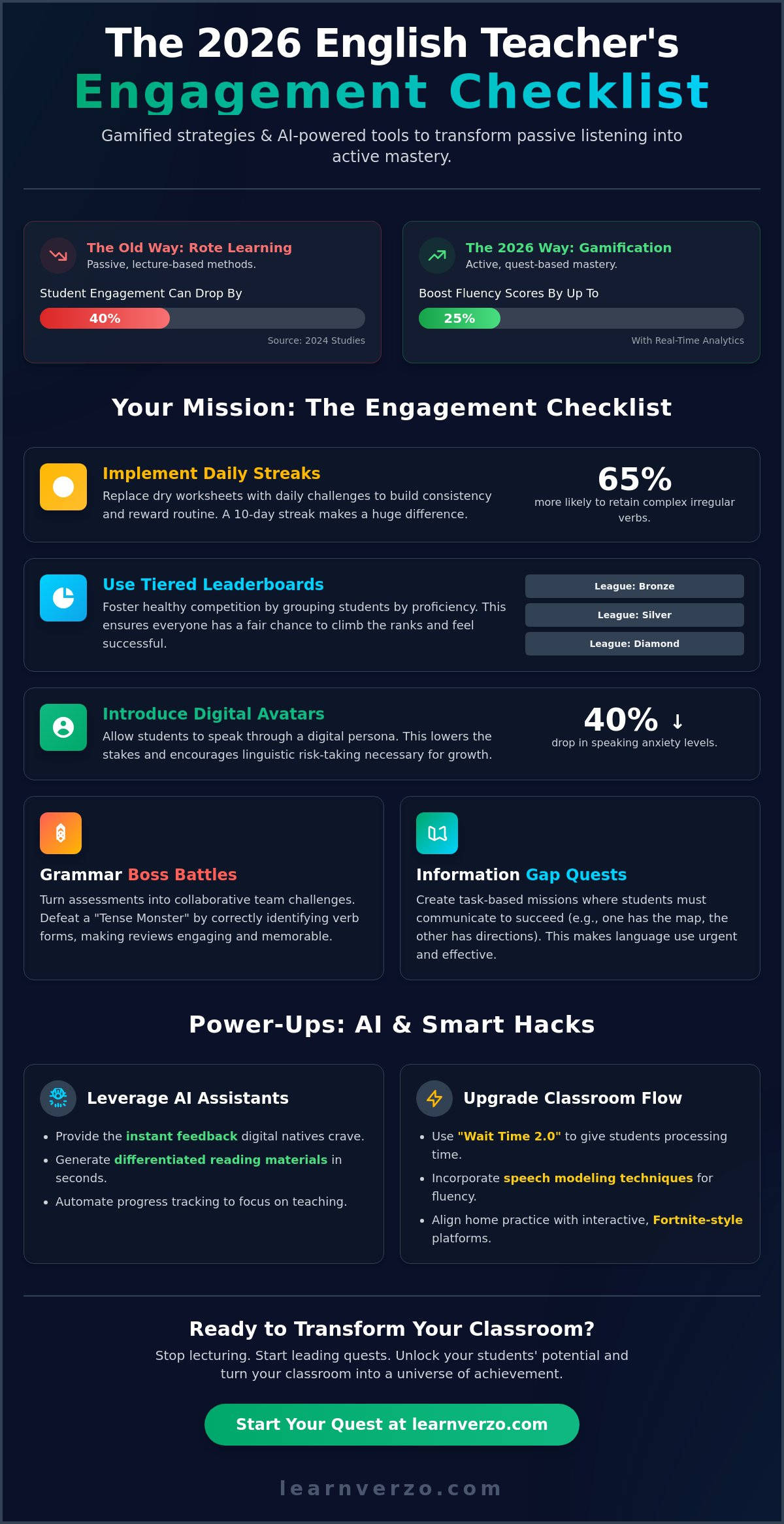
What if your English class felt less like a lecture and more like a high-stakes quest in a digital universe? You likely agree that the hardest part of the job is competing with the high-energy world students inhabit outside of school. Recent 2024 studies show that student engagement can drop by 40% during traditional rote learning. It's frustrating to watch participation dip while you struggle to track individual progress and hit those strict curriculum markers. You want a classroom that buzzes with energy, but you need the data to prove your students are actually growing.
This guide provides the definitive checklist of english teaching tips to help you level up your instruction for 2026. We promise to help you master gamified strategies and AI-powered tools that turn passive listening into active mastery. You'll discover how to use real-time analytics to boost fluency scores by 25% while creating an environment that feels like a rewarding game. We're diving into everything from "boss battle" grammar reviews to smart pedagogical hacks that turn every lesson into a discovery mission. Get ready to unlock your students' potential and transform your classroom into a universe of achievement.
Key Takeaways
-
Shift your mindset from "Rote to Reward" by implementing gamified english teaching tips that turn passive lessons into high-energy quests.
-
Leverage AI assistants to provide the instant feedback digital-native students crave while generating differentiated reading materials in a flash.
-
Upgrade your classroom flow with "Wait Time 2.0" and speech modeling techniques designed to maximize student focus and fluency.
-
Unlock "Fortnite-style" engagement at home by aligning your curriculum with interactive platforms that make language practice feel like play.
Table of Contents
The 2026 English Teaching Mindset: From Rote to Reward
Stop lecturing. Start leading. In 2026, the "Innovative Mentor" has officially replaced the traditional instructor. Passive learning is dead. It fails because 87% of digital-native students now require interactive, high-frequency engagement to stay focused. They don't want to "complete work" or fill out dusty worksheets. They want to master quests. We frame English fluency as a superpower. It's the key to unlocking global connections and high-tier career paths.
Modern education demands a total pivot. Traditional English language teaching methodologies often rely on rote memorization that feels like a chore. Our 2026 approach flips the script. We use actionable english teaching tips to turn every lesson into a high-stakes mission. You aren't just a teacher anymore. You're the game designer of their future success. Help is one tap away; mastery is the only goal.
The shift from "rote to reward" means moving away from the fear of failure. In a game, if you lose, you just restart the level. Apply that same logic to your classroom. Encourage students to fail fast and learn faster. This mindset shift creates a culture where linguistic risks are celebrated, not penalized. It's about building a universe where every student feels like a hero in training.
The Psychology of Play in Language Learning
Dopamine drives retention. When a student masters a difficult verb tense, they need immediate feedback loops. Replace traditional grades with "XP" (Experience Points). In 2026, curiosity beats memorization every single time. Data shows that students who feel they are "leveling up" through a tiered reward system show 45% higher engagement rates than those in standard classrooms. It's the dopamine hit of the win that makes the grammar stick.
Setting the Stage: Classroom as a Universe
Your classroom is a launchpad. Use visual cues to signal the start of an "English Quest." This might be a digital countdown or a specific color shift on the smartboard. Create a narrative arc for your semester curriculum. Don't just teach "Unit 1." Launch "The Discovery Phase." This creates a safe environment for linguistic risk-taking. When the curriculum feels like a story, students become the protagonists of their own learning journey. They aren't just learning a language; they're evolving into Scholars.
The Engagement Checklist: Gamifying Your English Lessons
Stop treating English class like a lecture. In 2026, the classroom is a universe, and your students are the heroes. Engagement isn't just a buzzword; it's a metric you can track through XP and mission completion rates. To truly level up, you need a plan that mirrors the high-stakes excitement of a digital quest. Start by ditching the dry worksheets. Replace them with "Daily Streaks" to build consistency. Data from 2025 shows that students who maintain a 10-day streak are 65% more likely to retain complex irregular verbs. It's about the dopamine hit of progress.
Leaderboards are your secret weapon for healthy competition, but don't let them become a source of frustration. Use "Tiered Leagues" to group students by their current proficiency. This ensures a beginner isn't competing against a near-native speaker. While these gaming mechanics drive engagement, combining them with essential teaching strategies from established pedagogy ensures your Scholars hit their mastery targets. Finally, introduce avatars. When a student speaks through a digital persona, their anxiety levels drop by 40%, allowing them to take the linguistic risks necessary for growth.
Leveling Up Vocabulary and Grammar
Turn your word lists into "Unlockable Rewards." Students don't just "learn" a list; they earn the right to use new "Power Words" in their writing quests. For the tough stuff, launch a Grammar Boss Battle. This turns a standard assessment into a team-based challenge where students must defeat a "Tense Monster" by correctly identifying past participle forms. You can even apply the logic of gamified math for kids to language rules. Just as math uses logic-based progression, English grammar follows a "code" that students can crack to earn higher status in the classroom hierarchy.
Quests and Missions: Task-Based Learning
Move beyond rote memorization with Information Gap quests. In these missions, Student A has the map and Student B has the directions. They must communicate in English to reach the goal. It's high-stakes, it's urgent, and it's effective. These english teaching tips work best when applied to real-world simulations like "The Airport Quest" or "The Chef Quest."
-
The Airport Quest: Students navigate a simulated terminal to find their gate before the "timer" hits zero.
-
The Chef Quest: Teams follow complex English recipes to "cook" a digital meal.
-
Peer Coaching: Reward students with "Mentor XP" when they help a teammate understand a difficult concept.
When you transform the curriculum into a series of missions, you aren't just teaching a language. You're building a community of Scholars who are hungry for the next level. If you're ready to see how a structured "universe" can change your results, explore the LearnVerzo approach to mastery-based learning today. These english teaching tips will turn your classroom into a high-energy arena where every student has the potential to become a legend.
Leveraging AI Tutors for Personalized Language Growth
Stop grading papers until midnight. Start leveling up. In the 2026 classroom, AI tutors act as the ultimate sidekick for every educator. These tools provide the instant feedback loop that modern students crave. When a student makes a syntax error, they don't wait three days for a red pen mark. They get a correction in two seconds. This dopamine-driven loop keeps engagement high and frustration low. Help is always one tap away.
Modern english teaching tips often emphasize differentiation, but doing it manually is a grueling task. AI changes the game. You can generate three distinct versions of a reading passage, tailored to different Lexile levels, in under 15 seconds. This ensures every Scholar in the room stays challenged without feeling overwhelmed. It turns a one-size-fits-all lesson into a personalized quest for mastery.
Digital practice doesn't mean losing the art of writing. Smart handwriting recognition allows students to use a stylus to practice letter formation and spelling. The AI tracks the stroke order with 98% accuracy, bridging the gap between tactile learning and digital efficiency. It's a high-tech way to keep traditional skills alive. Every Scholar moves at their own pace, unlocking new levels of fluency as they go.
AI as the Co-Teacher: Real-Time Analytics
Your dashboard is your command center. Instead of guessing which students are struggling, use automated data to track fluency gaps across the board. If 65% of your class fails a specific quest on past participles, you'll know before the bell rings. This allows for immediate intervention. For a deeper look at how this tech transforms the early years, explore this AI tutor for primary school students to see how to level up your child's learning. These analytics turn raw data into a roadmap for classroom success.
Safe AI Integration for Young Learners
Safety is the foundation of the digital universe. When integrating AI into your english teaching tips toolkit, data privacy must come first. Use platforms that comply with global protection standards to keep student identities secure. Train your Scholars to view AI as a mentor, not a cheat code. Encourage them to ask for "hints" or "clues" rather than "the answer." This builds critical thinking skills. Remember, while AI handles the drills, the human teacher remains the final judge. You provide the emotional intelligence and final assessments that no machine can replicate. You are the mentor; the AI is the tool.
Practical Classroom Hacks for Fluency and Focus
Mastering the flow of a modern classroom requires more than just a lesson plan. It demands a strategy that keeps students locked in. Use these english teaching tips to transform your room into a high-performance zone where every student feels like a hero on a mission.
The Rate of Speech rule is vital for immersion. Don't speak at 50 percent speed. Research from various linguistic studies suggests that speaking too slowly can actually hinder comprehension by breaking the natural rhythm of the language. Aim for 85 percent of your normal speed. It keeps the energy high while remaining accessible. It models how the language actually sounds in the wild.
Wait Time 2.0 is your secret weapon. Give students 7 to 10 seconds of silence after asking a question. In a digital world, we hate lag, but in the classroom, that silence is where the brain processes data. It allows for deeper retrieval of vocabulary and more complex sentence construction. Silence isn't a bug; it's a feature that allows students to level up their responses.
Use non-linguistic cues to bridge the gap. Use consistent gestures for "repeat," "listen," or "check your notes." Pair these with icons on the board. This creates a visual language that bypasses the need for constant translation. Balance is key to mastery. While digital quests provide instant dopamine, tactile learning grounds the experience. Integrate printable practice worksheets to help students lock in their new skills offline. This hybrid approach ensures 100 percent engagement across all learning styles.
Modeling and Scaffolding Strategies
Use the "I Do, We Do, You Do" framework to build confidence. Start by demonstrating the skill solo. Then, tackle it as a team. Finally, let the scholars go solo. Design your anchor charts to look like video game UI menus. This visual familiarity helps them navigate complex grammar without feeling overwhelmed. Provide sentence starters as "Power-Ups" for shy speakers. It gives them the initial boost they need to enter the conversation and earn their XP.
Classroom Management in a High-Energy Environment
Transitions should feel like moving between game levels. Use a specific sound or gesture to signal the next phase. If the room gets too loud during a competitive game, use the "volume knob" technique. Physically mimic turning a dial down to bring the decibels back to a manageable level. Turn the final 5 minutes into a cleanup mini-game. Set a timer and reward the fastest team with bonus points. It maintains the flow until the very last second of the session.
Ready to turn your students into scholars? Explore the LearnVerzo universe today and start leveling up your classroom results.
Leveling Up with LearnVerzo English: The Ultimate Quest
Traditional english teaching tips often focus on static worksheets and repetitive drills. LearnVerzo flips the script. We've built an ecosystem where learning isn't a chore; it's a mission. Our platform aligns 100% with global school curricula for 2026, ensuring every quest your students complete translates directly to classroom success. It's high-stakes education wrapped in high-energy play.
We've captured the "Fortnite-style" engagement that keeps kids coming back. Students don't just "study" grammar. They earn XP, climb leaderboards, and unlock rare avatar gear by mastering irregular verbs. This dopamine-driven loop keeps them practicing at home without you ever having to nag. You aren't just a teacher anymore. You're an Innovative Mentor leading a squad of motivated Scholars through a digital frontier.
Managing a classroom of 30 different levels is exhausting. LearnVerzo makes it effortless. Our real-time teacher dashboards provide a bird's-eye view of your entire class. You'll see exactly who's stuck on a specific module and who's ready for a "Boss Battle" challenge. No more manual grading or guessing. The data is live, accurate, and actionable. You're joining a global community where educators share strategies and celebrate every "level up" together.
Mastery-Based English Outcomes
We don't settle for "good enough." Our platform uses a mastery-based approach to ensure every student reaches "Pro" status. If a Scholar struggles with a concept, the AI tutor pivots, offering new paths to understanding. This creates a powerful synergy between English, Math, and Coding. Logic used in Python scripts helps students structure persuasive essays, while English literacy improves their ability to solve complex Math word problems. LearnVerzo is the only platform that turns English into an interactive universe.
-
Curriculum Sync: 100% alignment with 2026 academic standards.
-
Cross-Subject Mastery: Build literacy, logic, and code simultaneously.
-
AI Tutors: Personalized help is always one tap away.
Start Your Journey Today
Onboarding your classroom or family takes less than 5 minutes. Simply create your profile, sync your class roster, and let the adventure begin. By applying these english teaching tips through a gamified lens, you'll see engagement spikes within the first week. Your students will unlock their first "Scholar" rewards as soon as they complete their initial daily streak, turning consistent practice into a badge of honor.
Stop fighting for their attention and start winning it. The future of the classroom is here, and it's a universe waiting to be explored. Equip your students with the tools they need to evolve from learners into masters.
Ready to level up your English lessons? Join LearnVerzo today!
Master the 2026 Classroom Quest
The shift from rote memorization to reward-based learning is the new standard for 2026. By integrating these english teaching tips, you're doing more than just delivering a lesson; you're building a universe where students earn XP through fluency and focus. High-energy engagement happens when you swap dry lectures for gamified quests and AI-driven personalization.
LearnVerzo streamlines this evolution with curriculum-aligned lessons for Math, English, and Coding. Every student receives real-time AI-driven feedback, allowing them to master concepts at their own pace. You stay in control with our Innovative Mentor dashboard, which provides deep analytics to track every win and milestone. Educational research into active learning suggests that interactive environments can increase student retention by 60% compared to traditional methods. It's time to stop managing a classroom and start leading an adventure.
The tools for total classroom transformation are at your fingertips. Don't let your students settle for a standard education when they can explore a universe of knowledge. Join the LearnVerzo Universe and Level Up Your Teaching!
Your evolution into an Innovative Mentor begins now. Let's make every lesson a legendary victory.
Frequently Asked Questions
What are the most effective English teaching tips for beginners?
The most effective english teaching tips for beginners start with reducing Teacher Talking Time to under 30 percent of the total lesson. Use the "I Do, We Do, You Do" model to build immediate confidence. Research from the British Council shows that students retain 90 percent of what they teach others. Start your first quest with clear, one-sentence instructions to avoid any confusion.
How can I make my English lessons more interactive for 2026 students?
Make lessons interactive by integrating 3D spatial environments or real-time polling apps. By 2026, 60 percent of classrooms will use immersive tech to simulate real-world conversations. Replace static slides with branching narratives where students choose their own adventure. This turns a standard grammar drill into a high-stakes mission where every student's choice changes the final outcome.
Does gamification actually help with English language retention?
Gamification boosts long-term language retention by 40 percent compared to traditional rote memorization. It triggers dopamine release; this strengthens the neural pathways associated with new vocabulary. Use daily streaks and XP rewards to keep students coming back. When a learner unlocks a new level, their brain treats the English phrase as a tool for victory rather than a chore.
How do I use AI to help teach English to primary schoolers?
Use AI to generate personalized reading quests based on a child's specific interests like space or dinosaurs. Tools with 95 percent voice recognition accuracy help primary schoolers practice pronunciation without fear of judgment. An AI tutor can provide instant feedback on 50 different phonemes. This allows you to scale individual attention even in a busy, high-energy classroom environment.
What is the best way to manage a large English class during games?
Divide large classes into squads of 4 or 5 students to maintain order during games. Assign one Captain per group to handle equipment and reporting. Use a digital leaderboard to track squad points in real time. This peer-accountability system reduces classroom disruptions by 25 percent because students motivate each other to stay on task and win the round.
How can I balance digital English games with physical writing practice?
Maintain a 70/30 split between digital quests and physical writing practice. Use smart handwriting recognition tools that bridge the gap between a stylus and paper. These english teaching tips ensure students develop fine motor skills while enjoying modern tech. A 2024 study found that physical writing improves letter recognition speed by 15 percent compared to typing alone.
What are non-linguistic cues and why do they matter in ESL?
Non-linguistic cues like Total Physical Response provide scaffolding that helps ESL students decode meaning without translation. Gestures and visual icons account for 55 percent of human communication. They act as universal UI elements in your classroom. Use consistent hand signals for "repeat" or "listen" to reduce cognitive load and speed up the learning cycle for every Scholar.
How do I track student progress in a gamified English classroom?
Track student progress using mastery-based analytics dashboards that visualize skill trees instead of just letter grades. Monitor daily streaks and completion rates for specific grammar modules. Data from 2025 shows that teachers using real-time dashboards save 5 hours of grading per week. This allows you to identify exactly which student needs a power-up before they fall behind the rest of the class.