
Coding Games For Kids The Top Quests To Level Up Their Future In 2026
--- title: "Coding Games for Kids: The Top Quests to Level Up Their Future in 2026" slug: "coding-games-for-kids-the-top-quests-to-level-up-their-future-in-2026
title: "Coding Games for Kids: The Top Quests to Level Up Their Future in 2026" slug: "coding-games-for-kids-the-top-quests-to-level-up-their-future-in-2026" description: "Explore the top coding games for kids to level up their future. Our 2026 guide turns screen time into a fun quest, teaching real logic & programming skills." excerpt: "What if your child's favorite hobby was actually their most valuable career skill? By 2026, the demand for computational literacy is projected to grow by 25% across every major ind" publishedAt: "2026-05-05T10:00:00.000Z" author: "LearnVerzo Team" categories:
- "Blog" coverImage: "https://getautoseo.com/storage/hero_images/article_1243912_1777800054.jpg" draft: false

What if your child's favorite hobby was actually their most valuable career skill? By 2026, the demand for computational literacy is projected to grow by 25% across every major industry. Yet, most parents still feel a pang of guilt when they see their kids glued to a screen. You have probably watched your child abandon "educational" apps in under five minutes because they feel like a digital lecture. It's frustrating to explain complex logic like "loops" or "if-statements" when the content is dry and boring. We know you want screen time to be more than just passive scrolling.
We agree that learning should be a high-stakes adventure, not a chore. This guide promises to uncover the best coding games for kids that transform screen time into a high-octane quest for mastery. You'll learn how to help your child transition from basic block coding to real-world programming languages with measurable progress in logic and problem-solving. We're breaking down the top platforms that make coding lessons feel as exciting as a Fortnite victory royale. It's time to stop the homework battles and start leveling up their future today.
Key Takeaways
-
Understand why interactive logic is the essential literacy of 2026, turning your child from a digital consumer into a high-value creator.
-
Discover the top coding games for kids that successfully bridge the gap between simple block-based puzzles and real-world programming languages.
-
Learn how coding logic acts as a cognitive power-up, boosting performance in Math and strategic mastery in games like Chess.
-
Follow a mastery-based roadmap to assess your child's current "Tech XP" and choose the specific language that aligns with their future goals.
-
Explore how a gamified ecosystem with an AI Learning Assistant can prevent frustration and keep your young Scholar on a winning streak.
Table of Contents
-
Top 5 Coding Games to Level Up Your Child’s Skills (The 2026 Roundup)
-
Beyond the Screen: How Coding Games Build Real-World Superpowers
-
Choosing the Right Quest: A Mastery-Based Guide for Every Age Group
-
LearnVerzo Coding: Where Learning Feels Like a Game (But Smarter)
Why Coding Games for Kids are the New Literacy in 2026
Literacy has evolved. In 2026, reading and writing are just the baseline. To truly thrive, children must speak the language of machines. Coding games for kids provide an interactive environment where logic replaces the frustration of syntax memorization. Instead of staring at a dry, text-heavy screen, your child enters a vibrant universe where commands have immediate, visual consequences. It’s the difference between reading a manual about a bicycle and actually riding one through a digital forest.
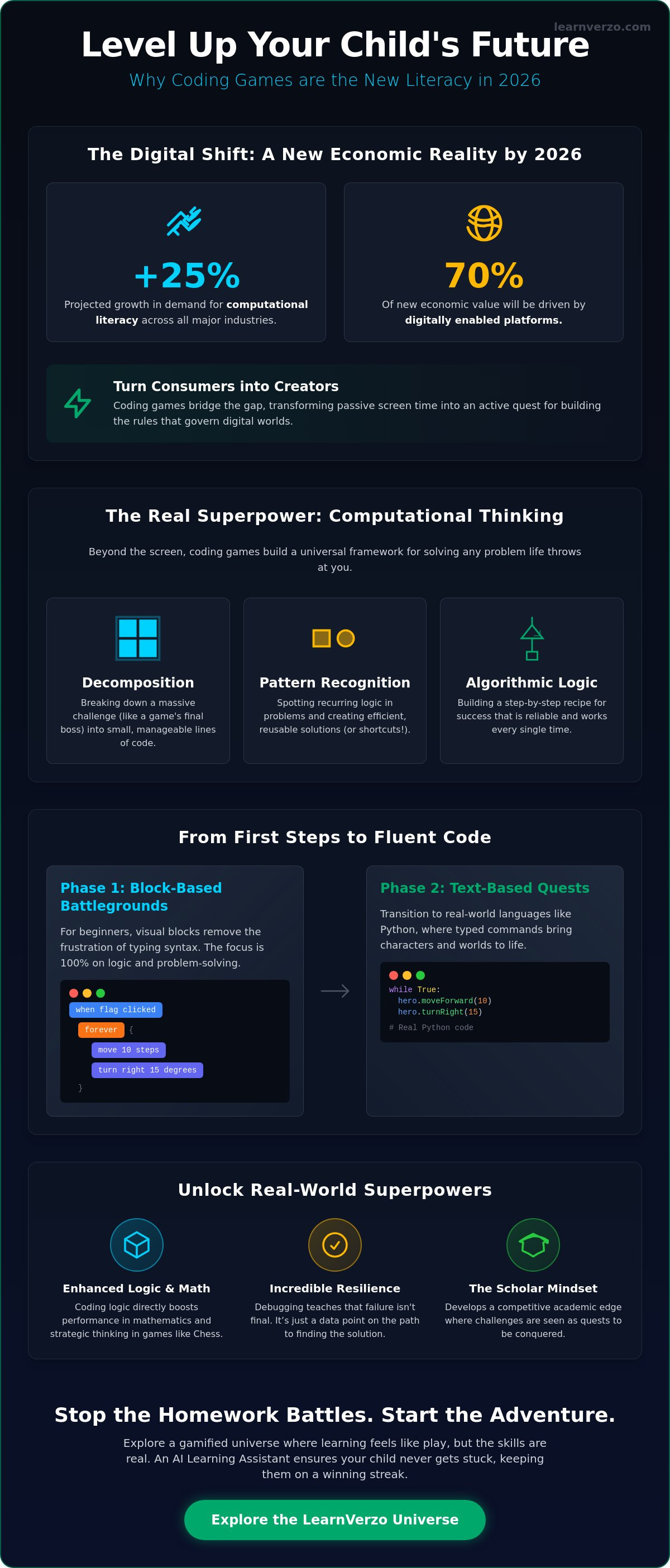
The global economy is undergoing a massive transformation. By 2026, experts predict that 70% of new economic value will be driven by digitally enabled platforms. This means the gap between "consumers" and "creators" is widening. Children who only know how to scroll are being left behind. Coding games bridge this divide by turning passive screen time into a high-octane quest for mastery. They don't just play the game; they learn how to build the rules that govern the world.
Traditional tutorials often fail because they treat coding like a chore. They lack the dopamine loop that makes modern entertainment so addictive. Immersive gaming universes succeed by using XP, leaderboards, and daily streaks to keep students engaged. When a child solves a puzzle to unlock a new level, they aren't just studying. They are experiencing the satisfaction of leveling up their own cognitive superpowers.
Computational Thinking: The Real Secret Behind the Games
Behind every colorful character is a foundation of computational thinking. This isn't just about computers; it's a framework for solving any life problem. Through play, kids master three core pillars:
-
Decomposition: Learning to break down a massive boss battle into small, manageable lines of code.
-
Pattern Recognition: Spotting the recurring code in daily routines and identifying efficient shortcuts.
-
Algorithmic Logic: Building a step-by-step recipe for success that works every single time.
Screen Time That Actually Counts
Most parents worry about passive consumption. Watching four hours of YouTube doesn't build skills. Coding games for kids flip the script by requiring active creation. This process builds incredible resilience through debugging. When a script fails, a child doesn't give up; they investigate, iterate, and try again. This creates a Scholar mindset where failure is just a data point on the path to mastery. By 2026, this grit will be the most competitive academic edge a student can possess.
Top 5 Coding Games to Level Up Your Child’s Skills (The 2026 Roundup)
In 2026, the digital marketplace is flooded with thousands of apps, but quantity doesn't equal quality. Most "educational" software is just a reskinned quiz. True coding games for kids must do more. They must integrate mechanics that keep a child coming back for "one more level" while building actual engineering skills. Whether your child is using an iPad in the backseat or a desktop in their room, the best platforms offer seamless cross-device compatibility. This ensures their progress, or XP, is always synced and ready for the next quest.
Choosing the right platform depends on your child's current "Tech XP." We've curated the top five environments that balance high-octane fun with mastery-based outcomes. If you want to see how these mechanics work in a unified ecosystem, you can explore our universe of coding games for kids today.
Block-Based Battlegrounds: Best for Beginners
For younger Scholars, the biggest hurdle isn't logic; it's the keyboard. Scratch and LearnVerzo provide the perfect entry point by using visual blocks. This method removes "syntax frustration" entirely. A child doesn't need to worry about where a semicolon goes or if they misspelled a command. Instead, they drag and drop logical actions to move characters or trigger events. This allows them to focus 100% on logic flow and problem-solving. By the time they finish their first quest, they've already mastered the fundamentals of loops and variables without typing a single line of text.
Text-Based Quests: Transitioning to Python and JavaScript
Once the logic is locked in, it's time to evolve. Text-based games like CodeCombat and LearnVerzo Coding turn real-world programming into an RPG adventure. Python remains the "Gold Standard" in 2026 because its syntax reads like English. In these environments, children type actual commands to cast spells or navigate 3D dungeons. There is a specific thrill in seeing real code move an avatar across the screen. These platforms often include multiplayer modes and leaderboards, turning a solo study session into a competitive social event. It’s not just about learning; it’s about winning the game through superior logic.
-
LearnVerzo: The ultimate gamified ecosystem for Math, English, and Coding.
-
Scratch: The classic MIT-born logic builder for visual learners.
-
CodeCombat: An immersive RPG that teaches Python through dungeon crawling.
-
Swift Playgrounds: A sleek, Apple-optimized quest for mobile developers.
-
Roblox Studio: A creative arena where kids use Lua to build their own multiplayer worlds.
Beyond the Screen: How Coding Games Build Real-World Superpowers
Coding isn't an isolated skill. It’s a force multiplier for every other academic subject. When children engage with coding games for kids, they aren't just learning to talk to machines. They are training their brains to handle complex, abstract systems. This digital training ground translates directly into classroom success and emotional resilience. It turns a standard student into a high-performing Scholar who views every obstacle as a puzzle to be solved.
Debugging is the ultimate lesson in grit. In a traditional classroom, a wrong answer can feel like a final defeat. In a coding quest, a bug is simply a challenge waiting for a solution. This shift in perspective builds vital emotional regulation. Children learn that failure isn't a stop sign; it's a data point. They investigate the error, iterate on their design, and try again. This persistence is a superpower that stays with them long after they log off.
The Math-Coding Synergy
Math often feels abstract and disconnected from the real world. Coding changes that dynamic instantly. In a game environment, a variable isn't just a lonely "x" in a textbook equation. It's the jump height of a hero or the firing rate of a spaceship. This makes algebra concrete and visible. Geometry becomes essential when a child must use coordinates to place objects in a 3D world or calculate angles for a character's movement.
Integrating these subjects creates a powerful mental feedback loop. This is why gamified math for kids is such a critical parallel skill for any young developer. The "Coding-Math Loop" has been shown to improve conceptual retention by 40% compared to traditional, siloed instruction. It transforms "I don't get it" into "I can build it."
Strategy and Focus: The Chess Connection
Strategy is the core of logical thinking. LearnVerzo integrates Chess as a fundamental pillar because it perfectly mirrors the structure of a well-written program. Predicting an opponent's move requires the same mental simulation as predicting a program's output. You must think three steps ahead. You have to account for every possible branch of logic and prepare a response for each one.
This mastery-based approach builds the deep focus needed for high-level problem solving. Whether a child is defending their King or writing a script for a new game level, the cognitive process remains the same. They are training their minds to stay calm under pressure and analyze situations with surgical precision. They aren't just reacting to the world; they are planning their victory through superior strategy.
Choosing the Right Quest: A Mastery-Based Guide for Every Age Group
Not every digital world is built the same. To find the best coding games for kids, you need a roadmap that evolves as they do. Stop guessing and start strategizing. The goal is a seamless transition from a "total noob" to a confident developer by 2026. This requires a structured approach that respects their current skill level while pushing them toward the next level of mastery.
-
Step 1: Assess Tech XP. Determine if your child understands basic sequences before moving to complex logic. Are they just starting, or are they ready to build their own scripts?
-
Step 2: Match the Goal. If your child dreams of creating the next big indie game, they'll need JavaScript or Unity. If they're fascinated by big data or robotics, Python is the non-negotiable king.
-
Step 3: Prioritize Mastery. Choose platforms that offer a structured curriculum. Skip the random "mini-games" that lead to a dead end. Look for a clear path from A to B.
-
Step 4: Deploy a Safety Net. Ensure the platform includes an AI Learning Assistant or a teacher dashboard. Help should always be one tap away to prevent the "quit" moment when things get tough.
The Early Explorers (Ages 5-8)
At this stage, curiosity is the primary fuel. Focus on "unplugged" logic and basic block sequences. Younger children thrive on storytelling and customizable avatars that make the experience feel personal. Research shows that 85% of kids lose interest in educational apps if they encounter a "wall of text" too early. Keep it visual. Keep it vibrant. Let them drag and drop their way to their first victory without the frustration of typing errors. They are building the mental muscle of logic, which is the foundation for everything else.
The Rising Scholars (Ages 9-13)
This is the critical transition period. It's time to move from the visual safety of LearnVerzo Coding blocks to the power of text-based Python. Independent learning becomes the priority here. With AI-driven support, Scholars can tackle real-world projects like building personal websites or simple multiplayer games. Seeing a script they wrote actually function in a 3D environment provides a massive dopamine hit. They aren't just playing anymore; they're engineering. This is where a hobby turns into a competitive academic edge that will define their future career path.
Ready to start the journey? Join the LearnVerzo Universe and level up your child’s future today.
LearnVerzo Coding: Where Learning Feels Like a Game (But Smarter)
Welcome to the LearnVerzo Universe. It’s a high-stakes digital arena where education meets adrenaline. While many coding games for kids focus on repetitive puzzles that lose their charm after five minutes, we’ve built an interconnected ecosystem. Here, every command typed and every logic gate solved contributes to a greater quest. Your child isn't just a user; they are a Scholar on a path to mastery. They earn XP, climb global leaderboards, and unlock rewards that prove their growth. It is learning that feels like Fortnite, but way smarter.
We solve the biggest problem in EdTech: the "quit" moment. When a child gets stuck on a complex loop or a tricky if-statement, they usually close the app in frustration. Not here. Our AI Learning Assistant is active 24/7. Help is one tap away. The assistant doesn't just hand out answers; it provides strategic hints that spark genuine discovery. This keeps the dopamine flowing and ensures the quest never stops. It turns a potential failure into a "level up" opportunity that builds lasting confidence.
Parents and educators stay in total control. The LearnVerzo Dashboard provides real-time analytics that go beyond simple grades. You can track every milestone, see time spent on specific logic puzzles, and identify exactly where a student needs a boost. It’s mastery-based learning with total transparency. You will see the progress in their problem-solving skills before they even finish their first project. No more guessing if they are actually learning; the data speaks for itself.
A Universe of Subjects
Coding doesn't exist in a vacuum. In our universe, logic flows into every corner of the curriculum. You will see how coding principles integrate with engaging english learning and advanced math. A single platform handles the entire school curriculum, making learning more efficient and cohesive. By 2026, fragmented learning is obsolete. We offer a unified mastery-based outcome where unlocking a new level requires proving real, applicable knowledge across multiple disciplines.
Level Up Today
Onboarding is lightning fast. You can go from sign-up to the first quest in under three minutes. Families and schools are ditching dry tutorials for our gamified universe because it works. The results are measurable, and the engagement is undeniable. Stop settling for passive screen time. Join the quest today and turn your child’s potential into a competitive superpower. Families are switching to coding games for kids that prioritize creation over consumption. It is time to join the LearnVerzo Universe and start leveling up.
Master the Future: Your Child’s Quest Starts Now
By 2026, the digital landscape will belong to those who can build it. You've seen how the right coding games for kids bridge the gap between passive screen time and high-octane mastery. It isn't just about entertainment; it’s about equipping your young Scholar with the resilience to debug life’s biggest challenges. We've explored how logical thinking improves math performance and how strategy games like Chess sharpen the mind for complex programming.
The quest for a competitive future doesn't have to be a chore. With AI-driven instant support and curriculum-aligned mastery, the path to becoming a developer is clear. Every line of code written and every level cleared earns XP that translates into real-world confidence. Don't let your child stay a mere consumer in a creator’s world. It’s time to unlock their full potential and join a global arena of high-performing students.
Start Your Coding Quest: Join the LearnVerzo Universe Today!
Your child is ready to evolve. We can't wait to see them reach the top of the leaderboard.
Frequently Asked Questions
Are coding games actually effective for learning real programming?
Yes, they are highly effective because they focus on computational thinking before syntax. Instead of memorizing semicolons, children learn decomposition and logic flow. Research indicates that 80% of students who start with gamified logic transition to text-based languages like Python more successfully than those using traditional textbooks. These platforms turn dry concepts into interactive quests that build a solid foundation for professional engineering.
What is the best age to start playing coding games?
Children can begin their journey as early as age 5. At this stage, they use visual blocks to understand basic sequences and cause-and-effect. By age 9, most Scholars have the cognitive focus to handle text-based languages. Starting early builds a Scholar mindset where technology is a tool for creation. It prepares them for a future where 90% of careers will require digital fluency by 2026.
Do I need a high-end gaming PC for these coding platforms?
No, you don't need expensive hardware to start. Most modern coding games for kids are web-based or optimized for tablets and standard laptops. As long as your device can run a modern browser like Chrome or Safari, your child can access the entire universe. This ensures that every student can level up their skills without the barrier of high equipment costs or complex installations.
Can my child learn Python through games, or is it just for blocks?
Your child can definitely master Python through gamified quests. While blocks are great for beginners, advanced platforms transition students into real-world text. Python is the gold standard for 2026 because its syntax is clean and readable. In a game environment, typing Python commands to move a character makes the learning process feel like a high-stakes adventure rather than a lecture. It is real code with real results.
How do I prevent my child from just playing and not actually learning?
Choose a platform that uses mastery-based progression and real-time analytics. A dedicated teacher or parent dashboard allows you to track specific milestones and XP gains. This ensures that your child isn't just clicking buttons but is actually solving logical puzzles. When rewards are tied to proving knowledge, the play becomes a structured educational path with measurable outcomes that you can monitor daily.
Is there an AI tutor that can help if my child gets stuck in a coding game?
Yes, the LearnVerzo AI Learning Assistant provides instant support whenever a child hits a roadblock. This prevents the quit moment that often happens with traditional apps. The AI acts as an innovative mentor, offering strategic hints rather than just giving away the answer. It keeps the momentum high and ensures that help is always just one tap away, keeping the dopamine-driven satisfaction of leveling up constant.
How long should a child spend playing coding games each day?
A session of 30 to 60 minutes is the ideal sweet spot for cognitive retention. This duration provides enough time to complete a meaningful quest without causing screen fatigue. Consistency is more important than long, irregular sessions. Daily streaks and XP goals encourage a healthy habit that turns learning into a natural part of their daily routine. It makes progress feel steady and rewarding.
Are there free coding games for kids that are actually good?
Yes, Scratch is a fantastic free resource for visual logic. Many premium platforms also offer free introductory quests to help you assess your child's Tech XP before committing. However, for a curriculum-aligned experience with AI support and advanced analytics, a mastery-based ecosystem is usually more effective. These tools ensure your child stays on a clear path toward professional-grade skills while coding games for kids keep them engaged.