
Fun Math Games To Play In The Classroom Level Up Your Lessons In 2026
--- title: "Fun Math Games to Play in the Classroom: Level Up Your Lessons in 2026" slug: "fun-math-games-to-play-in-the-classroom-level-up-your-lessons-in-2026
title: "Fun Math Games to Play in the Classroom: Level Up Your Lessons in 2026" slug: "fun-math-games-to-play-in-the-classroom-level-up-your-lessons-in-2026" description: "Find fun math games to play in the classroom for 2026. This guide shows teachers how to boost engagement, improve skills, and make math an epic quest." excerpt: "92% of U.S. educators now believe game-based learning is a necessity for the modern classroom. It makes sense when you consider that challenge-based gamification can improve studen" publishedAt: "2026-05-04T10:00:00.000Z" author: "LearnVerzo Team" categories:
- "Blog" coverImage: "https://getautoseo.com/storage/hero_images/article_1243911_1777529024.jpg" draft: false

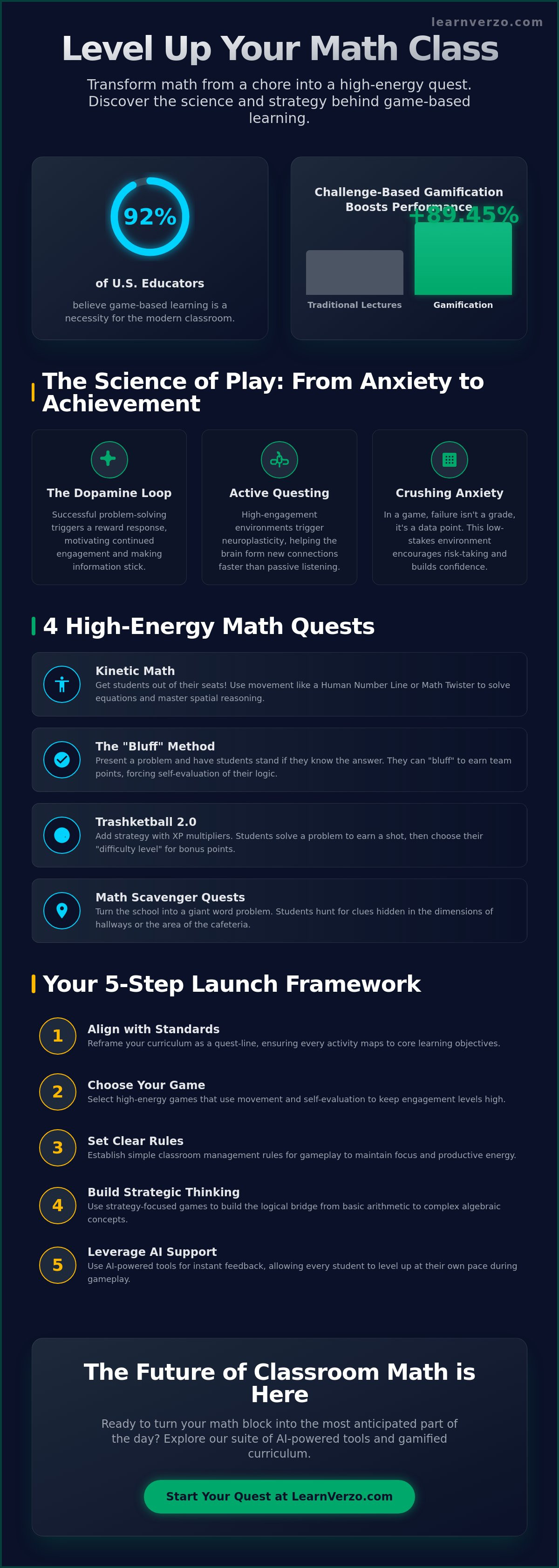
92% of U.S. educators now believe game-based learning is a necessity for the modern classroom. It makes sense when you consider that challenge-based gamification can improve student performance by 89.45% compared to traditional lectures. Yet, for many teachers, math drills still feel like a chore that triggers student anxiety and drains your prep time. You want your students to stop fearing the worksheet and start craving the challenge. Help is one tap away.
We agree that math should feel less like a repetitive task and more like an epic quest. This guide will show you the best fun math games to play in the classroom to turn your lessons into a high-energy learning universe. You'll discover a curated list of activities that boost participation and a step-by-step framework to help your students level up their skills in 2026. We are moving beyond simple points and leaderboards into meaningful, narrative-driven mastery. Let's transform your math block into the most anticipated part of the school day.
Key Takeaways
-
Reframe your math curriculum as a quest-based adventure to trigger dopamine release and lock in long-term mastery.
-
Discover high-energy, fun math games to play in the classroom that use movement and self-evaluation to keep engagement levels high.
-
Use strategy-focused gaming to build the logical bridge between basic arithmetic and complex algebraic concepts.
-
Follow a 5-step launch framework to align every activity with learning standards while maintaining clear classroom management rules.
-
Leverage AI-powered tools to provide instant support during gameplay, allowing every student to level up at their own pace.
Table of Contents
Why Gamified Math is the Secret to Classroom Mastery
Stop thinking about math as a series of repetitive drills. Start viewing it as a universe waiting to be explored. Gamified math isn't just adding a leaderboard to a static worksheet; it is a fundamental shift toward a quest-based approach to curriculum mastery. By 2026, the global gamified math apps market is projected to grow by 21.39%, reflecting a massive move toward high-energy instruction. When you integrate gamified math for kids, you change the student's objective from "finishing a task" to "conquering a level." This transformation turns your curriculum into a primary quest-line where every equation solved is a step toward becoming a Scholar.
The goal is simple. We want to replace the groans of a math block with the high-stakes excitement of a digital arena. To understand the foundation of this shift, we look at what are educational games and how they bridge the gap between play and pedagogical precision. Using fun math games to play in the classroom ensures that students aren't just memorizing formulas. They are applying them to win.
The Science of Play: Dopamine and Learning
Passive listening is the enemy of retention. When students sit through traditional lectures, their engagement levels often crater. Active questing changes the neurobiology of the room. High-engagement environments trigger neuroplasticity, allowing the brain to form new connections faster. Challenge-based gamification has been shown to improve student performance by 89.45% compared to lecture-based instruction. The dopamine-learning loop in educational technology is a neurochemical cycle where successful problem solving triggers a reward response that motivates continued academic engagement. This chemical "win" makes the information stick. Every solved problem provides a hit of satisfaction that keeps the student in the game.
Transforming Math Anxiety into Curiosity
Math anxiety is a wall that stops learning before it starts. Game mechanics like "infinite lives" or "respawning" tear that wall down. In a game, failure isn't a grade; it's a data point. Students can fail, learn from the mistake, and immediately try again without the stigma of a red pen. This safety encourages them to take risks and tackle harder problems. Avatars and personal progress bars give students a sense of ownership over their growth. They see themselves evolving from beginners to masters in real-time. By using fun math games to play in the classroom, you create a low-stakes competitive environment that demands high-stakes thinking. Students stop asking "Is this right?" and start asking "How do I beat this level?"
5 High-Energy Math Games for Instant Engagement
88% of teachers who use digital games report a massive surge in student engagement. But you don't need a screen for every quest. These fun math games to play in the classroom bridge the gap between physical movement and academic rigor. They turn your room into a dynamic arena where students aren't just learners; they are players on a mission. If you want to expand your toolkit further, explore more math games for school designed for various grade levels.
-
Kinetic Math: Get students out of their seats. Use movement to solve equations and master spatial reasoning. Physicality helps anchor abstract concepts in the real world.
-
The "Bluff" Method: Present a problem and ask students to stand if they know the answer. They can "bluff" to earn team points, but it forces them to evaluate their own certainty and logic.
-
Trashketball 2.0: This isn't just throwing paper into a bin. Add a strategic layer with XP multipliers. Students earn a shot by solving a problem; then they choose their "difficulty level" for bonus points.
-
Math Scavenger Quests: Turn the entire school building into a giant word problem. Students hunt for "clues" hidden in the dimensions of the hallway or the area of the cafeteria.
The goal is to keep the energy high and the stakes low. When students are moving, they are thinking. You can even train your mind with digital tools that mirror this fast-paced energy between physical rounds.
Kinetic Quests: Movement-Based Math
Movement isn't a distraction; it's a superpower. Use the Human Number Line to teach integers. Students physically jump to the left or right to visualize absolute value. Math Twister is another favorite. Call out a mental math problem like "15 divided by 3," and students must place a hand or foot on the corresponding multiple. These "brain breaks" aren't just fillers. They focus on core standards while giving students the physical release they need to stay focused for the next level of the lesson.
Collaborative Team Challenges
Teamwork turns a solitary struggle into a shared victory. Create 10-minute "Escape the Classroom" puzzles using math-based lockboxes. Students must solve a series of equations to find the code that "unlocks" their next quest. Relay Race Arithmetic is equally effective. Teams compete for speed and accuracy, passing a baton only when a problem is solved correctly. You can use printable practice worksheets as the source for these clues. It keeps the content curriculum-aligned while the format feels like a high-stakes competition.
Strategic Math Games: Building Logic and Focus
Strategy games are the ultimate test of mathematical stamina. They act as a vital bridge between basic arithmetic and the abstract logic required for algebra. While kinetic games build energy, strategic fun math games to play in the classroom build focus. They move students from "how to calculate" to "why to calculate." This shift is essential. It transforms math from a list of rules into a toolkit for solving complex problems. By 2026, the emphasis in education has moved toward narrative and emotional design, making strategy the primary quest-line for student mastery.
Strategic play introduces students to probability and risk assessment. They learn to weigh the cost of a move against the potential reward. This is where real-world math happens. Whether they are calculating the odds of a dice roll or predicting an opponent's next move, they are using high-level reasoning. Transitioning from physical dice games to digital learnverzo math challenges allows students to apply these logic skills in a data-driven environment. It's learning that feels like a high-stakes match, but it's grounded in curriculum-aligned precision.
Modern Classics: From Yahtzee to Wits & Wagers
Classic board games are powerful tools for building number sense. Probability Quests, using games like Yahtzee, teach students to visualize fractions and percentages in real-time. They aren't just looking at numbers on a page; they are calculating their chances of a "Full House." Estimation games like Wits & Wagers build a mathematical intuition that goes far beyond what a calculator can provide. You can adapt these standard board games for whole-class participation by creating teams. Each team acts as a single "player," debating their strategy before making a move. This collaborative logic ensures every student is engaged in the decision-making process.
The Chess Connection: Developing Strategy
Chess is a core pillar of the LearnVerzo identity. It is the perfect symbol for "Strategy & Focus." We use chess logic to elevate intellectual credibility and train the mind for complex patterns. You don't need a full tournament to see the benefits. Simple mini-games on a chessboard can teach coordinate geometry as students navigate pieces to specific "grid targets." These activities turn the board into a map for mathematical discovery. Building a classroom leaderboard for strategic "Daily Quests" keeps the momentum going. Students earn XP for solving logic puzzles, turning their daily warm-up into a competitive climb toward the status of Scholar. This constant "Leveling Up" ensures that focus becomes a habit, not just a one-time event.
How to Launch Your Classroom Math Games: A 5-Step Guide
60% of teachers report that gamification is the single most effective strategy for student engagement. However, launching fun math games to play in the classroom requires more than just picking an activity. It requires a framework. Without structure, "play" becomes "chaos," and the academic objective gets lost in the noise. You are the Innovative Mentor. Your job is to set the stage for mastery while keeping the energy high. Follow this 5-step guide to transform your math block into a structured, high-stakes arena.
-
Step 1: Align with a "Quest Objective." Every game must map back to a specific learning standard. If the game doesn't require the target skill to win, it's just a distraction.
-
Step 2: Establish "Rules of the Universe." Set clear boundaries for movement and noise. Management is the foundation of any successful gamified environment.
-
Step 3: Prepare your "Loot." Fuel the dopamine loop with XP, digital badges, or daily streaks. Rewards should acknowledge both effort and accuracy.
-
Step 4: Focus on Mastery over Speed. Encourage students to think deeply. Reward correct logic rather than just the first person to shout an answer.
-
Step 5: The Debrief. Always connect the game's mechanics back to the textbook concepts. Reflection turns a fun moment into a permanent memory.
Execution is everything. When you treat the classroom as a universe to be explored, students stop viewing math as a chore. They begin to see it as a series of challenges they are empowered to overcome. Ready to start your first mission? Join LearnVerzo Today to see how we bridge the gap between play and pedagogy.
Step 1: Aligning Quests with Your Curriculum
Choose a game that reinforces your current week's lesson. If you're teaching fractions, your game shouldn't just be about speed-solving multiplication. Avoid "fluff" games that offer rewards for simple clicks without requiring actual mathematical thinking. To audit a game for educational value, verify that the core gameplay mechanic is inseparable from the mathematical problem solving required. This ensures your quest-line remains curriculum-aligned and rigorous.
Step 2: Classroom Management for High-Energy Play
High energy doesn't mean out of control. Use "The Volume Meter" to keep the excitement within school limits; if the noise exceeds a level 4, the "quest" is temporarily paused. Implement a "Stop-Quest" signal, like a specific chime or hand gesture, to instantly transition from play to reflection. This keeps you in command of the arena. Manage team dynamics by assigning specific roles like "Strategist" or "Recorder" to ensure every Scholar participates equally in the mission.
Leveling Up with LearnVerzo: The Future of Classroom Math
The journey from a traditional classroom to a gamified universe is complete when you bridge the physical and digital worlds. LearnVerzo is the ultimate arena for this evolution. It's a space where learning feels like Fortnite but functions with surgical pedagogical precision. By combining the high-energy fun math games to play in the classroom discussed earlier with our digital ecosystem, you create a seamless flow of mastery. Students don't just solve problems; they complete quests, earn XP, and unlock new levels of understanding. Help is always one tap away.
Our AI tutor for primary school students provides instant, personalized support during every digital mission. If a student hits a wall with a complex equation, the AI doesn't just give the answer. It guides them through the logic, acting as an innovative mentor that scales with their individual pace. This ensures the dopamine-driven satisfaction of leveling up is never interrupted by frustration. You can finally stop worrying about students falling behind during complex activities.
Real-Time Analytics: Tracking the "Level Up"
Data is the secret weapon of the modern educator. The LearnVerzo Teacher Dashboard tracks student progress in real-time as they engage with fun math games to play in the classroom. You can see exactly which Scholars are excelling and which need a "Power-Up" intervention. We provide automated reporting for principals and parents that focuses on curriculum mastery rather than just participation. For schools looking to scale this success across multiple grade levels, institutional licensing offers a school-wide framework for gamification that aligns with national standards. It turns individual classroom wins into a global culture of achievement.
Join the LearnVerzo Universe Today
Setting up your first classroom quest takes under 5 minutes. The platform is designed for speed and efficiency, allowing you to focus on instruction while we handle the mechanics of the game. Mastery-based rewards ensure that student motivation remains high for the long haul. They aren't just playing; they are evolving. Every daily streak and every badge earned is a testament to their growth as a Scholar. Start your journey on the LearnVerzo platform and turn your math block into an epic adventure. The universe is waiting. Explore it today.
Master the Math Universe Today
The era of the boring math drill is over. You now have the blueprints to transform your room into a high-stakes arena using fun math games to play in the classroom. Whether you are leading a kinetic Human Number Line or a strategic chess-based warm-up, you are building more than just calculation skills. You are building Scholars. 92% of your peers already recognize that game-based learning is the necessity of the 2026 classroom. It's time to empower your students to stop fearing failure and start seeking challenges.
Don't let your students' progress get lost in the noise. Bridge the gap between physical play and digital precision with curriculum-aligned mastery tracking. Our platform provides AI-driven instant support for every learner; meanwhile, your real-time teacher analytics dashboard ensures you always stay in command of the mission. It is learning that feels like a game but delivers results like an elite academy.
Level up your classroom with LearnVerzo Math today! Your students are ready to explore the universe. Give them the superpowers they need to master the curriculum and evolve.
Frequently Asked Questions
What are the best math games for students with high math anxiety?
Low-stakes collaborative games that allow for "respawning" or do-overs are the most effective for anxious learners. Activities like "The Bluff" or team-based escape rooms remove the individual fear of the red pen and replace it with a shared quest. When failure is treated as a data point rather than a grade, students feel empowered to take risks and explore the mathematical universe without hesitation.
How do I ensure math games are aligned with my school curriculum?
Audit every game by checking if the winning mechanic is inseparable from the mathematical skill you are teaching. If a student can win through luck or speed alone without performing the target calculation, the game is "fluff." Always map your activities to a specific "Quest Objective" based on Common Core or NAEP frameworks to ensure every minute of play counts toward mastery.
Can I play these classroom math games without any internet connection?
Yes, many fun math games to play in the classroom are entirely physical and require zero Wi-Fi. Kinetic quests like the Human Number Line or Math Twister rely on movement and mental math rather than digital interfaces. These offline activities are perfect for building spatial reasoning and logical focus while giving your students a much-needed break from their screens.
How much time should I dedicate to math games in a standard 60-minute block?
Dedicate 10 to 15 minutes of your block to gamified learning to maximize engagement without losing instructional time. This 20% time investment acts as a high-energy "hook" at the start of class or a "boss battle" review at the end. Keeping the sessions short and punchy ensures that the dopamine-driven satisfaction remains high and the transition back to direct instruction stays crisp.
What are some fun math games for 3rd graders that focus on multiplication?
Array Relays and "Multiplication War" are the top choices for mastering products in 3rd grade. In an Array Relay, teams race to draw visual representations of equations on the whiteboard, which anchors the concept of repeated addition. These fun math games to play in the classroom turn multiplication from a memorization task into a competitive, high-speed challenge that students actually want to win.
How can I track student progress when they are playing physical math games?
Use an XP log or a "Scholar Passport" where students record their wins and the specific strategies they used to succeed. You can also implement a 2-minute "Post-Quest" exit ticket that requires them to solve a problem related to the game. This provides a concrete record of mastery that you can later input into your digital dashboard for long-term tracking.
Are there math games that work well for both high-achievers and struggling students?
Estimation games and "low floor, high ceiling" tasks are perfect for classrooms with diverse skill levels. Everyone can participate in a quest like "Wits & Wagers," but the depth of logic required to win keeps your most advanced Scholars challenged. This inclusive design ensures that every student in the room can level up their skills regardless of their starting point.
Is LearnVerzo Math safe for use in a public school classroom?
Yes, LearnVerzo is built with a secondary layer of professional sobriety that emphasizes safety and compliance. We prioritize data security and "mastery-based" outcomes to meet the rigorous standards of public education. While the student-facing language is playful and competitive, the backend is a secure, monitored environment designed to protect every Scholar as they explore our learning universe.