
Online Coding Games For Elementary Students The Ultimate Guide To Leveling Up In 2026
--- title: "Online Coding Games for Elementary Students: The Ultimate Guide to Leveling Up in 2026" slug: "online-coding-games-for-elementary-students-the-ultim
title: "Online Coding Games for Elementary Students: The Ultimate Guide to Leveling Up in 2026" slug: "online-coding-games-for-elementary-students-the-ultimate-guide-to-leveling-up-in-2026" description: "Discover the best online coding games for elementary students in 2026. Our guide turns screen time into a fun quest for logic, creativity, and real-world ski..." excerpt: "Your child's favorite screen time isn't a distraction; it is a high-stakes training ground for their future. In 2026, the best online coding games for elementary students turn" publishedAt: "2026-05-06T10:00:00.000Z" author: "LearnVerzo Team" categories:
- "Blog" coverImage: "https://getautoseo.com/storage/hero_images/article_1243914_1777876077.jpg" draft: false

Your child's favorite screen time isn't a distraction; it is a high-stakes training ground for their future. In 2026, the best online coding games for elementary students turn every click into a quest for logic and creativity. You have likely seen your child lose interest in dry tutorials that feel like extra homework. It is exhausting to manage technical questions when you just want to know their time isn't being wasted on empty entertainment.
We agree that learning should feel like a game, not a chore. This guide shows you exactly how to transform screen time into a series of rewarding challenges that build real-world superpowers. You will discover the top platforms for 2026, including AI-powered tools and the latest April 22 COPPA privacy updates that keep young scholars safe. From free editors like Scratch 3.0 to high-energy coding universes, we are diving into the strategies that make problem-solving addictive. It's time to stop scrolling and start leveling up.
Key Takeaways
-
Transform passive screen time into a high-stakes quest where students master computational logic through immersive play.
-
Find the perfect online coding games for elementary students by aligning game mechanics with curriculum goals and reading levels.
-
Unlock the secrets of sequencing and loops using interactive feedback loops that keep frustration low and engagement high.
-
Discover how AI-driven tutors and 2026 safety standards ensure your child's digital journey is both smart and secure.
-
Build a "Universal Scholar" by combining coding mastery with core subjects like Math and English for a truly integrated learning experience.
Table of Contents
-
Why Online Coding Games are the New Superpower for Elementary Students
-
The Anatomy of a Great Coding Game: From Logic Puzzles to Digital Quests
-
Core Coding Concepts Every Elementary Student Can Master Through Play
-
How to Select the Perfect Coding Game for Your Child's Skill Level
-
Leveling Up with LearnVerzo: Coding That Feels Like a Game (But Way Smarter)
Why Online Coding Games are the New Superpower for Elementary Students
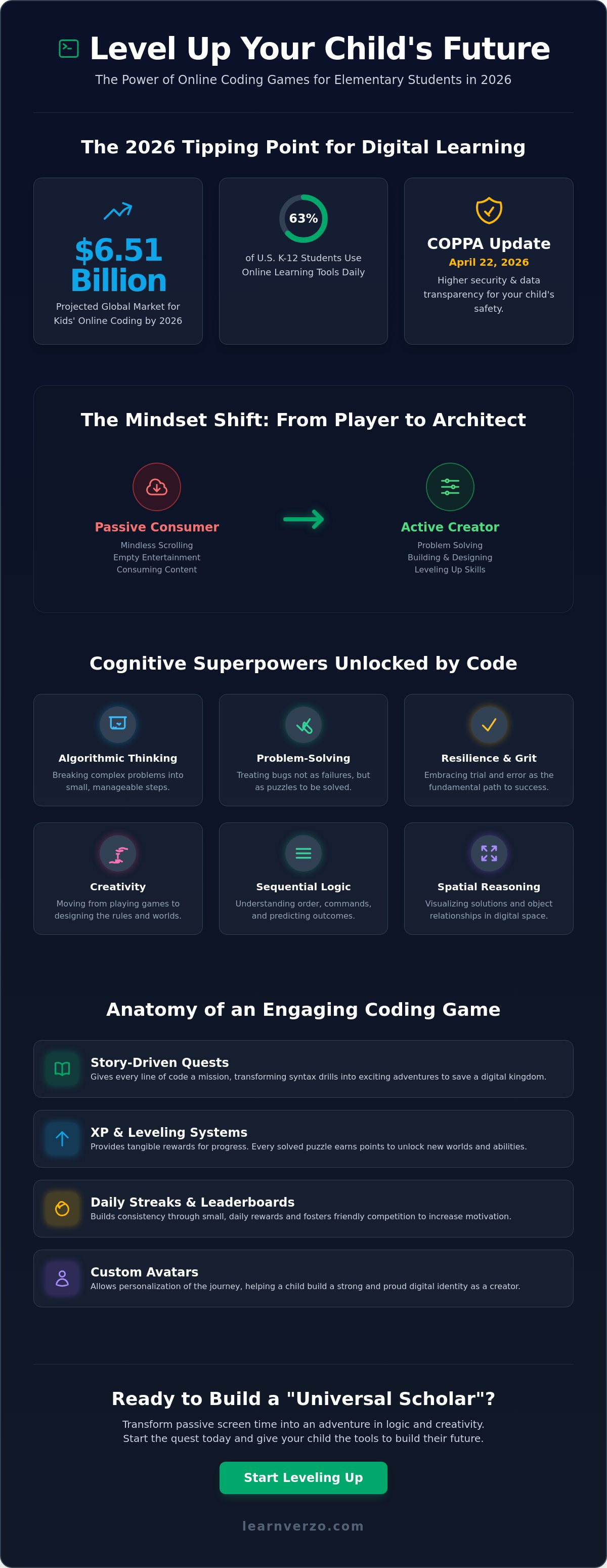
Online coding games for elementary students are not just digital toys. They are high-velocity, interactive environments where computational logic is taught through the psychology of play. In 2026, the global online coding market for kids is projected to reach $6.51 billion. This growth proves that coding is no longer a niche elective. It is a foundational literacy. It is as vital to a child's development as reading or basic arithmetic. We embrace a "Screen Time That Counts" philosophy. This approach balances raw, dopamine-driven fun with rigorous, mastery-based outcomes. Your child stops being a passive consumer of content. They become an active digital creator. They aren't just scrolling; they are leveling up.
The year 2026 marks a turning point for digital safety and education. With the April 22, 2026, deadline for updated COPPA regulations, the industry has shifted toward higher security and more transparent data practices. This makes it the perfect time to introduce your child to these platforms. When learning feels like a quest, students engage deeper. They stay longer. They learn faster. This is how we turn a simple tablet into a launchpad for a future "Scholar."
Beyond the Screen: The Cognitive Benefits of Early Coding
Coding builds a specific type of grit called resilience. In a standard classroom, a wrong answer might feel like a final failure. In a coding quest, a "bug" is just a puzzle waiting for a solution. This debugging process teaches students to embrace trial and error as a path to success. There is a direct link between this algorithmic thinking and improved performance in gamified math for kids. Both subjects require the same mental architecture to master complex patterns. By interacting with educational programming languages, students develop spatial reasoning and sequential logic in a low-stakes environment. They learn to predict outcomes and visualize solutions before they even type a line of code.
Coding as a Creative Outlet
The real magic happens when a child moves from playing a game to building the rules of the game. This empowerment changes their entire perspective. They begin to see themselves as "Scholars" and architects of their own digital universe. They aren't just users of technology anymore; they are the designers of it. Computational thinking is the ability to break complex problems into bite-sized, solvable steps. When a student masters this, they stop being intimidated by large, daunting tasks. They realize that every massive project is just a series of small, manageable quests. This mindset is the ultimate superpower for the digital age. It prepares them for a future where technology is a tool they control, not a mystery they simply observe.
The Anatomy of a Great Coding Game: From Logic Puzzles to Digital Quests
A great game isn't just about flashy graphics. It's about the "Hook." Dry syntax drills fail because they lack purpose. Story-driven quests succeed because they give every line of code a mission. When your child codes to save a digital kingdom, they aren't just typing. They are leveling up. This engagement is why 63% of U.S. K-12 students now interact with online learning tools daily. High-energy feedback loops keep the momentum alive. XP points, daily streaks, and leaderboards transform the "grind" of learning into a dopamine-driven victory. This is why online coding games for elementary students are the gold standard for 2026 education.
The best platforms target the "Zone of Proximal Development." This is the sweet spot where a challenge is just hard enough to be exciting but not so difficult that it causes a rage-quit. Recent research on the benefits of coding confirms that this balance is critical for developing mathematical reasoning and problem-solving skills. If the game is too easy, the child gets bored. If it's too hard, they feel defeated. Great games use specific mechanics to keep students hooked:
-
XP and Leveling: Every solved puzzle earns experience points to unlock new worlds.
-
Daily Streaks: Small, consistent rewards for logging in and practicing every day.
-
Live Leaderboards: Friendly competition with other Scholars to build social drive.
-
Custom Avatars: Personalizing the journey to build a strong digital identity.
Visual vs. Textual: The Learning Curve
Most beginners start with block-based coding like Scratch 3.0. It's the perfect entry point for online coding games for elementary students. It removes the frustration of typing errors and focuses entirely on logic. Avatars and unlockable rewards keep students motivated to finish one more level. As they progress, AI tutors for primary school students step in as the "Innovative Mentor." These digital guides help bridge the gap between simple blocks and complex text-based languages like Python or JavaScript. You can explore our coding universe to see this progression in action.
Real-Time Support and AI Integration
Parents often worry they can't help with technical questions. In 2026, "Help is one tap away" isn't just a slogan; it's a core feature. Modern AI doesn't just give the answer. It guides the logic. It identifies exactly where a student is stuck and offers a gentle nudge. AI in 2026 provides instant, personalized hints that adapt to a child's unique learning pace. This real-time support prevents the frustration that usually ends a study session. It ensures that every Scholar stays in the flow, mastering concepts at a speed that works for them. No more "I'm stuck" meltdowns; just pure, focused progress.
Core Coding Concepts Every Elementary Student Can Master Through Play
Coding is more than just memorizing commands. It is about building a mental architecture of logic. When kids engage with online coding games for elementary students, they aren't just "playing." They are mastering the same computational thinking used by software engineers at top tech firms. In 2026, 88% of U.S. public schools provide 1-to-1 devices. This access allows every student to explore these concepts at their own pace. By exploring the best coding games for kids, students encounter four foundational pillars of logic:
-
Sequencing: This is the quest map. It is the art of putting instructions in the exact order needed to achieve a goal. One wrong turn means the character fails the mission.
-
Loops: This is the efficiency hack. Instead of writing "move right" ten times, a Scholar uses a loop to repeat the action. It teaches them to value smart, clean solutions over repetitive "grind."
-
Conditionals (If/Then): This is the decision engine. If the character touches a lava pit, then they lose health. It builds "what-if" logic that is essential for strategy and focus.
-
Variables: These are the digital containers. They store information like XP, health points, or the player's name. Understanding variables helps kids grasp how data changes within a moving system.
Debugging: The Secret to Problem-Solving
In the LearnVerzo universe, we don't fear mistakes. We hunt bugs. Debugging is the process of finding and fixing errors in a sequence. It reframes failure as a necessary step toward mastery. This resilience translates directly to offline success. When a student learns to stay calm while fixing a "broken" level, they show better focus when completing printable practice worksheets. The dopamine hit of finally solving a bug is a powerful motivator. It proves that persistence is the ultimate superpower. Every bug fixed is a level up for their brain.
Functions and Modularity
Functions allow kids to build reusable logic blocks. Instead of reinventing the wheel every time, they create a "jump" function and call it whenever needed. This mirrors the way a "Scholar" approaches complex math problems. They learn to break a massive challenge into bite-sized, solvable modules. This transition from "doing" to "managing" complex systems is a major milestone. It moves the child from a basic user to a digital architect. They start to see the world as a series of interconnected systems. This is learning that feels like Fortnite, but it is way smarter. It prepares them for a future where they don't just use technology; they command it.
How to Select the Perfect Coding Game for Your Child's Skill Level
Picking the right quest is the difference between a child who gives up and a Scholar who masters the digital universe. You don't want your child stuck on a level that is too hard, nor bored by one that is too easy. In 2026, 63% of U.S. students engage in online learning daily. This makes finding the right online coding games for elementary students a high-stakes decision for parents. Follow this five-step selection framework to ensure your child stays in the "flow state" of learning.
-
Step 1: Assess Reading Level. Pre-readers (ages 5 to 7) require icon-based interfaces. Forcing text-heavy syntax on a child who is still mastering phonics creates unnecessary friction. Older kids need the challenge of text-based commands to prepare for real-world languages.
-
Step 2: Demand Curriculum Alignment. Ensure the game teaches actual computational logic. Avoid apps that focus on "random clicking" or simple entertainment. The goal is mastery-based outcomes.
-
Step 3: Verify Safety and Compliance. With the April 22, 2026, COPPA rule update, safety is non-negotiable. Only choose platforms with mandatory data security and strict parental consent policies.
-
Step 4: Evaluate the Engagement Engine. Does the game have the high-energy feel of Roblox or Fortnite? If the visuals are dry, the student will treat it like a chore. Look for XP, avatars, and vibrant digital worlds.
-
Step 5: Test the Dashboard. You need real-time analytics. A professional teacher dashboard allows you to track progress, see daily streaks, and "Level Up" the difficulty as your child evolves.
Age-Specific Recommendations (5-11)
For ages 5 to 7, focus on "unplugged" logic and simple directional sequencing. They should learn to move a character from point A to point B using visual arrows. Once they reach ages 8 to 10, introduce learnverzo coding. This transition uses block-based quests to build complex logic without the frustration of typing errors. For students aged 11 and up, the focus shifts to real syntax. They can begin mastering Python or JavaScript within a gamified environment that rewards every successful line of code.
The Role of Competition and Community
Healthy competition is a powerful motivator. Leaderboards and daily streaks foster a competitive spirit that keeps students coming back. Unlocked rewards, such as new gear for an avatar, turn the hard work of learning into a visible win. You should balance solo quests with collaborative challenges. This mirrors the real world, where developers work in teams to solve massive problems. Ready to see your child evolve? Join the LearnVerzo universe and start their first coding quest today.
Leveling Up with LearnVerzo: Coding That Feels Like a Game (But Way Smarter)
Welcome to the LearnVerzo Universe. It is not just a website; it is an interconnected arena where Math, English, and Coding converge into one massive quest. We don't just offer online coding games for elementary students; we forge "Universal Scholars." These are students who recognize that the logic used to debug a script is the same strategy required to win a chess match or solve a complex algebraic pattern. Our platform bridges the gap between high-stakes entertainment and structured academic growth. It is a universe where every click has a purpose and every lesson is a step toward mastery.
Our philosophy is simple: Learning should feel like Fortnite, but way smarter. We use high-energy graphics, reward-heavy feedback loops, and deep engagement mechanics to keep students hooked. While other platforms offer dry tutorials, we offer an adventure. This is dopamine-driven education at its finest. We redirect the natural competitive drive of children toward academic excellence. They aren't just "playing" a game; they are training their minds for a digital future. With our AI Learning Assistant, "Help is one tap away." No student ever stays stuck, and no parent has to feel overwhelmed by technical questions. Our AI acts as the "Innovative Mentor," providing personalized hints that adapt to each Scholar's unique pace.
The Scholar’s Journey: Learn, Practice, Level Up
The path to mastery follows a clear, three-step logic. First, students engage with interactive lessons that don't feel like "lessons." They are immersive challenges that introduce core concepts through play. Next, they practice those skills in a sandbox environment, earning XP and unlocking new avatars as rewards for their hard work. Finally, they Level Up. This progression is tracked in real time. Our Teacher Dashboard provides parents and educators with deep analytics. You can see the "superpowers" being built, from sequential logic to complex modularity. It is a transparent, data-driven way to ensure every child is evolving into a dedicated learner.
Join the LearnVerzo Universe Today
The future of education is mastery-based, AI-supported, and fundamentally fun. Whether you are a parent looking for an individual "Scholar" plan or a school leader interested in institutional licensing, the LearnVerzo Universe is ready for you. We provide the tools, the tech, and the "gaming" energy needed to make learning irresistible. It is time to move beyond passive screen time and embrace active digital creation. Join a global community of students who are leveling up their minds every single day. Don't just let them play games; let them build the future of play.
Master the Quest: Your Child's Digital Future Starts Today
The era of passive screen time is over. By 2026, coding has become the foundational literacy for every young Scholar. You now know that the best online coding games for elementary students are those that balance high-energy play with rigorous, curriculum-aligned logic. Whether your child is mastering sequencing or transitioning into real-world Python, the focus remains on building resilience. With the global coding market projected to reach $6.51 billion this year, your child's digital literacy is their most valuable asset. It is time to leverage the 1-to-1 computing programs found in 88% of U.S. schools for real academic growth.
Don't let them just play. Let them lead. Our AI-driven support ensures students never stay stuck; it provides the perfect mentor for every level. It is learning that feels like Fortnite, but way smarter. From curriculum-aligned mastery to real-time analytics, we provide everything needed to turn a curious child into a digital architect. The quest for mastery begins with a single click. Ready to Level Up? Explore the LearnVerzo Coding Universe Today!
Frequently Asked Questions
Is coding too difficult for elementary students to learn online?
Coding is perfectly accessible when presented as a series of quests rather than dry lectures. By 2026, 63% of students engage in daily online learning, proving that digital literacy is now a standard skill. Most online coding games for elementary students use adaptive difficulty to keep challenges exciting. It isn't about being a genius; it is about building resilience through play. Every Scholar starts at level one and evolves at their own pace.
Can my child learn to code if they can't read well yet?
Yes, pre-readers can master logic through icon-based games that require zero text input. These visual platforms use directional arrows and color-coded blocks to teach sequencing and loops. It allows children as young as five to build computational thinking skills before they even master their first spelling test. Once their reading improves, they naturally transition into text-heavy levels. This ensures no child is left behind in the digital universe.
How much screen time is recommended for online coding games?
We recommend 30 to 60 minute sessions to maximize focus without causing digital fatigue. Quality of engagement matters more than the total hours spent staring at a screen. Focus on "Screen Time That Counts" by ensuring the game is curriculum-aligned. Short, daily streaks are more effective for retention than long, weekly marathons. This rhythm helps students maintain their XP and keeps their problem-solving skills sharp without overwhelming them.
What is the difference between block-based and text-based coding for kids?
Block-based coding uses drag-and-drop visual pieces to eliminate typing errors and focus on pure logic. Text-based coding requires writing actual syntax in languages like Python or JavaScript. Most online coding games for elementary students start with blocks to build confidence. As the student levels up, the platform introduces text commands. This gradual shift prevents frustration and ensures a smooth journey from a beginner to a true digital creator.
Do online coding games really help with math and logic skills?
Coding significantly boosts math performance by reinforcing concepts like variables, coordinates, and logic patterns. Algorithmic thinking is the backbone of both subjects. When a student solves a coding quest, they are practicing the same mental steps needed for complex word problems. This integrated approach is why we focus on building Universal Scholars. They don't just learn to code; they learn to think strategically across every academic subject they encounter.
How can parents help their kids with coding if they don't know how to code themselves?
You don't need to be a developer to support your child's journey. Modern platforms provide parent dashboards and real-time analytics to track progress automatically. If they get stuck, the "Help is one tap away" feature provides instant AI-driven guidance. Your role is the "Innovative Mentor" who encourages their daily streaks and celebrates their new high scores. You provide the motivation; the platform provides the technical expertise and curriculum.
What are the best free online coding games for beginners in 2026?
Scratch 3.0 remains the gold standard for free, community-driven creation in 2026. Tynker also offers a free basic plan for those just starting their adventure. For younger learners, ScratchJr provides a solid foundation without any cost. These tools allow beginners to explore the universe of code before committing to a paid subscription. They are excellent for testing your child's interest and building their first basic digital projects without an initial investment.
Is an AI tutor safe for my child to use while learning to code?
AI tutors are extremely safe when they adhere to the updated April 22, 2026, COPPA compliance rules. These assistants are designed to guide logic rather than collect personal data. They act as a protective layer, ensuring your child receives immediate help without needing to browse the open web. Always check that your chosen platform has mandatory data security policies. Safety is a core pillar of any high-quality learning environment in the digital age.